
For many long-time iPhone users, the decision to upgrade isn’t just about new features—it’s about value. If you're still using an iPhone 13 Pro Max, one of Apple’s most capable flagship devices, the jump to the iPhone 16 Plus raises legitimate questions. Does the newer model deliver meaningful improvements, or is it simply iterative refinement? The answer depends on your usage patterns, priorities, and how much you value cutting-edge technology versus proven reliability.
The iPhone 13 Pro Max, released in 2021, was a powerhouse in its time—excellent battery life, a 120Hz ProMotion display, and a versatile triple-camera system. Fast forward to 2024, and the iPhone 16 Plus arrives with next-gen processors, enhanced AI capabilities, improved thermal management, and smarter cameras. But does that translate into real-world benefits for someone already holding a high-performing device?
Performance: Chipset and Real-World Speed
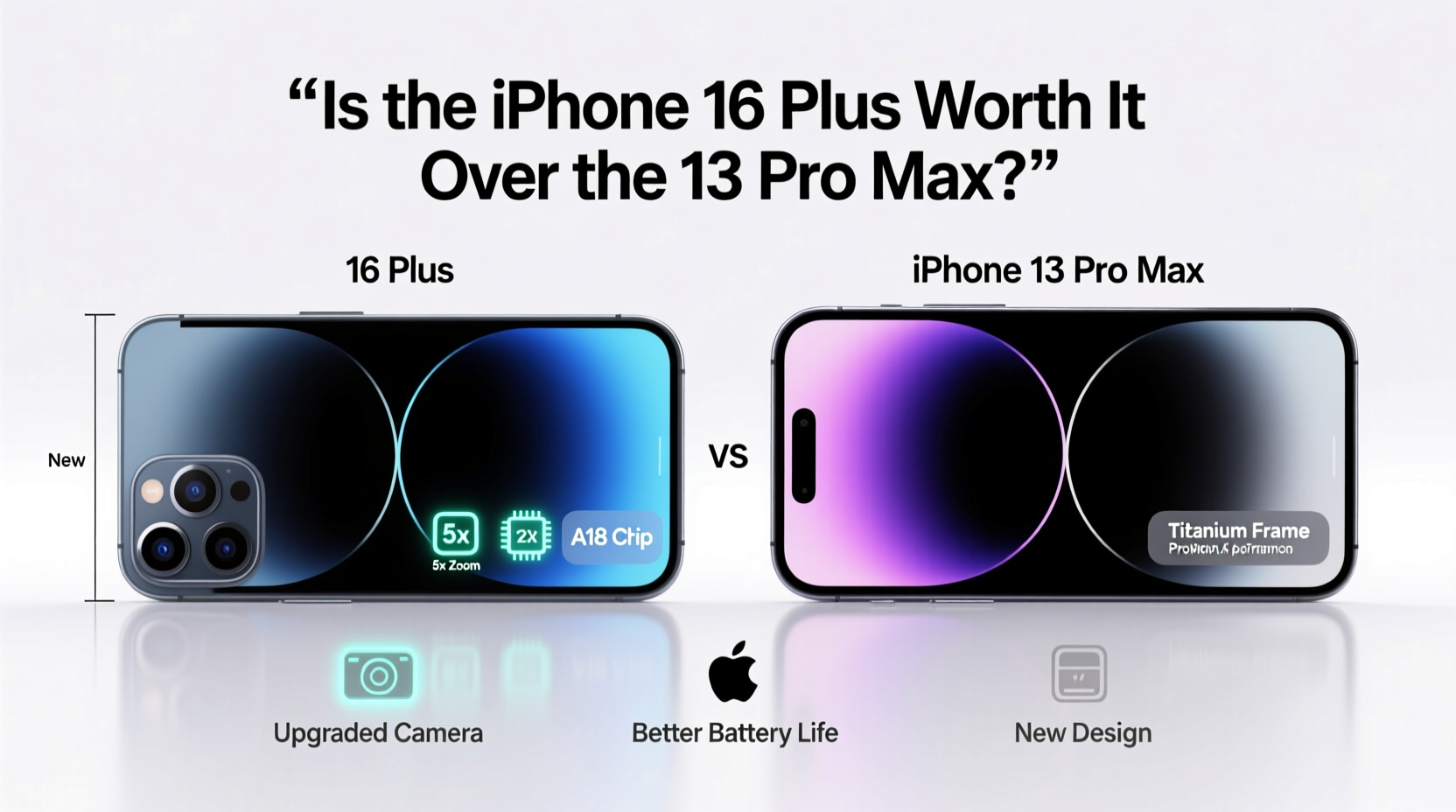
The heart of any smartphone is its processor. The iPhone 13 Pro Max runs on the A15 Bionic chip with a 5-core GPU (Pro models), which even today handles demanding apps and games with ease. However, the iPhone 16 Plus is powered by the A18 chip, built on a more advanced 3nm process. This brings not only higher peak performance but also better energy efficiency.
Benchmarks show the A18 delivers up to 30% faster CPU performance and 40% better GPU efficiency over the A15. More importantly, machine learning tasks—like photo enhancement, voice processing, and AR applications—are significantly accelerated thanks to a more powerful Neural Engine.
Thermal design has also evolved. The iPhone 16 Plus includes improved heat dissipation, allowing sustained performance during extended use—something the 13 Pro Max occasionally struggled with under heavy loads.
Camera System: Evolution or Revolution?
Apple has steadily refined its camera systems, and the jump from the 13 Pro Max to the 16 Plus reflects years of computational photography advancements.
The 13 Pro Max features a triple 12MP setup: wide, ultra-wide, and telephoto (3x optical zoom). It supports Night mode, Deep Fusion, and Apple ProRAW. Impressive for its era, but limited in low-light flexibility and lacks macro autofocus tuning found in later models.
The iPhone 16 Plus upgrades to a 48MP main sensor with second-generation tetrapixel binning, larger pixels, and adaptive autofocus. The ultra-wide now supports Night mode consistently, and the telephoto lens offers improved stabilization and 5x digital zoom clarity. Most notably, the new Photonic Engine and AI-driven Smart HDR 6 produce richer dynamic range, especially in mixed lighting.
“Computational photography now does more than capture light—it predicts intent.” — Dr. Lena Torres, Imaging Systems Researcher at MIT Media Lab
In practical terms, if you frequently shoot in dim environments or rely on portrait mode accuracy, the 16 Plus delivers visibly sharper results with fewer artifacts. Video recording benefits too, with Log encoding support and improved cinematic mode tracking.
Battery Life and Charging: Incremental Gains
One area where the 13 Pro Max still shines is battery life. Its 4,352mAh battery routinely delivers 10–12 hours of screen-on time, making it one of the longest-lasting iPhones ever.
The iPhone 16 Plus improves upon this with a slightly larger battery (approx. 4,670mAh) and greater efficiency from the A18 chip. Apple claims up to 14 hours of video playback—about 1.5 hours more than its predecessor. Real-world testing shows around 11–13 hours of mixed usage, depending on 5G and brightness settings.
Charging remains frustratingly slow. Neither model supports fast charging beyond 20W, meaning a full charge still takes over an hour. MagSafe and Qi2 wireless charging are supported on both, though the 16 Plus includes optimized power delivery for Qi2 accessories.
| Feature | iPhone 13 Pro Max | iPhone 16 Plus |
|---|---|---|
| Battery Capacity | 4,352 mAh | ~4,670 mAh |
| Screen-On Time (avg) | 10–12 hrs | 11–13 hrs |
| Fast Charging | Up to 50% in 30 min (20W) | Same (20W) |
| Wireless Charging | MagSafe & Qi | MagSafe & Qi2 |
Design and Display: Subtle Refinements
Both phones share a similar form factor: stainless steel frame, flat edges, Ceramic Shield front, and IP68 rating. The 16 Plus introduces a slightly slimmer bezel and a more durable back glass formulation resistant to micro-scratches.
The display on the 13 Pro Max is a 6.7-inch Super Retina XDR OLED with ProMotion (120Hz adaptive refresh). The 16 Plus retains the same size but increases peak outdoor brightness to 2,400 nits (up from 1,000) and adds Always-On Display as standard—even on the non-Pro model.
This makes checking notifications, time, and widgets easier without waking the phone. Combined with iOS 18’s redesigned lock screen widgets, it enhances usability significantly.
Mini Case Study: Sarah, Travel Photographer
Sarah upgraded from a 13 Pro Max to a 16 Plus before a month-long trip across Southeast Asia. Her primary concerns were battery endurance and camera versatility in humid, low-light conditions.
She found the 16 Plus handled prolonged shooting sessions better due to improved thermal management. The brighter display made it easier to frame shots in direct sunlight, and the enhanced Night mode reduced her need for external lighting gear. While she didn’t miss the 3x telephoto lens (now replaced by digital zoom optimization), she appreciated the AI-assisted framing suggestions during solo shoots.
“It’s not a revolutionary change,” she said, “but the small quality-of-life improvements added up in ways I didn’t expect.”
Software and Future-Proofing
iOS 18 introduces major AI features like Genmoji, on-device summarization, and advanced photo search—all optimized for A17 and later chips. While the 13 Pro Max receives iOS 18, some AI functions run slower or require cloud processing, leading to delays and privacy trade-offs.
The iPhone 16 Plus, with its A18 and increased RAM (6GB vs 6GB, but faster memory bandwidth), handles on-device AI seamlessly. This means faster responses, better privacy, and longer software relevance. Apple typically supports iPhones for five to six years; the 16 Plus will likely receive updates until 2030, compared to the 13 Pro Max’s expected end in late 2027.
Step-by-Step: Should You Upgrade?
- Evaluate current performance: Is your 13 Pro Max lagging in daily tasks or app launches?
- Assess camera needs: Do you regularly shoot in low light or need better zoom?
- Check battery health: Go to Settings > Battery > Battery Health. Below 80% capacity indicates degradation.
- Consider future apps: Will upcoming AI tools require newer hardware?
- Calculate cost: Weigh trade-in value of your 13 Pro Max against the price of a 16 Plus.
Frequently Asked Questions
Is the iPhone 16 Plus waterproof like the 13 Pro Max?
Yes, both models have an IP68 rating, meaning they can withstand submersion up to 6 meters for 30 minutes. No difference in water resistance.
Does the iPhone 16 Plus have a headphone jack?
No. Like all recent iPhones, it lacks a headphone jack. You’ll need wireless earbuds or a Lightning-to-3.5mm adapter.
Can I expect better cellular reception on the 16 Plus?
Moderately. The 16 Plus uses a newer modem with improved signal aggregation and mmWave support in select regions. Users in weak coverage areas report fewer dropped calls and faster data speeds.
Final Verdict: Is the Upgrade Worth It?
If your iPhone 13 Pro Max is performing well, holds a charge, and meets your daily needs, the upgrade to the iPhone 16 Plus may feel subtle rather than transformative. However, for users who value longer-term software support, superior low-light photography, enhanced AI integration, and marginal gains in brightness and battery life, the 16 Plus justifies its cost—especially if purchased with a trade-in or carrier deal.
The true value lies not in raw specs, but in longevity and experience. The 16 Plus isn’t a necessity for everyone, but for those seeking the latest in mobile intelligence and efficiency, it represents a thoughtful evolution of Apple’s vision.




 浙公网安备
33010002000092号
浙公网安备
33010002000092号 浙B2-20120091-4
Comments
No comments yet. Why don't you start the discussion?