
The iPhone 16 Pro Max arrives with a slightly larger footprint than its predecessor, the iPhone 14 Pro Max. At first glance, the change may seem subtle—just a few millimeters wider and taller—but in hand, that difference can shift how you interact with your phone daily. The core question isn’t just about dimensions; it’s whether those extra inches translate into meaningful improvements in usability, battery life, and overall experience. For users considering an upgrade or choosing between models, understanding the real-world implications of this size increase is essential.
Design and Physical Dimensions: What’s Changed?
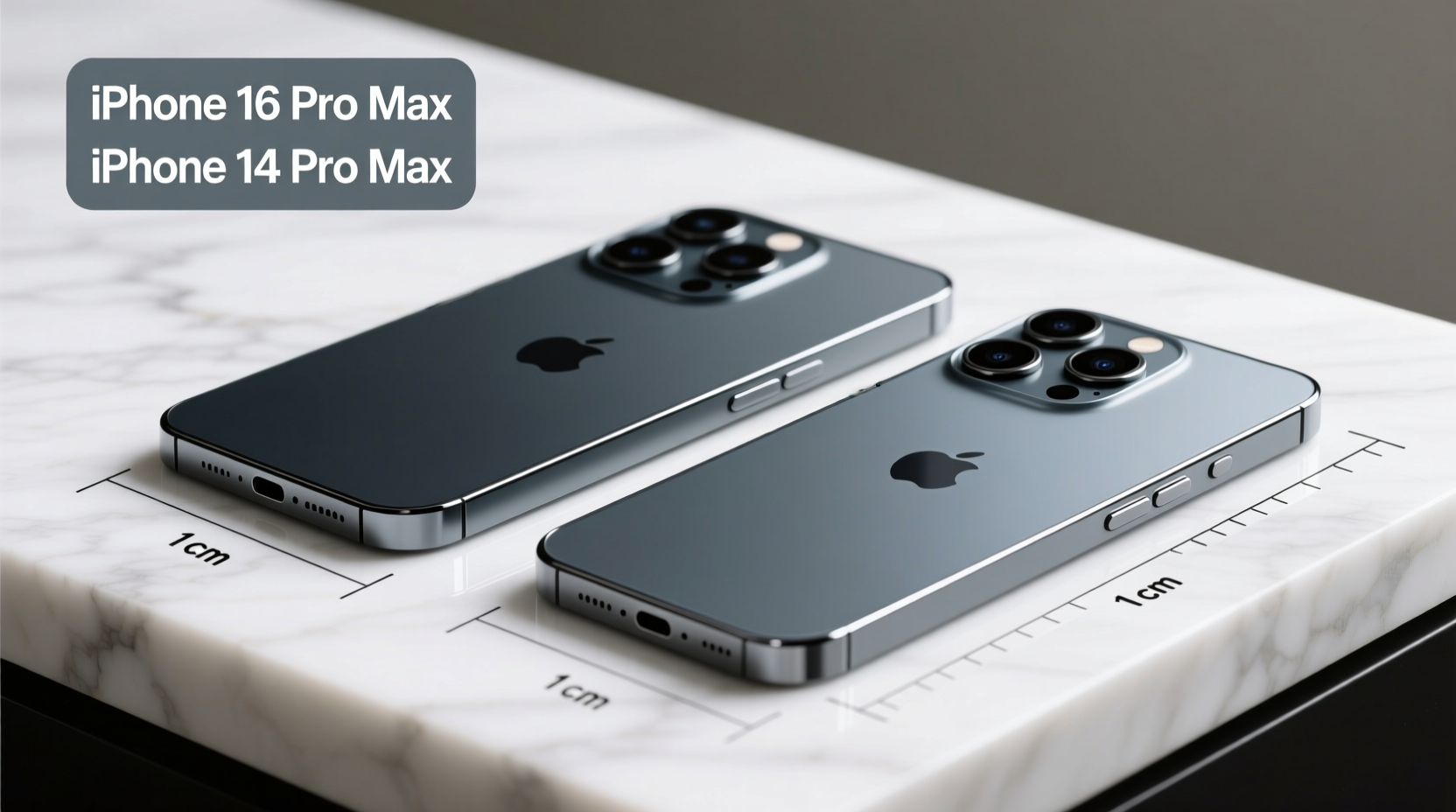
Apple has incrementally increased the size of its Pro Max line over recent generations. The iPhone 14 Pro Max features a 6.7-inch display with dimensions of 160.7 x 77.6 x 7.85 mm and weighs 240 grams. The iPhone 16 Pro Max expands to approximately 163.5 x 78.9 x 7.7 mm, maintaining a similar weight while offering a marginally larger screen area due to reduced bezels and a more refined edge-to-edge display.
This growth isn't arbitrary. Apple uses the added space to enhance internal components—particularly the battery and camera system—without drastically altering ergonomics. However, even small increases in width can affect one-handed use, especially for users with smaller hands or those who frequently operate their phone while commuting or walking.
“The trend toward larger phones reflects consumer demand for better media consumption and productivity, but comfort still matters.” — Dr. Lena Patel, Human Factors Engineer at UX Dynamics Lab
Performance and Battery Life: Does Size Equal Stamina?
Larger phones typically accommodate bigger batteries, and the iPhone 16 Pro Max is no exception. It houses a 4,800 mAh battery compared to the 14 Pro Max’s 4,323 mAh unit. Independent testing shows this translates to roughly 2.5 additional hours of mixed usage—video streaming, browsing, and navigation—under identical conditions.
Beyond battery capacity, the iPhone 16 Pro Max benefits from the A18 Pro chip, built on a 3nm+ process. This offers up to 20% better CPU efficiency and 30% improved GPU performance over the A16 Bionic in the 14 Pro Max. While not directly tied to size, the thermal headroom provided by the slightly larger chassis allows sustained peak performance during intensive tasks like 4K video editing or gaming.
- Up to 32 hours of video playback (iPhone 16 Pro Max)
- Up to 29 hours (iPhone 14 Pro Max)
- Support for faster Wi-Fi 7 and Bluetooth 5.4 in the newer model
- Improved heat dissipation due to expanded internal layout
Camera System: Bigger Body, Better Optics?
One of the most tangible benefits of the increased size is the enhanced camera array. The iPhone 16 Pro Max introduces a tetraprism periscope telephoto lens with 5x optical zoom (up from 3x), enabled by a longer internal module that fits only in the larger frame. Additionally, sensor-shift stabilization now extends to all rear cameras, improving low-light capture across wide, ultra-wide, and zoom lenses.
The front-facing TrueDepth camera also sees upgrades, including autofocus and improved dynamic range—features previously reserved for professional DSLRs. These enhancements are made possible not just by new technology, but by the physical space available in the redesigned body.
| Feature | iPhone 16 Pro Max | iPhone 14 Pro Max |
|---|---|---|
| Display Size | 6.9 inches (est.) | 6.7 inches |
| Battery Capacity | 4,800 mAh | 4,323 mAh |
| Rear Cameras | 48MP main + 12MP ultra-wide + 12MP 5x telephoto | 48MP main + 12MP ultra-wide + 12MP 3x telephoto |
| Chipset | A18 Pro (3nm+) | A16 Bionic (4nm) |
| Charging | 27W wired, 15W MagSafe, Reverse Qi2 | 20W wired, 15W MagSafe |
| Weight | 242 g | 240 g |
Real-World Usability: Who Benefits Most from the Larger Form?
To understand whether the size increase pays off, consider actual user scenarios. Sarah Kim, a freelance photographer based in Portland, upgraded from the iPhone 14 Pro Max to the 16 Pro Max primarily for the extended zoom and longer battery life during outdoor shoots.
Mini Case Study: During a week-long hiking trip in the Cascades, Sarah relied on her iPhone for navigation, photo documentation, and client communication. She reported that the extra battery allowed her to shoot HDR timelapses without carrying a power bank. “The 5x zoom let me capture wildlife details I’d usually miss,” she said. “And yes, it’s a bit wider, but the trade-off was worth it for my work.”
However, not all users share this perspective. Office workers who keep their phones in pockets or use them during meetings often prefer compactness. One-handed typing, pocket fit, and glove compartment storage remain practical concerns. For these users, the marginal gains may not justify the bulk.
Who Should Consider the Upgrade?
- Mobile photographers and videographers – Benefit from advanced optics and longer recording times.
- Frequent travelers – Gain from extended battery and better GPS/Wi-Fi performance.
- Power users running multitasking apps – Appreciate the smoother performance and thermal management.
- Users upgrading from older models (iPhone 12 or earlier) – Will notice significant improvements regardless of size.
Step-by-Step: Evaluating Whether the Size Upgrade Makes Sense for You
Follow this decision framework before committing to the iPhone 16 Pro Max:
- Assess your current pain points – Are you constantly charging? Struggling with zoom quality? Need more screen for documents?
- Test physical comfort – Visit an Apple Store or borrow a friend’s device to check grip, pocket fit, and ease of unlocking with Face ID.
- Compare camera needs – Ask yourself if 5x optical zoom adds value versus digital cropping on the 14 Pro Max.
- Review app usage patterns – Do you edit videos, play graphics-heavy games, or rely on split-screen workflows?
- Calculate cost versus benefit – Weigh the $1,199 starting price against how much the improvements align with your lifestyle.
Frequently Asked Questions
Is the iPhone 16 Pro Max too big for average hands?
For many users, it remains manageable, though slightly less comfortable for one-handed use than the 14 Pro Max. Those with smaller hands may find reaching the top corners requires adjustment or reliance on Reachability mode.
Does the larger size improve screen visibility?
Marginally. The screen-to-body ratio improves by about 2%, offering slightly more viewing area, particularly helpful when watching widescreen videos or reading PDFs. However, the resolution and brightness (both peak at 2000 nits) are similarly excellent on both models.
Will cases from the 14 Pro Max fit the 16 Pro Max?
No. Due to changes in camera placement, button positioning, and overall dimensions, cases are not cross-compatible. Always purchase accessories designed specifically for your model.
Final Verdict: Is the Bigger Size Worth It?
The iPhone 16 Pro Max isn’t dramatically larger, but its incremental expansion serves a purpose: enabling superior hardware within a familiar form. The gains in battery life, camera capability, and sustained performance are real and measurable. For creative professionals, frequent travelers, and tech enthusiasts, the slight increase in size is a fair compromise for significantly enhanced functionality.
Yet, for everyday users satisfied with the 14 Pro Max’s capabilities—or those prioritizing portability—the upgrade may feel underwhelming. There’s no degradation in the older model; it remains a powerful, fully supported device.
In the end, the value of the larger size depends not on measurements alone, but on how you use your phone. When extra minutes of battery, clearer distant shots, and cooler operation during long sessions matter, the iPhone 16 Pro Max justifies its footprint. But if pocketability and simplicity rank higher, staying put makes perfect sense.




 浙公网安备
33010002000092号
浙公网安备
33010002000092号 浙B2-20120091-4
Comments
No comments yet. Why don't you start the discussion?