
As the smartphone market approaches 2025, anticipation for the iPhone 16 series is growing. Meanwhile, Android flagships from Samsung, Google, OnePlus, and others continue to push boundaries with faster chips, higher-resolution cameras, and innovative software. But amid the noise of leaks, benchmarks, and marketing hype, which features truly impact your daily experience? Not all advancements are created equal—some deliver real value, while others are little more than spec-sheet theater.
This breakdown cuts through the rumors and compares upcoming iPhone 16 expectations against current and near-future Android flagships, focusing on what actually matters: longevity, usability, camera quality in real conditions, battery efficiency, and ecosystem integration.
Performance: Raw Power vs Real-World Efficiency
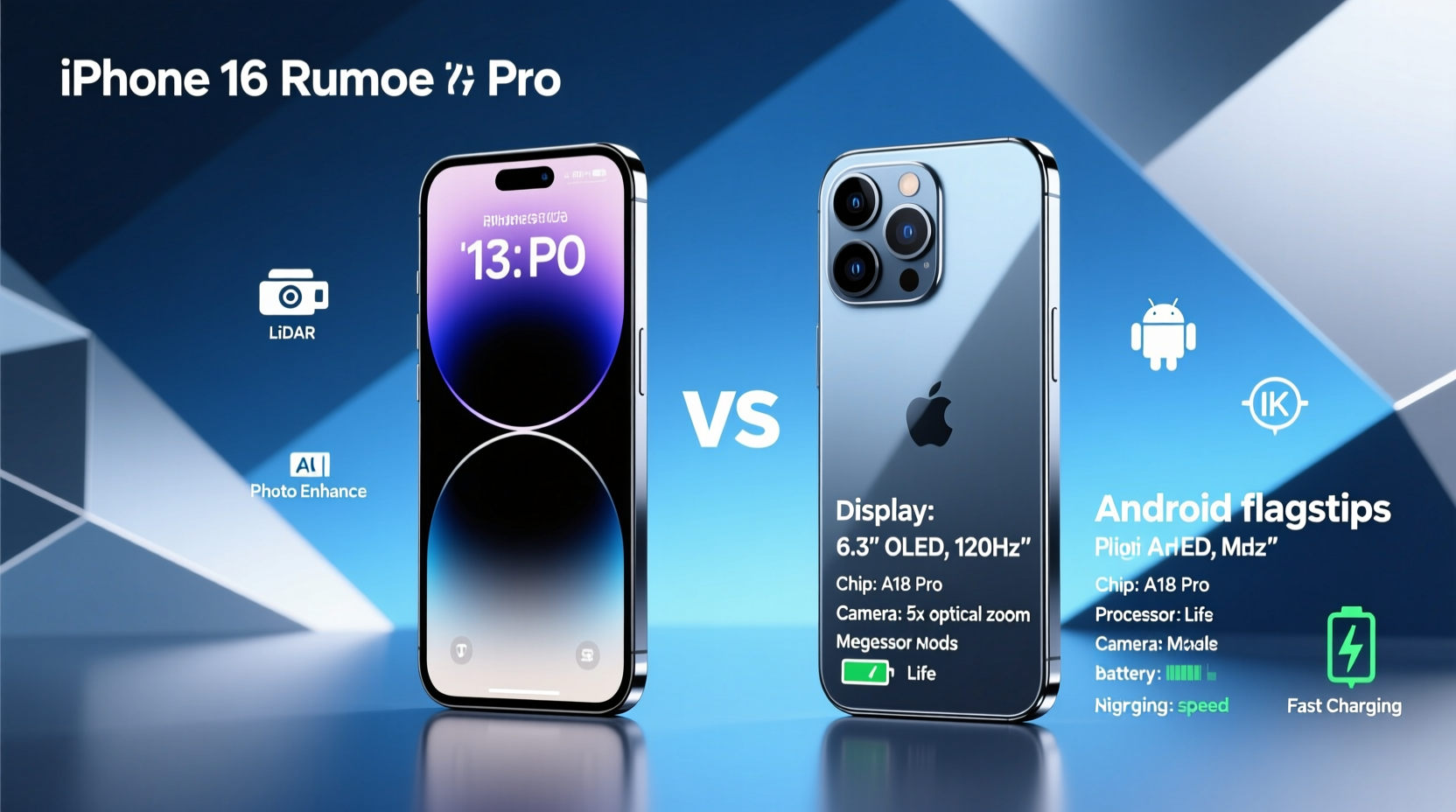
Every year, Apple and Android OEMs tout new processors as \"the fastest ever.\" The iPhone 16 is rumored to launch with the A18 chip, built on a refined 3nm process, promising improved CPU and GPU performance alongside better thermal management. On the Android side, devices like the Samsung Galaxy S25 Ultra and Google Pixel 9 Pro will likely feature Snapdragon 8 Gen 4 or Exynos 2500, both leveraging advanced AI acceleration and next-gen architectures.
But peak performance doesn’t tell the full story. What matters more is sustained performance under load—how well the phone handles multitasking, gaming, and video editing over extended periods without throttling. Apple’s tightly integrated hardware-software model gives it an edge here. iOS is optimized specifically for each A-series chip, resulting in smoother long-term operation even as apps grow more demanding.
Android has made strides in optimization, especially with Google’s Tensor G4 in the Pixel line emphasizing on-device AI and voice processing. However, fragmentation across brands and software skins (like Samsung’s One UI) can lead to inconsistent performance over time. Some manufacturers still struggle with aggressive background app killing or delayed updates that degrade user experience.
“Performance isn’t about who wins Geekbench—it’s about how reliably your phone works when you need it most.” — David Kim, Senior Mobile Analyst at TechInsight Group
Camera Systems: Megapixels vs Intelligence
The camera war between Apple and Android has evolved beyond megapixels. While Samsung’s Galaxy S24 Ultra boasts a 200MP main sensor and Google’s Pixel 8 Pro delivers unmatched computational photography, the iPhone 16 is expected to refine its approach rather than overhaul it—possibly introducing a tetraprism telephoto lens for true 5x optical zoom and enhanced low-light fusion algorithms.
In practical terms, photo quality comes down to consistency, dynamic range, color accuracy, and low-light performance—not just resolution. Here’s how they compare:
| Feature | iPhone 16 (Rumored) | Top Android Flagships (2024–2025) |
|---|---|---|
| Main Sensor Resolution | 48MP (refined tuning) | 50MP–200MP |
| Telephoto Zoom | 5x optical (tetraprism), up to 25x digital | 5x–10x optical, up to 100x digital (Samsung) |
| Low-Light Performance | Improved sensor-shift + AI denoising | Advanced Night Sight (Pixel), Adaptive Pixel (Samsung) |
| Video Capabilities | Log video, ProRes over HDMI, 4K/120fps HDR | 8K recording, AI-powered stabilization |
| Computational Photography | On-device Deep Fusion, Smart HDR 6 | Google Magic Editor, Galaxy AI photo enhancer |
While Android leads in flexibility—offering more lenses, manual controls, and AI editing tools—Apple excels in reliability. An iPhone photo tends to look natural straight out of the camera, requiring minimal editing. For users who prioritize point-and-shoot excellence over customization, this consistency is invaluable.
Real Example: Travel Photographer’s Dilemma
Sophie, a freelance travel photographer, uses both an iPhone and a Galaxy S24 Ultra. On a recent trip to Iceland, she shot landscapes in freezing conditions. The Galaxy captured stunning detail with its 10x zoom on distant glaciers, but struggled with white balance in mixed lighting. The iPhone produced warmer, more balanced shots with less noise in twilight scenes, though it couldn’t match the reach. Ultimately, she used the iPhone for social media posts and the Galaxy for print work where cropping was needed.
Her takeaway? “Zoom is impressive, but accurate colors and reliable autofocus in cold weather mattered more.”
Battery Life and Charging: Endurance Over Speed
Rumors suggest the iPhone 16 lineup may finally adopt USB-C across all models, with slightly larger batteries—up to 15% more capacity in the Pro variants. Fast charging could reach 40W, closing the gap with Android counterparts that already support 65W–100W charging.
However, fast charging isn’t always better. Repeated ultra-fast charging accelerates battery degradation. Apple’s conservative approach—prioritizing battery health over speed—means slower top-ups but potentially longer lifespan. Most iPhone users report retaining 85%+ battery health after two years, compared to some Android devices dropping below 75%.
What really matters is screen-on time and adaptive power management. Android’s newer AI-driven systems (like Samsung’s Energy Guardian and Pixel’s Adaptive Battery) learn usage patterns to extend life. iOS also uses machine learning to optimize background activity, but with stricter limitations due to privacy constraints.
“Battery longevity trumps fast charging. I’d rather charge once a day slowly than replace my battery every 14 months.” — Lena Patel, Sustainable Tech Advocate
Checklist: Maximizing Battery Longevity
- Keep charge between 20% and 80% whenever possible
- Enable optimized battery charging (iOS) or adaptive charging (Android)
- Avoid exposing your phone to extreme heat (e.g., left in a car)
- Use dark mode on OLED screens to reduce power draw
- Disable unnecessary background refresh and location services
Ecosystem Integration: The Hidden Advantage
One area where Apple consistently outperforms Android is ecosystem cohesion. If you own a Mac, iPad, Apple Watch, or AirPods, the iPhone 16 will likely deepen integration through features like seamless handoff, Continuity Camera, and enhanced FaceTime collaboration.
Rumors point to new “Apple Intelligence” features—on-device AI that syncs reminders, summarizes notifications, and enhances Siri’s contextual awareness across devices. This level of integration remains unmatched by most Android setups, even with Samsung’s DeX or Microsoft’s Link to Windows.
That said, Android offers greater interoperability with non-phone devices. You can pair Android phones with Windows PCs, Chromebooks, smart home hubs, and automotive systems more flexibly. Google’s ecosystem—especially with ChromeOS and Wear OS—is improving, but still lags behind Apple in seamlessness.
Software Updates and Long-Term Support
This is where the divide becomes stark. Apple guarantees five years of iOS updates for new iPhones—meaning an iPhone 16 will receive security patches and feature upgrades until at least 2030. In contrast, most Android manufacturers offer only three to four years of OS updates, with exceptions like Google Pixel (7 years) and Samsung Galaxy (4 years, extendable).
Long-term support affects everything: app compatibility, security, performance tuning, and resale value. A well-maintained iPhone retains functionality longer, reducing electronic waste and saving money over time.
Additionally, iOS updates arrive simultaneously for all supported devices. Android rollouts depend on carriers and OEMs, causing delays of weeks or even months. Even with Project Treble and Google’s efforts, fragmentation persists.
Step-by-Step: Choosing Based on Update Policy
- Assess your upgrade cycle. If you keep phones for 4+ years, prioritize update longevity.
- Check official support timelines. Look up exact update commitments for specific models.
- Consider secondary markets. iPhones hold value better due to longer software support.
- Weigh security needs. Outdated phones are vulnerable to exploits; timely patches matter.
- Factor in future-proofing. Will the phone run next-gen apps (AR, AI assistants) in 2028?
Frequently Asked Questions
Will the iPhone 16 have a foldable design?
No credible leaks suggest a foldable iPhone 16. Apple is reportedly testing foldable technology, but any such device is likely several years away. The iPhone 16 will maintain the traditional slab design with minor refinements to bezels and button placement.
Do Android phones really have better cameras than iPhones?
It depends on use case. Android flagships often win in zoom, manual control, and AI editing. But iPhones deliver more consistent, natural-looking photos with superior video stabilization. For casual shooters, the difference is negligible. For enthusiasts, Android offers more tools—but requires more effort.
Is USB-C on iPhone a big deal?
Yes, but not just for charging. Standardizing on USB-C simplifies travel, reduces e-waste, and enables faster data transfer (especially for Pro models). It also allows interoperability with laptops, monitors, and accessories using the same cable ecosystem.
Conclusion: Focus on What Enhances Your Life
The battle between iPhone 16 rumors and Android flagships isn’t about specs—it’s about sustainability, usability, and alignment with your lifestyle. Blazing-fast processors mean little if the phone stutters after a year. A 200MP camera is useless if photos require heavy editing. And 100W charging won’t help if the battery degrades in 18 months.
What actually matters? Reliable performance over time, accurate and effortless photography, strong battery longevity, meaningful software updates, and seamless integration with your other devices. Apple continues to excel in ecosystem harmony and long-term support. Android counters with innovation, customization, and faster adoption of new technologies.
Instead of waiting for leaks or chasing headlines, ask yourself: What do I actually do with my phone every day? How long do I plan to keep it? Does it make my life easier—or just noisier?




 浙公网安备
33010002000092号
浙公网安备
33010002000092号 浙B2-20120091-4
Comments
No comments yet. Why don't you start the discussion?