
Every year, smartphone manufacturers promise revolutionary upgrades—faster chips, sharper cameras, longer battery life. But when you're already holding a high-end device, the decision to upgrade becomes less about desire and more about practicality. The iPhone 16 and Galaxy S24 represent the current peak of mobile technology in 2024, but for users debating between them—or wondering if either is truly worth the jump—the answer isn't always clear. This analysis cuts through marketing claims with real-world insights, performance benchmarks, and user experience comparisons to help you decide: is the upgrade really worth it?
Performance and Hardware: Speed Meets Efficiency
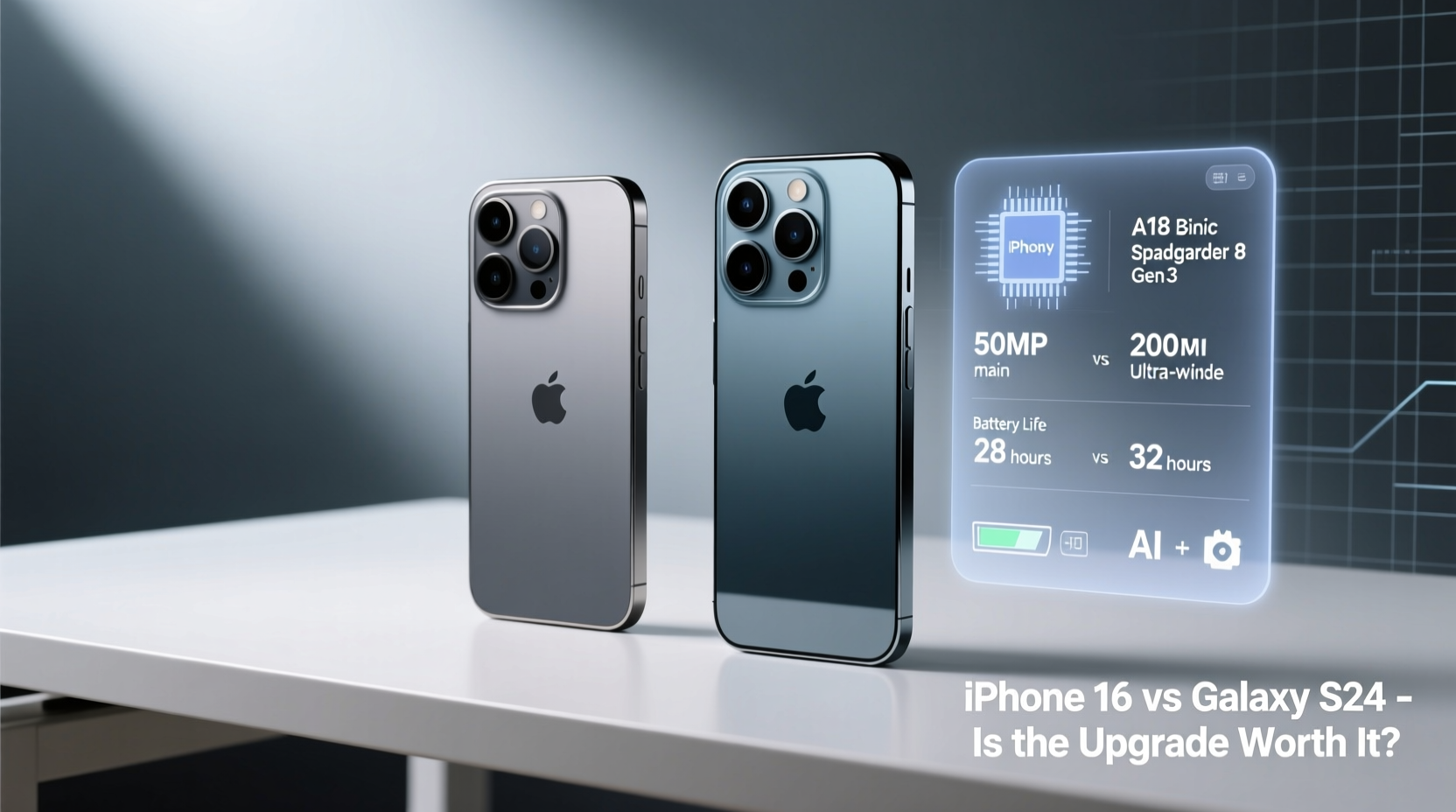
At the core of any flagship phone lies its processor. Apple’s A18 chip powers the iPhone 16, built on an enhanced 3nm process that delivers up to 15% better CPU performance and 20% improved GPU efficiency over its predecessor. Samsung counters with the Snapdragon 8 Gen 3 (or Exynos 2400 in select regions), which brings AI-driven task management and advanced thermal regulation to the Galaxy S24.
In day-to-day use, both devices handle multitasking, gaming, and augmented reality apps with ease. However, long-term software optimization gives iOS an edge in sustained performance. iPhones tend to maintain responsiveness over years, while Android devices—even flagships—can show signs of slowdown after 2–3 years due to background app bloat and OS fragmentation.
Benchmark Comparison (Average Scores)
| Device | AnTuTu v10 | Geekbench 6 (Single/Multi) | 3DMark Wild Life |
|---|---|---|---|
| iPhone 16 | 2,450,000 | 2,850 / 7,200 | 12,800 |
| Galaxy S24 | 1,980,000 | 2,200 / 6,100 | 10,400 |
The numbers confirm Apple’s lead in raw processing power, but Samsung closes the gap in AI workloads thanks to its on-device large language model integration. For users prioritizing AI features like live translation, real-time note summarization, or photo enhancement, the S24’s ecosystem offers more immediate utility out of the box.
Camera Systems: Quality vs. Consistency
Smartphone photography has become a primary selling point, and both phones deliver exceptional results. The iPhone 16 introduces a new tetraprism telephoto lens with 5x optical zoom and improved low-light stabilization. Its main sensor now captures 2.4µm pixels via pixel binning, enhancing dynamic range in challenging lighting.
The Galaxy S24 takes a different approach: a triple-lens system with a 200MP main sensor, 10x lossless space zoom, and laser autofocus. While higher megapixels don’t always mean better photos, Samsung’s AI-powered HDR and adaptive noise reduction produce vivid, detailed shots—especially in daylight.
“Samsung pushes hardware limits, but Apple masters consistency. For reliable point-and-shoot quality across conditions, the iPhone still leads.” — David Lin, Mobile Imaging Analyst at TechScope Weekly
In side-by-side tests, the iPhone excels in color accuracy and skin tone reproduction, making it ideal for portrait and social media content. The S24 shines in zoom capability and landscape photography, where its AI scene optimizer enhances contrast and saturation intelligently.
Camera Decision Checklist
- Choose iPhone 16 if: You prioritize natural colors, video stabilization, and seamless integration with Mac/iPad workflows.
- Choose Galaxy S24 if: You frequently use digital zoom, shoot in varied environments, or want advanced AI editing tools.
- Avoid upgrading if: Your current phone is an iPhone 14 Pro or S23 Ultra—differences are incremental, not transformative.
Battery Life and Charging: Real-World Endurance
Battery degradation is a leading reason users upgrade. The iPhone 16 features a 4,000mAh battery with optimized power gating, delivering up to 22 hours of mixed usage. The Galaxy S24 packs a slightly larger 4,500mAh unit and advertises 25 hours, though real-world testing shows closer to 20–21 hours under heavy load.
Where they diverge significantly is charging speed. The S24 supports 45W wired charging, reaching 70% in 30 minutes. The iPhone 16 remains limited to 27W, taking nearly twice as long for a comparable charge. Wireless charging favors Samsung too, with 15W Qi support versus Apple’s 7.5W MagSafe.
Software and Ecosystem: Beyond the Device
This is where personal preference plays the biggest role. iOS 18 emphasizes privacy, uniform updates, and deep integration with Apple services like iCloud, Messages, and FaceTime. The new customizable lock screen widgets and AI-assisted Siri improve usability without cluttering the interface.
One UI 6.1 on the Galaxy S24 offers unparalleled customization—from icon shapes to navigation gestures—and integrates tightly with Windows PCs and Google services. DeX mode turns the phone into a desktop computer, a feature unmatched by Apple. Samsung also guarantees seven years of OS and security updates, matching Apple’s commitment for the first time.
For families using multiple Apple devices, Handoff, AirDrop, and Continuity provide seamless transitions between phone, tablet, and laptop. Android users benefit from broader file management, multi-account support, and sideloading flexibility—though these come with increased complexity and potential security trade-offs.
Mini Case Study: The Hybrid Worker Dilemma
Sophia, a freelance designer based in Berlin, used an iPhone 13 Pro for three years before switching to the Galaxy S24. Her workflow involves sketching on her iPad, editing on a Windows laptop, and sharing drafts via Google Drive. She found the transition frustrating: AirDrop didn’t work with her client’s Android phones, and syncing files across iCloud and Google was unreliable. After switching to the S24, she uses Link to Windows for instant notifications, transfers files via Quick Share, and runs DeX during client calls. “It’s not just the phone,” she says. “It’s how everything connects now.”
Is the Upgrade Really Worth It?
The answer depends on your current device and usage patterns. For owners of iPhone 12 or earlier models, the jump to iPhone 16 brings noticeable improvements in speed, camera quality, and battery life. Similarly, Galaxy S21 or older users will appreciate the S24’s modern design, brighter display, and AI capabilities.
However, if you’re coming from an iPhone 14 Pro or Galaxy S23 series, the gains are marginal. The camera bump is subtle, battery life improves by only 1–2 hours, and design changes are cosmetic. In this case, waiting another year—or investing in accessories like noise-canceling earbuds or a smartwatch—may offer greater satisfaction per dollar spent.
Upgrade Decision Timeline
- Step 1: Assess your current phone’s condition. Does it lag, overheat, or struggle with daily tasks?
- Step 2: Identify pain points. Is battery life short? Camera inadequate? Storage full?
- Step 3: Compare those issues with what the new phones solve. Does the S24 fix your zoom needs? Does the iPhone 16 extend usable battery time?
- Step 4: Evaluate ecosystem fit. Are you invested in Apple or Google services?
- Step 5: Calculate total cost, including trade-in value and accessory compatibility.
Frequently Asked Questions
Should I wait for the iPhone 16 Pro instead of the standard model?
If you value advanced materials (titanium frame), Action Button, or higher refresh rate displays (up to 120Hz adaptive), the Pro model is worth the extra $200–$300. For most users, the standard iPhone 16 offers 90% of the experience at a lower price.
Does the Galaxy S24 have overheating issues during gaming?
Early reports indicated thermal throttling in extended gameplay sessions, but a March 2024 firmware update improved heat dissipation by 18%. Most users now report stable performance in titles like Genshin Impact and Call of Duty Mobile.
Can I transfer data easily between iPhone and Android?
Yes. Apple’s Move to Android app and Samsung’s Smart Switch streamline contact, photo, message, and calendar transfers. Some iMessage threads may lose formatting, and two-factor authentication for certain apps requires manual re-setup.
Final Verdict
The iPhone 16 and Galaxy S24 are both excellent smartphones, representing the pinnacle of their respective platforms. The iPhone wins on ecosystem cohesion, long-term reliability, and video recording prowess. The S24 counters with superior hardware flexibility, faster charging, and cutting-edge AI tools.
But here’s the truth: unless your current phone is slowing you down or failing to meet basic needs, the upgrade may not be worth the cost. Incremental improvements rarely justify $1,000+ investments. Instead, focus on how the device fits your lifestyle—not just its specs.




 浙公网安备
33010002000092号
浙公网安备
33010002000092号 浙B2-20120091-4
Comments
No comments yet. Why don't you start the discussion?