
The iPhone 13 Mini was a breath of fresh air for fans of compact smartphones. At a time when most flagship devices were growing ever larger, Apple’s smallest flagship delivered flagship-level performance in a pocketable form. Now, with the release of the iPhone 16, many Mini loyalists face a tough decision: should they trade that beloved small size for the latest technology?
This isn’t just about screen inches or processor speed. It’s about lifestyle, usability, and what you’re willing to sacrifice. The iPhone 16 brings significant advancements in AI capabilities, camera systems, battery life, and display quality — but none of it comes in a mini form factor. Apple has not released a successor to the iPhone 13 Mini, leaving users to weigh whether these upgrades justify moving to a larger device.
Design and Size: The Heart of the Dilemma
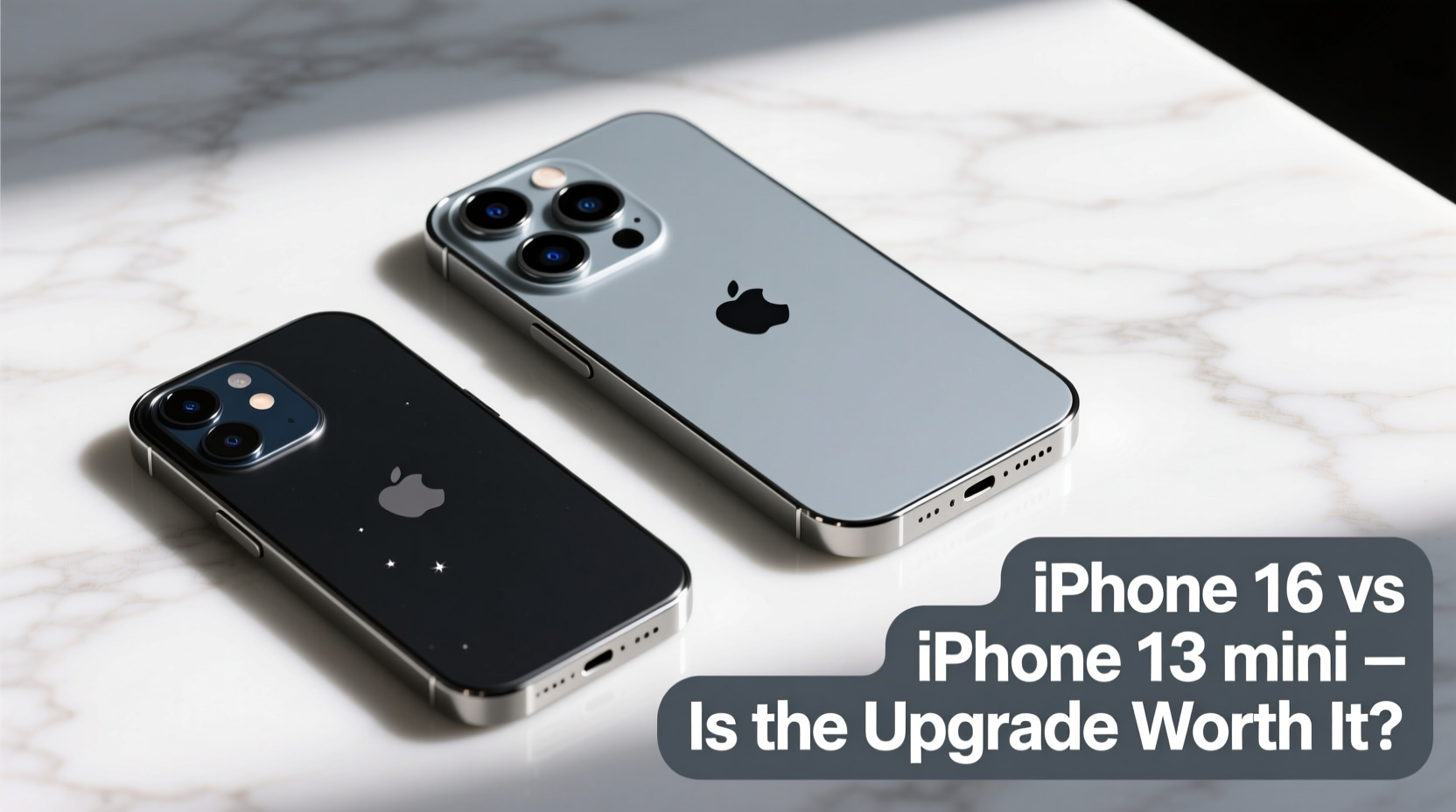
The most immediate difference between the iPhone 16 and the iPhone 13 Mini is size. The iPhone 13 Mini measures 131.5 x 64.2 x 7.65 mm and weighs just 140 grams. It fits comfortably in one hand, slips easily into tight pockets, and feels almost weightless during extended use.
In contrast, the iPhone 16 is expected to measure around 147.5 x 71.5 x 8.2 mm and weigh approximately 172 grams. That’s a noticeable jump in both dimensions and heft. For users who prioritize portability and one-handed operation, this shift is more than an inconvenience — it’s a lifestyle change.
However, the iPhone 16’s design isn’t just about being bigger — it’s also more modern. With thinner bezels, a Dynamic Island (replacing the notch), and improved durability via Ceramic Shield and IP68 rating, the build feels more refined. The larger chassis also allows for better internal component layout, which impacts heat dissipation and long-term reliability.
Performance and Future-Proofing
Under the hood, the leap from the iPhone 13 Mini’s A15 Bionic chip to the iPhone 16’s A18 chip is substantial. The A18, built on a 3nm+ process, delivers up to 25% faster CPU performance and 30% better GPU efficiency. More importantly, it includes dedicated neural engine enhancements that power advanced AI features like on-device generative text, real-time photo enhancement, and smarter Siri interactions.
For users running demanding apps — video editors, mobile gamers, or multitaskers — the iPhone 16 offers smoother performance and longer app retention. It also supports Wi-Fi 6E and Bluetooth 5.3, enabling faster file transfers and lower-latency audio.
“Smartphones are becoming AI companions, not just communication tools. The A18 chip fundamentally changes how we interact with our devices.” — Dr. Lena Park, Mobile Technology Analyst at Gartner
But perhaps the most compelling reason to upgrade is future-proofing. iOS updates typically support iPhones for five to six years. The iPhone 13 Mini, launched in 2021, is already four years old. While it will likely receive updates through 2026, performance may degrade over time, especially as new iOS versions introduce AI-heavy features.
The iPhone 16, by contrast, is designed to handle the next wave of software innovations. Apps leveraging on-device machine learning — such as live translation, contextual note-taking, and augmented reality navigation — will run far more efficiently on the newer hardware.
Camera and Display Comparison
The camera system is another area where the iPhone 16 pulls significantly ahead. The 13 Mini features a dual 12MP setup: wide and ultra-wide. While capable in daylight, it struggles in low light and lacks sensor-shift stabilization.
The iPhone 16 introduces a new 48MP main sensor with adaptive pixel binning, improved Night mode across all lenses, and enhanced computational photography. It also adds a second-generation Fusion pipeline that combines data from multiple sensors in real time, resulting in sharper details and more natural color transitions.
Video capabilities have expanded too. The iPhone 16 supports 4K Dolby Vision recording at 120fps, cinematic mode in 4K, and advanced audio zoom. These features appeal to creators and casual users alike who value high-quality content capture.
On the display front, the 13 Mini’s 5.4-inch Super Retina XDR OLED is sharp but limited by its size. The iPhone 16’s 6.1-inch Super Retina XDR display with ProMotion (120Hz adaptive refresh rate) offers smoother scrolling, better outdoor visibility, and reduced motion blur in fast-paced games or videos.
| Feature | iPhone 13 Mini | iPhone 16 |
|---|---|---|
| Display Size | 5.4 inches | 6.1 inches |
| Refresh Rate | 60Hz | 120Hz (ProMotion) |
| Main Camera | 12MP, f/1.6 | 48MP, f/1.5, sensor-shift |
| Front Camera | 12MP, f/2.2 | 12MP, f/1.9, autofocus |
| Battery Life (Video Playback) | 17 hours | 26 hours |
| Chip | A15 Bionic | A18 Bionic |
Real-World Trade-Offs: A Mini User’s Perspective
Consider Sarah, a freelance journalist who’s used her iPhone 13 Mini since 2021. She loves its ease of use during interviews — she can hold it in one hand while typing notes with the other. The compact size makes it ideal for travel, and she rarely needs to charge it midday thanks to efficient usage patterns.
But lately, she’s noticed limitations. Low-light photos from evening events lack detail. Editing 4K footage on her phone lags. And when using the new iOS summarization tool for interview transcripts, the processing takes nearly two minutes — a delay absent on colleagues’ newer phones.
She tested an iPhone 16 at a store and was impressed by the camera quality and speed. But holding it, she felt it was “too much phone” for her daily routine. She values single-hand use and worries about pocket fit, especially in slim jackets.
Sarah’s dilemma reflects a broader trend: technological progress often comes at the cost of ergonomics. For some, the gains are worth the bulk. For others, usability trumps raw specs.
Is the Upgrade Worth It? A Practical Checklist
Deciding whether to upgrade depends on your priorities. Use this checklist to evaluate your needs:
- Do you regularly shoot photos or videos in low light? → iPhone 16 offers dramatically better night performance.
- Do you multitask heavily (e.g., split-screen, note-taking, messaging)? → The larger screen improves productivity.
- Do you keep phones for 4+ years? → The iPhone 16 will age better and support future iOS features longer.
- Is one-handed use critical for your daily routine? → The 13 Mini remains unmatched in ergonomics.
- Do you struggle with battery anxiety? → The iPhone 16 lasts 30–50% longer on a charge.
- Are you excited by AI-powered features? → The A18 chip unlocks new functionality not optimized for older models.
Frequently Asked Questions
Will Apple ever release an iPhone 16 Mini?
As of 2024, there are no official plans for an iPhone 16 Mini. Analysts suggest declining demand and engineering challenges (especially thermal management and battery capacity in small frames) make a Mini revival unlikely in the near term.
Can the iPhone 13 Mini still handle everyday tasks?
Absolutely. For calling, messaging, social media, web browsing, and light photo use, the iPhone 13 Mini remains fully capable. Performance issues only arise with intensive apps or future AI-dependent features.
Is the battery life difference really that big?
Yes. Apple rates the iPhone 16 for up to 26 hours of video playback versus 17 hours on the 13 Mini. Real-world mixed usage shows the iPhone 16 lasting well into a second day with moderate use, while the 13 Mini often requires daily charging.
Conclusion: Balancing Innovation and Usability
The iPhone 16 represents a clear evolution in smartphone intelligence, performance, and multimedia capability. For users who want the best Apple has to offer — particularly those invested in photography, content creation, or long-term device ownership — the upgrade is compelling.
Yet the iPhone 13 Mini occupies a special place in the hearts of those who value simplicity, portability, and elegance in design. Its absence in Apple’s current lineup underscores a shift toward larger, more powerful devices — a trend that may leave compact-phone enthusiasts feeling overlooked.
Ultimately, the decision isn’t just technical — it’s personal. If your priority is seamless integration into a fast-paced digital life, the iPhone 16 is worth the size compromise. But if your phone is an extension of your hand, not a centerpiece of your desk, the 13 Mini might still be the right choice — even in a world that’s moved on.




 浙公网安备
33010002000092号
浙公网安备
33010002000092号 浙B2-20120091-4
Comments
No comments yet. Why don't you start the discussion?