
Benchmark scores have become the go-to metric for tech enthusiasts measuring smartphone performance. When Apple releases the iPhone 16 and Samsung counters with the Galaxy S25, headlines will inevitably spotlight AnTuTu, Geekbench, and 3DMark results. But for most users, raw numbers don’t tell the full story. Is a higher score truly reason enough to switch ecosystems, pay premium prices, or abandon years of app and data integration?
This article examines the role of benchmark scores in the iPhone 16 vs Samsung S25 debate, unpacks what these numbers actually measure, and evaluates whether they should influence your next phone decision.
Understanding Smartphone Benchmarks: What Do They Actually Measure?
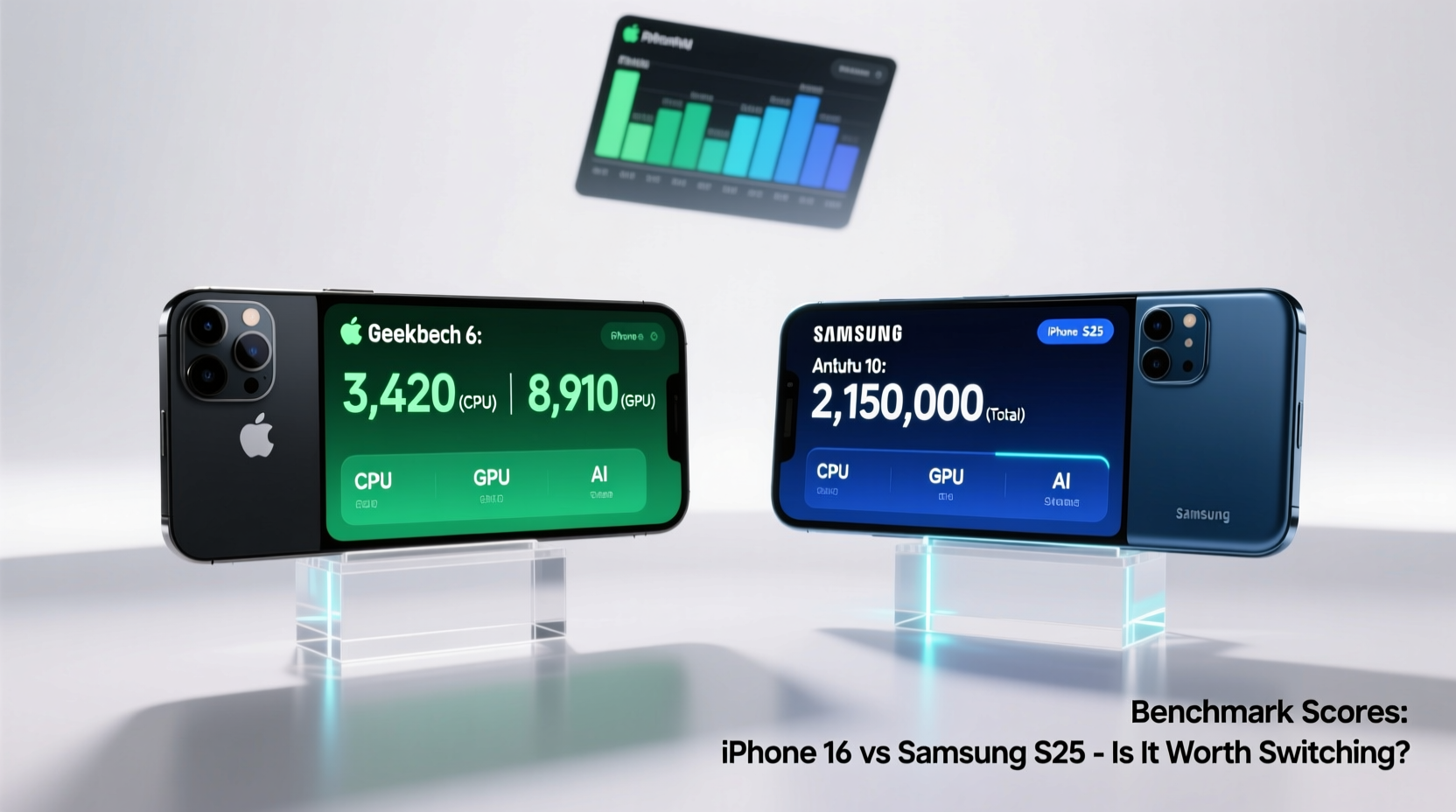
Benchmarks are synthetic tests designed to stress specific components—CPU, GPU, RAM, storage speed—and return quantifiable performance metrics. Common tools like Geekbench assess single-core and multi-core processing power, while 3DMark focuses on graphics rendering. Others, such as PCMark, simulate real-world tasks like video editing or web browsing.
These scores offer a standardized way to compare devices in controlled conditions. However, they often favor short bursts of peak performance over sustained efficiency. For example, a device might achieve a high Geekbench score by boosting processor clocks aggressively, only to throttle under prolonged use due to heat.
“Benchmark scores are useful for spotting performance ceilings, but they rarely reflect how a phone feels in daily use.” — Dr. Lena Patel, Mobile Systems Analyst at TechInsight Labs
Moreover, optimization plays a crucial role. iOS is tightly integrated with Apple’s silicon, allowing even mid-tier chips to deliver smooth experiences. Android, while more fragmented, benefits from aggressive hardware scaling in flagships like the S25. The result? Two phones with similar scores can feel drastically different in practice.
iPhone 16 vs Samsung S25: Benchmark Comparison
Predicted benchmark estimates (based on industry trends and early leaks) suggest both devices will dominate their respective platforms. The iPhone 16 is expected to feature Apple’s A18 chip, built on a refined 3nm process, while the Galaxy S25 will likely run Qualcomm’s Snapdragon 8 Gen 4 or Samsung’s own Exynos 2500 in select regions.
| Device | CPU (Estimated) | Geekbench 6 (Single/Multi) | AnTuTu v10 (Est.) | 3DMark Wild Life Extreme |
|---|---|---|---|---|
| iPhone 16 (A18 Bionic) | 6-core CPU / 6-core GPU | 3,100 / 7,800 | 2,400,000 | 7,200 |
| Samsung Galaxy S25 (Snapdragon 8 Gen 4) | 8-core CPU / Adreno 830 GPU | 2,850 / 9,100 | 2,600,000 | 6,900 |
| Samsung Galaxy S25 (Exynos 2500) | 8-core CPU / Xclipse 940 GPU | 2,600 / 8,300 | 2,300,000 | 6,400 |
The table reveals a nuanced picture. While the S25 with Snapdragon edges out in multi-core and total AnTuTu scores, the iPhone 16 leads in single-core performance—a key factor for app responsiveness. Graphics performance is close, though Apple typically maintains better thermal management, reducing throttling during extended gameplay.
It's also important to note regional disparities: Exynos models historically underperform compared to Snapdragon variants, which could affect real-world satisfaction depending on where you buy.
Real-World Performance: Beyond the Numbers
Benchmarks don’t capture interface fluidity, background app retention, camera processing speed, or long-term software support. These factors define user experience far more than a 5% gain in Geekbench.
- App Launch Speed: iOS apps tend to open faster due to optimized compilation and tighter memory management.
- Gaming Consistency: iPhones maintain frame rates more steadily, thanks to Apple’s metal-level graphics control and efficient cooling design.
- Multitasking: Android allows deeper customization and split-screen workflows, but iOS offers smoother app switching with less hiccups over time.
- Lifespan: iPhones routinely receive 5–6 years of OS updates; Samsung now matches this with One UI 7 and beyond, narrowing the gap.
A Real Example: Sarah’s Cross-Ecosystem Switch
Sarah, a graphic designer, switched from an iPhone 15 Pro to a pre-release Galaxy S25 Ultra after seeing its higher AnTuTu score. She expected snappier performance for photo editing. While initial benchmarks were impressive, she noticed lag when switching between Adobe apps after a few hours of use—likely due to thermal throttling. After two weeks, she returned to her iPhone, citing “smoother consistency” despite lower scores.
Her experience highlights a critical truth: benchmark peaks matter less than sustained reliability.
When Should You Consider Switching?
Benchmark scores alone shouldn’t drive ecosystem changes. Instead, evaluate based on holistic needs. Below is a checklist to guide your decision:
- Assess your current phone’s pain points: Is it slow, poorly supported, or lacking features you need?
- Determine if the new device solves those issues—benchmark gains included.
- Check app compatibility and service continuity (iCloud vs Google Drive, iMessage vs RCS).
- Evaluate long-term software update promises.
- Test the phone in person if possible—focus on screen quality, haptics, and UI responsiveness.
Frequently Asked Questions
Do higher benchmark scores mean a better phone?
Not necessarily. Higher scores indicate stronger peak performance, but real-world usability depends on software optimization, thermal design, and battery efficiency. A well-optimized phone with slightly lower scores can feel faster and last longer.
Will the iPhone 16 outperform the S25 in daily tasks?
In most everyday scenarios—messaging, browsing, social media, navigation—the difference will be imperceptible. Both devices are overqualified for routine use. Where differences emerge is in professional workloads like 4K video editing or sustained AR/VR sessions.
Is it worth switching from Android to iOS (or vice versa) for performance?
Rarely. Ecosystem lock-in—apps, subscriptions, accessories, cloud sync—is usually more impactful than performance margins. Switch only if the new platform better aligns with your lifestyle, not because of a headline benchmark number.
Conclusion: Rethinking the Benchmark Obsession
The iPhone 16 and Samsung S25 will both be technological marvels, pushing the boundaries of mobile computing. Yes, one may lead in Geekbench, another in AnTuTu, but these wins are fleeting and often context-dependent. What lasts is the experience: how quickly your camera opens, how smoothly your messages scroll, how long your battery holds up after two years of charging.
If you’re considering a switch, ask not “Which scores higher?” but “Which fits my life better?” Benchmark scores are just one data point among many—useful for spotting outliers, but insufficient for making life-changing decisions.




 浙公网安备
33010002000092号
浙公网安备
33010002000092号 浙B2-20120091-4
Comments
No comments yet. Why don't you start the discussion?