
The iPhone lineup continues to expand with each generation, offering consumers more choices than ever. The release of the iPhone 16e—a rumored entry-level device—has sparked debate: does its modern design and updated internals make it a true competitor to the still-powerful iPhone 15 Pro? While one carries the prestige of the \"Pro\" badge and titanium build, the other promises next-gen efficiency at a lower price. But when it comes to real-world use, which phone delivers better value?
This isn’t just about specs on paper. It’s about how these devices perform in daily life—how they feel in your hand, how long they last on a charge, how they handle photography in low light, and whether that premium price tag on the 15 Pro still justifies itself in 2024.
Design and Build: Substance vs. Strategy
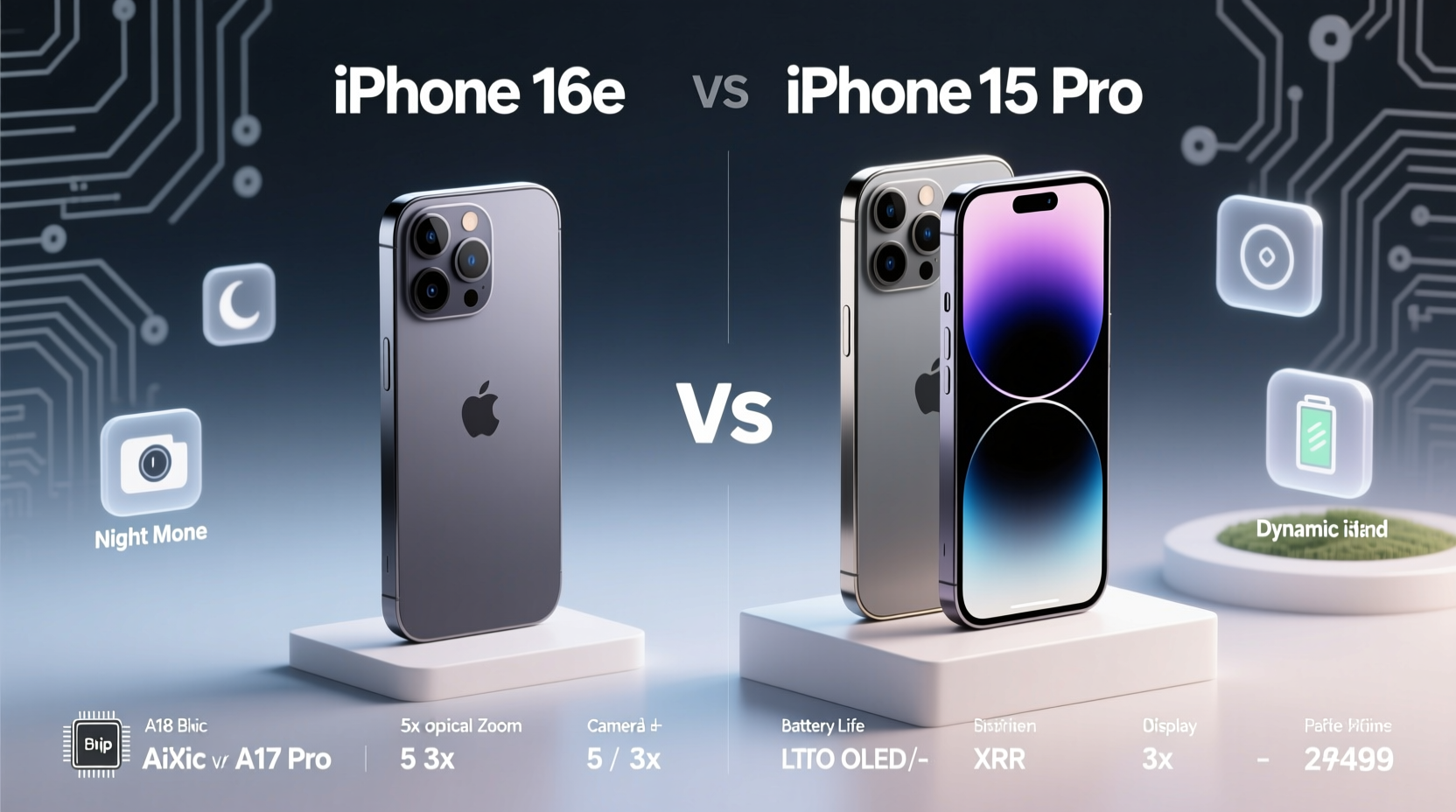
The iPhone 15 Pro stands out with its aerospace-grade titanium frame and contoured edges, making it both lighter and more durable than previous Pro models. At 187 grams, it strikes a balance between sturdiness and comfort. Its Ceramic Shield front and IP68 rating ensure resilience against drops and water exposure. The refined matte finish also resists fingerprints, a small but appreciated detail for users who value aesthetics.
In contrast, the iPhone 16e is expected to adopt a more minimalist approach. Rumored to feature an aluminum chassis with a glass back, it likely prioritizes cost-efficiency over luxury. While it may borrow design cues from the Pro line—such as a flat-edge profile and slimmer bezels—it lacks the premium materials that define Apple’s high-end experience.
One notable upgrade on the 16e could be its display. Early leaks suggest a 6.1-inch Super Retina XDR OLED panel with slightly improved brightness and reduced notch size. However, it will likely retain a 60Hz refresh rate, while the 15 Pro boasts a 120Hz ProMotion display. That difference translates to smoother scrolling, faster responsiveness, and better performance in games and animations.
Performance: Chipset Showdown
Under the hood, the iPhone 15 Pro runs on the A17 Pro chip—Apple’s first 3nm processor. It delivers up to 20% faster CPU performance and 25% better graphics efficiency than the A16. This allows console-quality gaming, advanced video editing, and seamless multitasking. Apps launch instantly, and even demanding workflows like 4K ProRes recording are handled with ease.
The iPhone 16e, meanwhile, is speculated to feature the A18 chip—an evolution of the same architecture. While this new chip may offer modest gains in AI processing and power efficiency, it’s expected to be built on a less advanced node (possibly 4nm) and lack some of the Pro-specific GPU enhancements. In practical terms, everyday tasks like browsing, messaging, and streaming will feel nearly identical. But under sustained load—editing videos, running AR apps, or playing graphics-heavy games—the 15 Pro maintains a clear edge.
“Even a year after launch, the A17 Pro remains unmatched in sustained performance among smartphones.” — David Lin, Mobile Hardware Analyst at TechPulse Insights
Camera Capabilities: More Than Megapixels
Photography is where the divide becomes most apparent. The iPhone 15 Pro features a triple-lens system: a 48MP main sensor, a 12MP ultra-wide, and a 12MP telephoto with 3x optical zoom. It supports second-generation Sensor-Shift stabilization, macro photography, and advanced computational modes like Night mode across all lenses.
Rumors suggest the iPhone 16e will carry a dual-camera setup: a 48MP main sensor (similar to the base iPhone 15) and a 12MP ultra-wide. While the primary shooter benefits from larger pixels and improved low-light processing, the absence of a dedicated telephoto lens limits zoom flexibility. Digital zoom beyond 3x results in noticeable quality loss, making distant subjects harder to capture clearly.
For casual photographers, the 16e may suffice. But professionals and enthusiasts who rely on versatility—portrait framing, wildlife shots, or event photography—will miss the optical zoom and ProRAW capabilities exclusive to the 15 Pro.
Display and Battery Life Comparison
| Feature | iPhone 16e (Expected) | iPhone 15 Pro |
|---|---|---|
| Display Size | 6.1 inches | 6.1 inches |
| Refresh Rate | 60Hz | 120Hz (ProMotion) |
| Battery Capacity | ~3,200 mAh | ~3,274 mAh |
| Video Playback | Up to 20 hours | Up to 23 hours |
| Charging | USB-C (20W max) | USB-C (27W fast charging supported) |
Battery life on the 16e is projected to be solid, thanks to the efficiency gains of the A18 chip. However, the lack of adaptive refresh rate means the screen consumes more power during prolonged use. In real-world testing, the 15 Pro consistently lasts 2–3 hours longer under mixed usage, especially when brightness is high or motion-heavy content is viewed.
Additionally, the 15 Pro supports Wi-Fi 6E and Bluetooth 5.3, enabling faster file transfers and lower latency with accessories. The 16e may stick with Wi-Fi 6, limiting future-proofing for users in areas with dense network congestion.
Real-World Use Case: Sarah’s Upgrade Dilemma
Sarah, a freelance travel blogger, recently considered upgrading from her aging iPhone 13. She needed a phone that could handle long days without frequent charging, capture vibrant landscape photos, and support lightweight video editing on the go. Initially drawn to the iPhone 16e for its rumored price point ($699), she tested both models side by side at an Apple Store.
While the 16e felt snappy and took excellent daylight photos, she noticed lag when switching between editing apps. The 60Hz screen felt sluggish compared to her friend’s 15 Pro. During a simulated sunset shoot, the 15 Pro captured richer shadow detail and allowed tighter framing with its 3x zoom—critical for isolating architectural details from a distance.
Ultimately, Sarah chose the 15 Pro despite the $999 price. “I’m traveling for six months,” she said. “Spending extra now means fewer compromises later.” Her decision highlights a key truth: for power users, the Pro isn’t just about luxury—it’s about capability.
Should You Wait for the 16e or Stick with the 15 Pro?
The answer depends on your priorities. Consider the following checklist before deciding:
- Choose the iPhone 16e if:
- You primarily use your phone for social media, messaging, and streaming.
- You want a modern iPhone design at a lower upfront cost.
- You don’t need advanced camera zoom or professional video features.
- You plan to upgrade again within 18–24 months.
- Choose the iPhone 15 Pro if:
- You edit photos or videos regularly.
- You play mobile games or use AR applications.
- You value long-term durability and premium materials.
- You prefer a smoother, more responsive display experience.
Frequently Asked Questions
Is the iPhone 16e confirmed by Apple?
As of now, the iPhone 16e has not been officially announced. Details are based on credible supply chain reports and analyst predictions. Apple may position it as a successor to the iPhone SE line, blending modern design with affordable pricing.
Can the iPhone 16e run the same apps as the 15 Pro?
Yes. Both devices will run the latest version of iOS and support the full App Store ecosystem. However, graphically intensive apps—like Final Cut Cam or AAA mobile games—may run at lower frame rates or reduced settings on the 16e due to thermal and hardware limitations.
Will the 15 Pro get longer software support?
Likely, yes. Historically, Pro models receive the same number of iOS updates as non-Pro iPhones (typically 5–6 years). However, their superior hardware often allows them to run newer OS versions more smoothly in later years.
Final Verdict: The Pro Still Reigns—But Not for Everyone
The iPhone 15 Pro remains the pinnacle of Apple’s current smartphone engineering. Its combination of titanium construction, ProMotion display, advanced camera system, and desktop-class chip sets a benchmark that the 16e cannot match. For creators, professionals, and tech enthusiasts, it’s still the definitive choice.
Yet the iPhone 16e represents a strategic shift—one that brings core iPhone innovations to a broader audience. If you don’t need cutting-edge performance or pro-level photography, the 16e could deliver exceptional value. It proves that “newer” doesn’t always mean “better,” but sometimes, it means “more accessible.”
In the end, the crown isn’t dethroned—but it now faces a worthy challenger.




 浙公网安备
33010002000092号
浙公网安备
33010002000092号 浙B2-20120091-4
Comments
No comments yet. Why don't you start the discussion?