
Apple’s latest iPhone lineup continues to divide consumers: should you go for the more affordable iPhone 16e or invest in the high-end iPhone 16 Pro? With price differences reaching up to $400, it’s a decision that demands careful consideration. While marketing pushes the Pro model as the ultimate experience, many users find themselves wondering—does the premium price translate into meaningful daily improvements?
This breakdown dives deep into design, camera capabilities, performance, battery life, and long-term value to help you decide whether the iPhone 16 Pro justifies its steep cost over the 16e.
Design and Build Quality
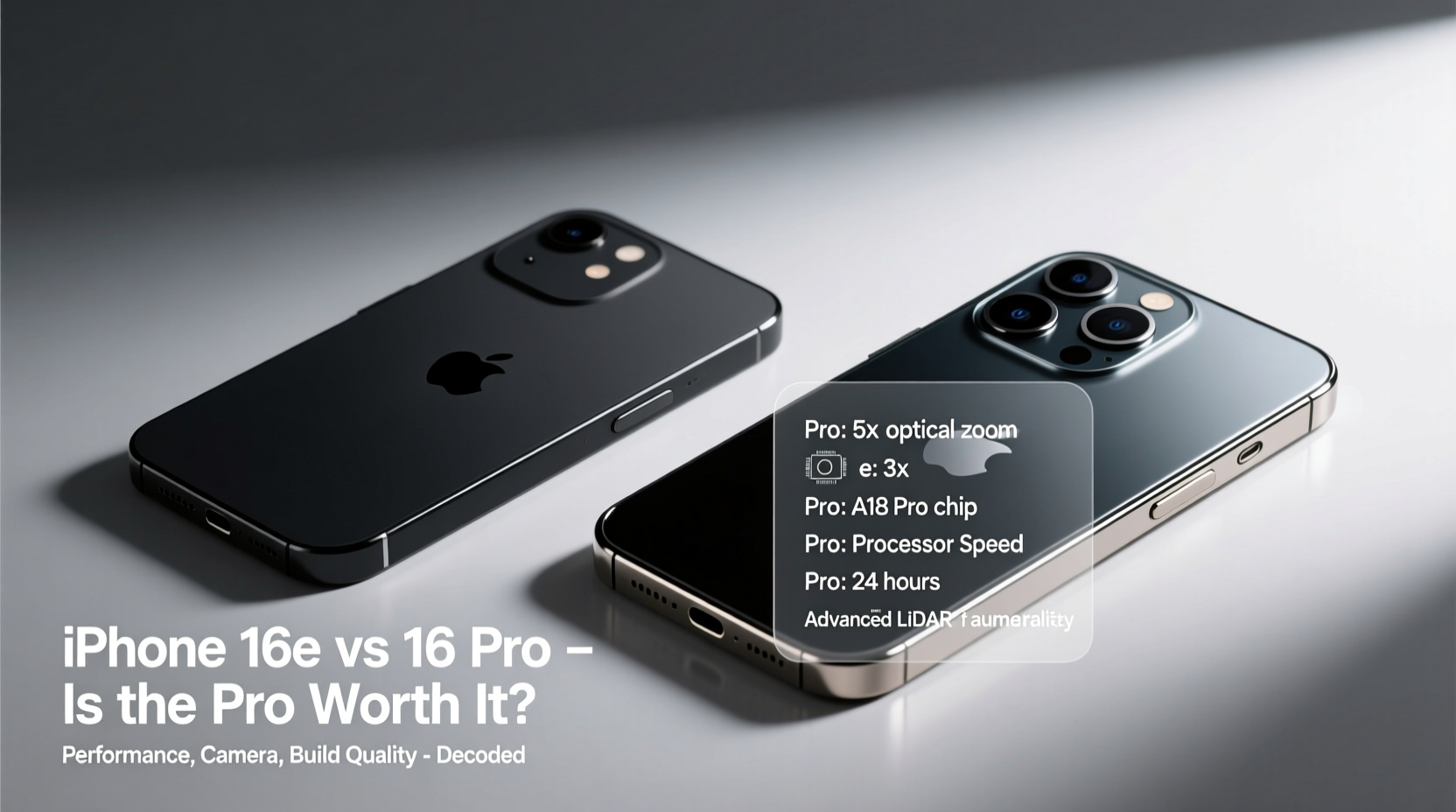
The most immediate difference between the iPhone 16e and the 16 Pro lies in their construction. The 16e retains Apple’s mid-tier approach with an aerospace-grade aluminum frame and a glass back, offering durability at a lower weight and cost. It’s lighter and slightly more compact, making it easier to handle one-handed.
In contrast, the iPhone 16 Pro uses surgical-grade stainless steel and a ceramic shield front, contributing to a noticeably heavier but more premium feel. The Pro also introduces a new matte titanium finish option, enhancing grip and reducing fingerprint smudges—a small but appreciated upgrade for frequent handlers.
Display: Brightness, Refresh Rate, and Usability
The display is where the gap widens significantly. Both models feature Super Retina XDR OLED panels, but the iPhone 16 Pro includes ProMotion technology with a 120Hz adaptive refresh rate. This results in smoother scrolling, faster touch response, and a more fluid overall interface—especially noticeable during gaming or video playback.
The 16e sticks to a standard 60Hz refresh rate. While perfectly functional, the difference becomes apparent after extended use of higher-refresh screens. Additionally, the Pro boasts peak brightness levels of up to 2000 nits (HDR), compared to the 16e’s 1200 nits. In direct sunlight, this makes outdoor visibility far superior on the Pro model.
“High refresh rates aren’t just about gaming—they make every interaction feel more responsive and refined.” — David Lin, Mobile UX Designer at TechFlow Labs
Camera System: Real-World Performance Differences
Apple markets the iPhone 16 Pro as a photography powerhouse, and there’s truth to that claim. The Pro features a triple-lens system: a 48MP main sensor, a 12MP ultra-wide, and a 12MP telephoto lens with 5x optical zoom. The 16e, by comparison, has a dual-camera setup: a 48MP main sensor and a 12MP ultra-wide, lacking any dedicated telephoto lens.
This means the 16 Pro can capture distant subjects without quality loss, while the 16e relies on digital zoom, which degrades image clarity. Low-light performance is also improved on the Pro due to larger sensor sizes and advanced computational photography algorithms.
For casual photographers who mostly shoot landscapes, friends, and social media content, the 16e’s camera is more than sufficient. But professionals, travel enthusiasts, or those who frequently shoot portraits and wildlife will appreciate the Pro’s versatility.
| Feature | iPhone 16e | iPhone 16 Pro |
|---|---|---|
| Main Camera | 48MP f/1.8 | 48MP f/1.5 with sensor-shift stabilization |
| Telephoto Lens | None | 12MP f/2.8, 5x optical zoom |
| Video Recording | 4K @ 60fps, Dolby Vision | 4K @ 120fps, ProRes, Log encoding support |
| Low-Light Mode | Smart HDR 6 | Advanced Night mode + Photonic Engine Pro |
Performance: Chipset and Longevity
Both phones are powered by Apple’s A18 chip, but here’s the catch: the iPhone 16 Pro includes 8GB of RAM versus the 16e’s 6GB. While iOS manages memory efficiently, the extra RAM allows the Pro to handle multitasking, augmented reality apps, and future iOS updates more gracefully.
Benchmarks show the Pro maintaining cooler temperatures and consistent performance under sustained loads—important for gamers or power users. The 16e performs excellently in everyday tasks like browsing, messaging, and streaming, but may show minor throttling during prolonged 4K video editing or heavy app switching.
If you plan to keep your phone for four years or more, the Pro’s additional memory and thermal management could extend its useful lifespan by a year or two.
Real-World Example: Travel Photographer’s Choice
Sophie Ramirez, a freelance photographer based in Barcelona, upgraded from an iPhone 13 to both the 16e and 16 Pro for testing. She used each device for two weeks during a trip through Morocco.
“The 16e took great photos in daylight,” she said. “But when I tried to capture a camel caravan in the desert at sunset, the lack of optical zoom meant I had to crop heavily, losing detail. On the Pro, I got a tight shot with natural depth and minimal noise. For my work, that difference justified the extra cost.”
However, she noted that for Instagram stories and casual shots, the 16e was indistinguishable in quality.
Battery Life and Charging
Battery capacity differs subtly: the 16e offers up to 20 hours of video playback, while the 16 Pro reaches 26 hours. Real-world usage shows about 1.5 to 2 hours more screen-on time on the Pro, thanks to a larger battery and more efficient power management.
Both support fast charging (up to 50% in 30 minutes) and MagSafe compatibility. However, only the Pro supports Wi-Fi-based Ultra-Wideband (UWB) for precision Find My tracking and Car Key functionality—features that matter to tech-savvy users.
Is the iPhone 16 Pro Worth the Extra Money?
The answer depends on your usage patterns. Here’s a checklist to help you decide:
- Do you shoot videos regularly or edit them on your phone?
- Do you need optical zoom for photography?
- Are you a mobile gamer or use AR-intensive apps?
- Do you plan to keep the phone for 4+ years?
- Do you value the smoothness of a 120Hz display?
- Is budget flexibility limited?
If you answered “yes” to the first five, the iPhone 16 Pro is likely worth the investment. If you said “yes” to the last, the 16e delivers excellent value without compromising core functionality.
Step-by-Step Decision Guide
- Assess your primary use: Communication, social media, and light photography favor the 16e.
- Evaluate camera needs: Zoom and low-light performance favor the Pro.
- Consider longevity: More RAM and better cooling extend the Pro’s usability.
- Test display preferences: Try both refresh rates in-store if possible.
- Calculate total cost: Include accessories, cases, and potential trade-in value.
- Decide based on value, not specs: Ask what features you’ll actually use daily.
Frequently Asked Questions
Can the iPhone 16e handle iOS updates as well as the Pro?
Yes, both models will receive the same iOS updates for at least five years. However, the Pro’s extra RAM may delay performance slowdowns in later versions.
Is the camera difference noticeable in normal lighting?
Not significantly. In daylight and well-lit environments, both cameras produce sharp, color-accurate images. The gap appears in low light, zoomed shots, and professional editing scenarios.
Does the 16 Pro have features the 16e lacks beyond hardware?
Yes. The Pro supports Apple ProRAW, ProRes video recording, and advanced UWB features like Precision Finding and CarKey. These are absent on the 16e.
Final Verdict
The iPhone 16 Pro is undeniably superior in specs, materials, and long-term performance. But superiority doesn’t always equal necessity. For most average users—students, professionals, parents—the iPhone 16e offers nearly all the essential features at a much friendlier price point.
The Pro shines for creators, travelers, and tech enthusiasts who demand the best tools available. If your work or lifestyle depends on high-quality imaging, seamless multitasking, and future-proofing, then yes, the Pro is worth the extra $300–$400.
But if you’re upgrading from an iPhone 12 or newer and mainly use your phone for calls, messages, streaming, and occasional photos, the 16e delivers 90% of the experience at 70% of the cost.




 浙公网安备
33010002000092号
浙公网安备
33010002000092号 浙B2-20120091-4
Comments
No comments yet. Why don't you start the discussion?