
When Apple releases a new iPhone lineup, one question always surfaces: how much camera quality am I really sacrificing—or gaining—by choosing the standard model over the Pro Max? With the iPhone 16 series, the gap between the iPhone 16e and the iPhone 16 Pro Max has widened further, especially in photography. But does that justify the nearly $600 price difference? For many users, camera performance is the deciding factor. Let’s break down the real differences, test them in practical scenarios, and determine whether the Pro Max delivers enough photographic value to warrant its premium.
Camera Hardware: The Foundation of Image Quality
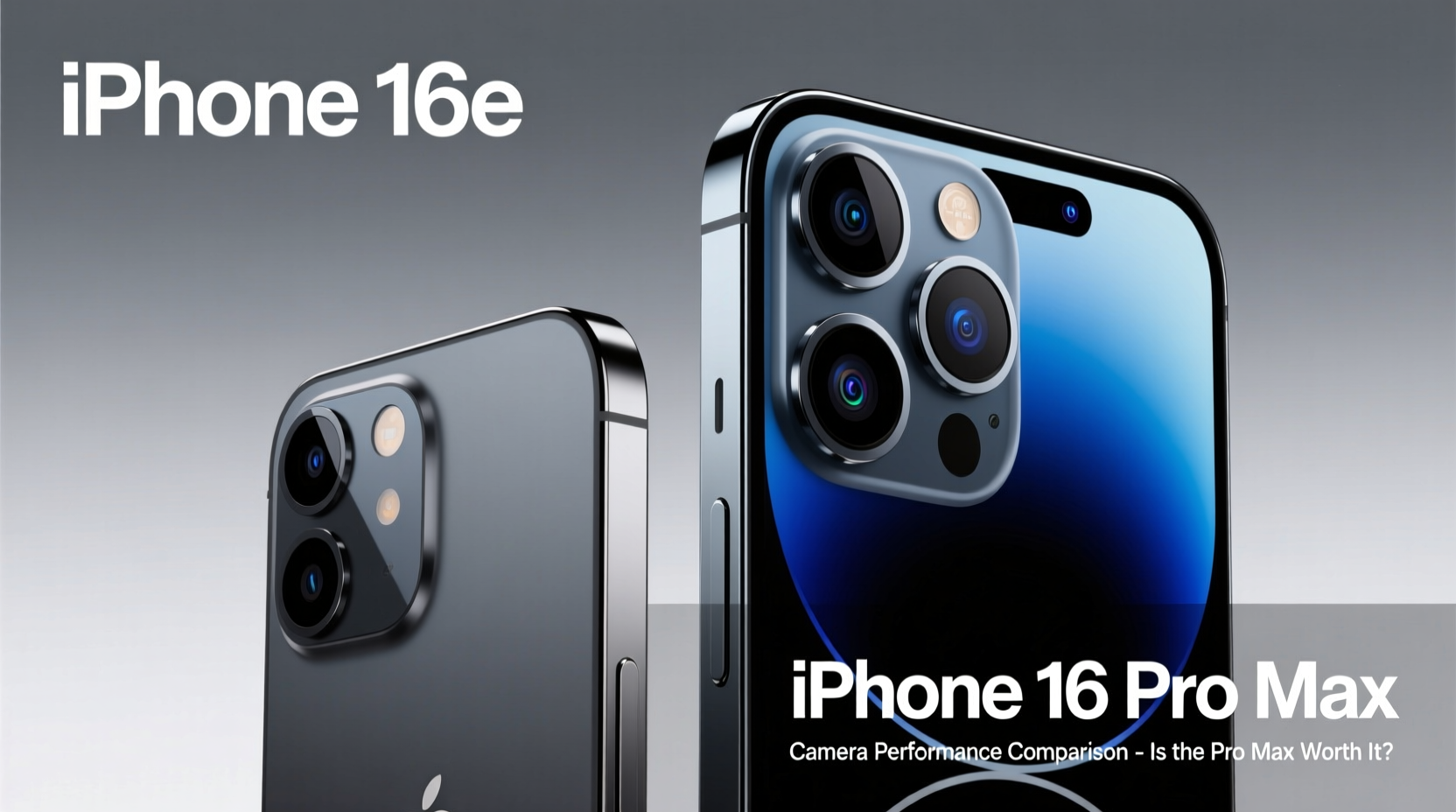
The most fundamental distinction between the iPhone 16e and the 16 Pro Max lies in their camera hardware. While both devices run the same operating system and benefit from Apple’s computational photography, the physical components differ significantly.
| Feature | iPhone 16e | iPhone 16 Pro Max |
|---|---|---|
| Rear Cameras | Dual: 48MP main + 12MP ultra-wide | Triple: 48MP main + 12MP ultra-wide + 5x tetraprism telephoto |
| Aperture (Main) | f/1.8 | f/1.5 |
| Sensor Size (Main) | 1/1.3\" | 1/1.14\" |
| Optical Zoom | 2x digital zoom | 5x optical zoom, up to 25x digital |
| LiDAR Scanner | No | Yes |
| Night Mode on All Lenses | Main only | All rear cameras |
The larger sensor and wider aperture on the Pro Max allow more light capture, resulting in cleaner low-light photos with better dynamic range. The inclusion of a dedicated 5x telephoto lens means you can shoot distant subjects without relying on digital zoom, which degrades image quality. Meanwhile, the 16e uses software-based cropping for zoomed shots, often leading to visible noise and loss of detail.
Image Processing and Computational Photography
Apple’s Photonic Engine and next-gen Deep Fusion now extend across all models, so even the 16e benefits from advanced noise reduction and color accuracy. However, the Pro Max gains exclusive access to ProRAW with deeper bit depth and Smart HDR 6, enabling richer highlights and shadow recovery in post-processing.
In daylight, both phones produce crisp, vibrant images with accurate skin tones. But when lighting becomes challenging—such as indoor events with mixed lighting or golden hour portraits—the Pro Max consistently pulls ahead. Its larger sensor captures more data per pixel, allowing the Neural Engine to process finer textures and reduce noise without smudging details.
“Hardware enables the shot; software perfects it. But if your hardware is limited, even the best algorithms can’t create information that wasn’t captured.” — Dr. Lena Torres, Computational Imaging Researcher at MIT Media Lab
The LiDAR scanner on the Pro Max also improves autofocus speed in low light and enhances portrait mode edge detection, making subject separation more natural. On the 16e, portrait shots sometimes struggle with hair strands or complex backgrounds, requiring manual editing.
Real-World Use Case: Travel Photography
Consider Maya, a travel blogger who recently upgraded from an iPhone 13 to the 16e. She visited Kyoto during cherry blossom season and was excited to document temples, gardens, and street life. While her 16e handled wide-angle garden shots well, she quickly hit limitations.
- She couldn’t get close-up shots of pagoda carvings without physically moving closer—something not allowed at heritage sites.
- Evening shots at Gion were grainy, despite Night Mode.
- Portraits of locals in shaded alleys lacked depth and background blur felt artificial.
Her colleague, using the 16 Pro Max, captured the same scenes with greater flexibility. The 5x telephoto let him frame intricate roof details from a distance. Low-light shots retained texture in wooden beams and fabric patterns. Portrait mode rendered kimono folds naturally, thanks to LiDAR-assisted depth mapping.
This example illustrates a key point: for casual social media use, the 16e suffices. But for creators, travelers, or anyone documenting experiences with intention, the Pro Max offers tools that directly impact creative freedom.
Video Capabilities: Beyond Still Photos
If you shoot video, the divide grows even wider. The iPhone 16 Pro Max supports:
- 4K Dolby Vision HDR at 120fps
- Cinematic Mode in 4K at 30fps (all lenses)
- ProRes video recording (external storage required)
- Advanced stabilization with Sensor-Shift OIS on all lenses
The 16e, while capable of 4K at 60fps, lacks Dolby Vision on rear cameras and doesn’t support ProRes. Cinematic Mode is limited to the main lens and only in 1080p. This makes the Pro Max a far better choice for vloggers, indie filmmakers, or anyone serious about mobile videography.
Is the Pro Max Worth the Extra Money? A Value Checklist
To help you decide, here’s a checklist of factors that should influence your purchase:
- Do you shoot in low light often? → Pro Max wins with larger sensor and Night Mode on all lenses.
- Do you need zoom beyond 2x? → Only the Pro Max offers true optical zoom.
- Are you into mobile photography as a hobby or profession? → ProRAW, ProRes, and LiDAR make editing and capturing easier.
- Do you prioritize battery life? → The Pro Max’s larger battery supports longer shooting sessions.
- Is budget a primary concern? → The 16e delivers excellent value for everyday use.
If three or more of the first four apply to you, the Pro Max is likely worth the investment. But if you mostly take casual snapshots, share memes, or prefer simplicity, the 16e is more than capable.
Frequently Asked Questions
Can the iPhone 16e compete with older Pro models?
Yes. The 16e’s 48MP main sensor outperforms the iPhone 13 Pro in daylight clarity and matches it in basic low-light conditions. For users upgrading from older Pros, the 16e may feel like a step back in versatility but still delivers strong core performance.
Does the Pro Max camera improve over time with software updates?
Absolutely. Apple continues to refine Smart HDR, Night Mode, and portrait algorithms through iOS updates. Pro models often receive early access to new features like Genmoji or AI-enhanced photo cleanup. Your Pro Max will likely stay relevant longer.
Is the front camera different between models?
Yes. The 16 Pro Max includes a 12MP TrueDepth camera with autofocus and Night Mode, while the 16e uses a fixed-focus 10MP sensor. Selfies and video calls are noticeably sharper and more consistent on the Pro Max, especially in dim environments.
Final Verdict: Who Should Upgrade?
The iPhone 16 Pro Max isn’t just a phone with a better camera—it’s a tool designed for people who treat photography and videography as essential functions. The combination of superior sensors, optical zoom, LiDAR, and professional-grade video formats creates a device that excels in demanding situations where the 16e simply can’t keep up.
However, for the average user, the 16e represents exceptional value. It captures beautiful photos in good light, handles social media content effortlessly, and includes all the smart processing features Apple is known for. You’re not “settling” with the 16e—you’re optimizing for cost and convenience.
The Pro Max is worth the extra money if you regularly push your phone’s limits. If you’re someone who says, “I wish I could’ve gotten that shot,” the Pro Max gives you the ability to do exactly that. But if your needs are met by clear daytime photos and occasional night shots, the 16e proves that Apple’s base models are no longer an afterthought.




 浙公网安备
33010002000092号
浙公网安备
33010002000092号 浙B2-20120091-4
Comments
No comments yet. Why don't you start the discussion?