
The iPhone X was a landmark device—Apple’s first edge-to-edge OLED display, Face ID debut, and the start of the modern iPhone era. Released in 2017, it still holds nostalgic value for many users who’ve held onto it thanks to its build quality and iOS longevity. But with the arrival of the iPhone 16e, a new entry-level contender built on over half a decade of technological progress, the question arises: after all these years, is it finally time to let go?
This isn’t just about specs on paper. It’s about real usability, battery life, software support, and whether the upgrade meaningfully improves your daily experience. Let’s break down what’s changed—and whether the leap from the iPhone X to the iPhone 16e delivers enough value to justify the switch.
Design & Build: Evolution of Form and Function
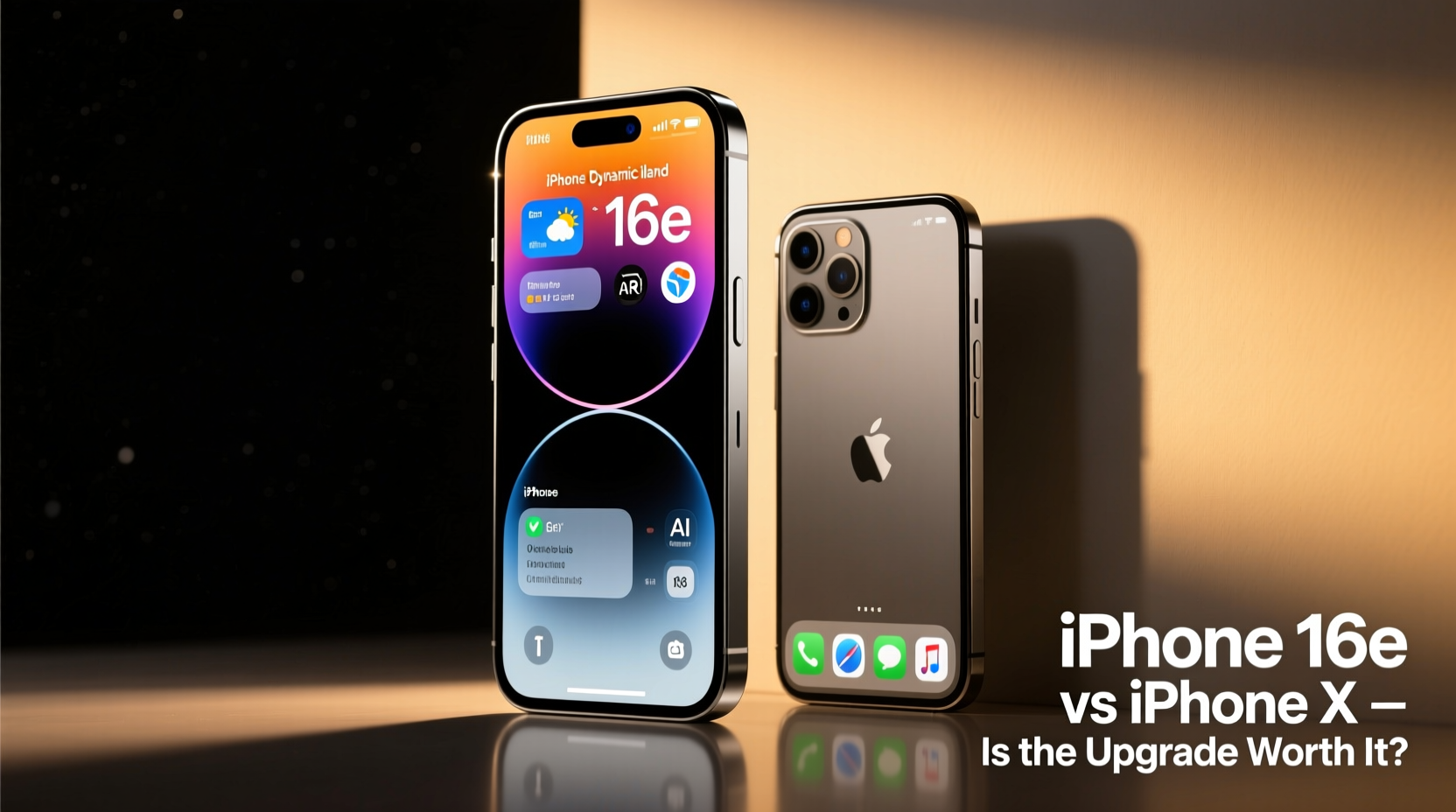
The iPhone X introduced a stainless steel frame with glass back, supporting wireless charging—a novelty at the time. Its 5.8-inch Super Retina OLED display was sharp and vibrant, especially compared to previous LCD models. However, bezels were still present at the top (for the notch) and bottom, and the phone felt dense in hand.
In contrast, the iPhone 16e adopts Apple’s latest design language: aerospace-grade aluminum, slimmer bezels, and an under-display Face ID system that eliminates the notch. The display now stretches edge-to-edge with a 6.1-inch Dynamic OLED panel, offering higher peak brightness (up to 2000 nits), improved outdoor visibility, and ProMotion-like adaptive refresh rate technology (10–120Hz) even at this tier.
More importantly, the 16e features IP68 dust/water resistance with improved sealing, better drop protection via ceramic shield front cover, and a lighter overall weight despite a larger screen. For users coming from the iPhone X, the feel in hand is immediately more modern and comfortable.
Performance: From Capable to Future-Proof
The iPhone X ran the A11 Bionic chip—an impressive processor in 2017. Even today, it can handle basic tasks like email, messaging, and light web browsing. But app launches are noticeably slower, multitasking stutters occur, and newer iOS versions (like iOS 18) have visibly reduced fluidity on the X.
The iPhone 16e, powered by the A18 chip, represents a generational leap. Built on a 3nm process, the A18 delivers up to 2x CPU performance and 3x GPU gains over the A11. Real-world impact? Apps open instantly, AR experiences run smoothly, and background processes (like photo indexing or Siri requests) happen seamlessly.
Perhaps most critical: future-proofing. The iPhone X received its last major OS update with iOS 16; iOS 17 and 18 offer limited compatibility with degraded performance. The iPhone 16e, however, is expected to receive at least six years of iOS updates, keeping it secure and functional through 2030.
“Devices from 2017 are reaching their hardware limits. The A18 isn’t just faster—it enables AI-driven features that older chips simply can’t support.” — Dr. Lena Torres, Mobile Systems Analyst at TechInsight Group
Camera Comparison: Night Mode, Computational Photography, and More
The iPhone X’s dual-camera system (12MP wide + telephoto) was excellent for its time, but lacks key advancements introduced since. No Night mode, no Deep Fusion, no Smart HDR 4. Low-light photos are grainy, dynamic range is limited, and portrait mode relies heavily on software simulation.
The iPhone 16e features a significantly upgraded 48MP main sensor with pixel binning, second-generation Night mode, enhanced computational photography, and improved autofocus. Video recording jumps from 4K@60fps to 4K@120fps with cinematic mode available in both photo and video. Audio zoom and spatial audio capture are now standard.
In practical terms, users upgrading from the iPhone X will notice dramatic improvements in low-light shots, sharper details, and far more consistent color accuracy across lighting conditions. The ultrawide lens (new to the 'e' series) also adds creative flexibility for landscapes and group photos.
Real Example: Sarah’s Upgrade Experience
Sarah, a freelance photographer, used her iPhone X for seven years, relying on it for client previews and social media content. After switching to the iPhone 16e, she noticed immediate differences: “I used to avoid shooting indoors because the noise ruined everything. Now, I take usable shots in dim cafes. The depth sensing in portrait mode actually works on pets now—my cat finally has good photos!”
Battery Life and Charging: From All-Day Anxiety to True Endurance
The iPhone X offered around 10–11 hours of mixed usage, which felt adequate in 2017. Today, that falls short. Heavy users often needed midday charging, and battery degradation over time has made this worse for long-term owners.
The iPhone 16e boasts up to 18 hours of video playback and 14+ hours of real-world mixed use. This is achieved through a larger battery, more efficient A18 chip, and optimized power management. Standby drain is minimal, and background app refresh is smarter thanks to on-device intelligence.
Charging has also evolved. While the iPhone X supported 7.5W wireless and 15W wired (with USB-C adapter), the 16e supports 20W fast charging out of the box and 15W MagSafe-compatible wireless. A 30-minute charge now delivers over 50% battery—something the X could never achieve.
| Feature | iPhone X | iPhone 16e |
|---|---|---|
| Display | 5.8\" OLED, 1125x2436 | 6.1\" Dynamic OLED, 1179x2556, 120Hz |
| Chipset | A11 Bionic | A18 |
| Rear Camera | Dual 12MP (wide + telephoto) | 48MP main + 12MP ultrawide |
| Front Camera | 7MP | 12MP, Auto-Focus, Night Mode |
| Battery Life (Video) | 13 hrs | 18 hrs |
| Charging | 7.5W wireless, ~30min for 50% | 20W wired, 15W wireless, ~30min for 60% |
| iOS Support Window | Ended with iOS 16/17 | Expected through iOS 24+ |
Should You Upgrade? A Practical Checklist
Deciding whether to upgrade depends on your needs, budget, and current pain points. Use this checklist to evaluate your situation:
- ✅ Do you regularly experience app crashes or slow performance?
- ✅ Is your battery draining within 6–8 hours of use?
- ✅ Are you unable to install the latest iOS updates or security patches?
- ✅ Do you struggle to take clear photos in low light?
- ✅ Do you want access to newer features like Live Voicemail, Genmoji, or on-device AI tools?
- ✅ Is your iPhone X showing physical wear (cracked screen, swollen battery)?
If three or more apply, the upgrade is not only worth it—it may improve your productivity, safety, and digital well-being.
Frequently Asked Questions
Will my accessories work with the iPhone 16e?
Most MagSafe-compatible cases, chargers, and wallets will work. However, older Lightning accessories require a USB-C adapter. Note: The 16e uses USB-C (finally), so you’ll need new cables unless you already transitioned.
Can the iPhone 16e run advanced apps like Final Cut Pro or Adobe Premiere Rush smoothly?
Yes. The A18 chip and 6GB RAM allow full desktop-class video editing on mobile. Users upgrading from the iPhone X will find these apps either unavailable or unusably slow on the older device.
Is the iPhone 16e durable enough to replace a phone I’ve had for years?
Absolutely. With tougher glass, better water resistance, and structural aluminum frame, the 16e is built to last. Paired with a simple case, it can easily serve as a 5+ year device—unlike the X, which is now beyond its intended lifespan.
Final Verdict: Yes, It’s Finally Worth It
For years, holding onto the iPhone X made sense. It was reliable, beautifully designed, and remarkably resilient. But technology has moved forward—especially in areas that affect daily usability: battery life, camera performance, processing speed, and software support.
The iPhone 16e isn’t just a new phone. It’s a gateway to the next era of iOS: on-device AI, richer accessibility features, seamless Continuity enhancements with Mac and iPad, and longer-term security. The upgrade cost is real, but so is the return: fewer frustrations, better photos, longer battery, and peace of mind knowing your device won’t become obsolete in a year.
If you’ve been waiting for the right moment to move on from your iPhone X, this is it. The gap between then and now has never been clearer—or more compelling.




 浙公网安备
33010002000092号
浙公网安备
33010002000092号 浙B2-20120091-4
Comments
No comments yet. Why don't you start the discussion?