
In 2025, the flagship smartphone battle reaches a new intensity with the anticipated launch of the iPhone 17 Pro Max and the Galaxy S25 Ultra. For years, consumers have been divided between Apple’s ecosystem loyalty and Samsung’s hardware innovation. But as both companies push the limits of AI integration, camera performance, battery efficiency, and design refinement, the question becomes more pressing: is Samsung’s latest leap forward compelling enough to justify switching from iOS to Android?
This isn’t just about specs on paper. It’s about real-world usability, long-term software support, ecosystem compatibility, and personal workflow alignment. Whether you're a creative professional, a mobile photographer, or someone who values seamless daily integration, understanding the tangible differences between these two devices could influence your tech decisions for years.
Design and Build: Refinement vs Innovation
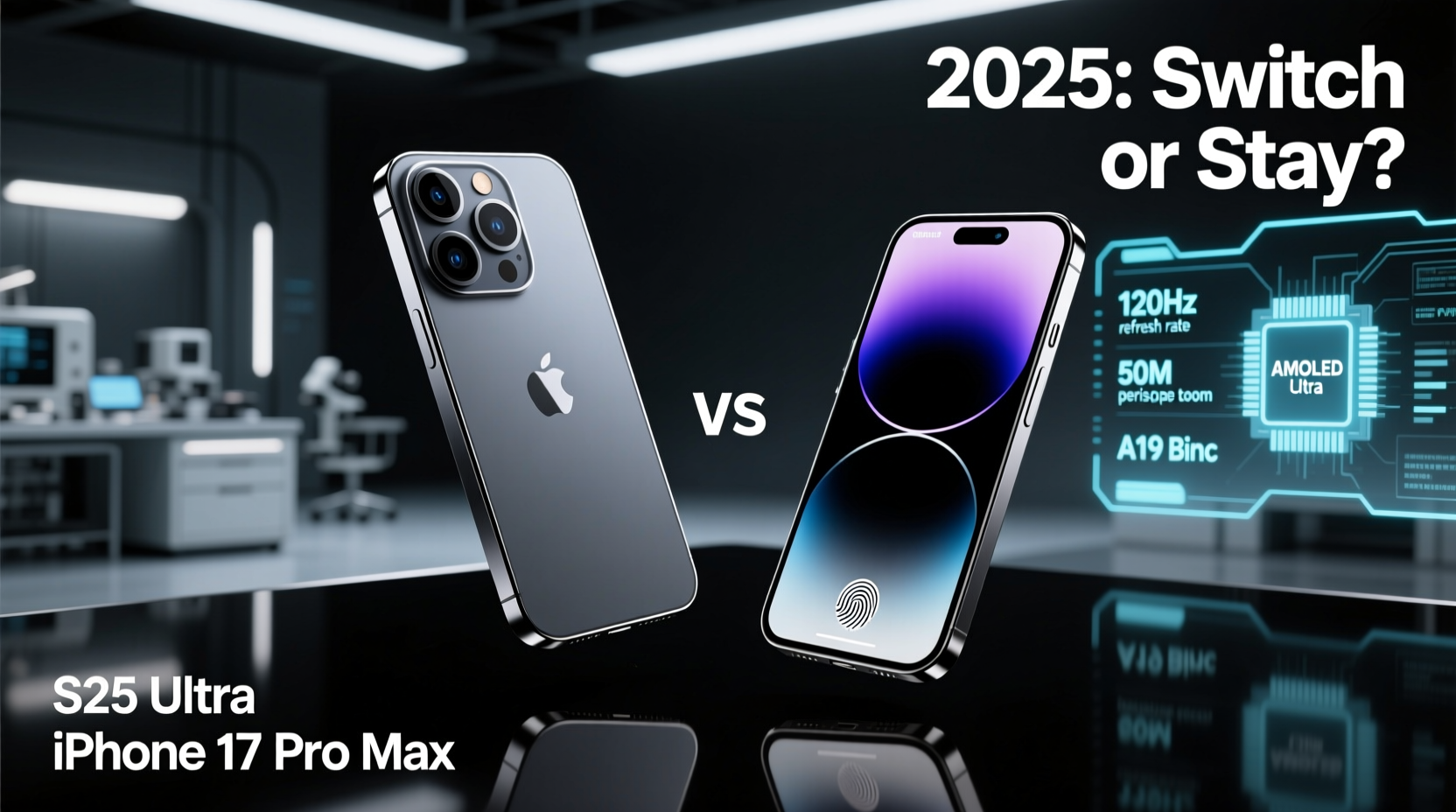
The iPhone 17 Pro Max is expected to continue Apple’s minimalist titanium design language introduced with the iPhone 15 Pro series, but with subtle refinements. Rumors suggest a slightly thinner bezel, a flat-edge redesign for better grip, and improved durability with next-gen Ceramic Shield X. The device will likely retain its 6.9-inch display size, staying competitive in the large-screen category while maintaining excellent one-handed usability thanks to iOS optimizations.
On the other hand, the Galaxy S25 Ultra is poised to redefine premium Android design. Leaks indicate a fully symmetrical edge-to-edge Dynamic AMOLED 3X display with virtually invisible under-display cameras. Samsung may introduce aerospace-grade aluminum or even a titanium hybrid frame, reducing weight without sacrificing strength. The iconic S Pen will remain embedded, now with Bluetooth LE functionality for remote control of presentations, photos, and smart home devices.
Display and Performance Comparison
Both phones will feature cutting-edge displays, but their approaches differ. The iPhone 17 Pro Max is rumored to debut Apple’s first 120Hz micro-OLED display, offering deeper blacks and improved power efficiency over traditional OLED. Brightness levels may exceed 3,000 nits peak, making it ideal for outdoor visibility and HDR content consumption.
The Galaxy S25 Ultra, however, is expected to push boundaries further with a 6.9-inch QHD+ Dynamic AMOLED 3X panel boasting 4,000 nits peak brightness, adaptive 1Hz–144Hz refresh rate, and per-pixel calibration for color accuracy. This makes it a favorite among videographers and designers who demand precision.
Under the hood, Apple’s A19 Bionic chip—manufactured on a 2nm process—is projected to deliver unmatched single-core performance and AI acceleration optimized for iOS-specific tasks like computational photography and on-device Siri intelligence. Meanwhile, the S25 Ultra will likely be powered by the Snapdragon 8 Gen 4 (or Exynos 2500 in select regions), emphasizing multi-threaded workloads and generative AI capabilities through Samsung’s Gauss 3.0 platform.
“Samsung’s AI stack in the S25 series isn’t just cosmetic—it enables real-time transcription, document summarization, and photo editing that rivals desktop tools.” — Dr. Lena Park, Mobile AI Researcher at MIT Media Lab
Camera Systems: Computational Photography vs Versatility
Apple has steadily improved its camera system with a focus on natural color science and cinematic video recording. The iPhone 17 Pro Max is expected to feature a tetraprism 5x optical zoom lens, replacing the current 4x, delivering sharper long-range shots. Its main sensor may grow to 48MP with enhanced pixel binning, and low-light video performance should benefit from larger apertures and advanced sensor-shift stabilization.
Samsung, meanwhile, continues to lead in zoom versatility. The S25 Ultra is rumored to include a 200MP main sensor with adaptive pixel technology, a 10x periscope lens, and an upgraded 5x telephoto for lossless 50x hybrid zoom. More importantly, its AI-powered image processing can reconstruct details in ultra-zoomed photos far beyond optical limits—a feature particularly useful for wildlife or event photography.
For videographers, the iPhone remains the gold standard for dynamic range and audio sync, especially with ProRes and Log encoding. However, the S25 Ultra introduces 8K/60fps HDR video with AI-based stabilization and scene detection—features increasingly adopted by social media creators.
| Feature | iPhone 17 Pro Max | Galaxy S25 Ultra |
|---|---|---|
| Main Camera | 48MP, f/1.6, Sensor-Shift OIS | 200MP, f/1.4, Adaptive Pixel |
| Telephoto Zoom | 5x Optical (Tetraprism) | 10x Optical + 5x Dual Periscope |
| Video Recording | 4K/120fps, ProRes, Log | 8K/60fps, HDR10+, AI Stabilization |
| Front Camera | 12MP, Auto-Focus | 12MP, 4K/60fps, Eye Tracking |
| AI Features | Portrait Mode Enhancements, Scene Detection | Real-Time Editing, Object Erase, Voice Clarity Boost |
Battery Life and Charging: Efficiency vs Speed
The iPhone 17 Pro Max is expected to pack a 5,000mAh battery—the largest in iPhone history—paired with aggressive power management from the A19 chip. Real-world usage suggests up to 14 hours of screen-on time, especially with iOS 18’s new “Adaptive Energy” mode that throttles background processes based on usage patterns.
The S25 Ultra, despite similar battery capacity (5,100mAh), leverages Samsung’s AI-driven power optimization across apps and display settings. It supports 45W wired fast charging (0–100% in ~50 minutes) and 15W wireless charging, significantly faster than Apple’s 20W wired and 15W MagSafe limits. Samsung also introduces reverse wireless charging with extended range, allowing users to power wearables or earbuds simply by placing them near the phone.
Ecosystem and Software Experience
This is where the decision often hinges. Apple’s ecosystem—iCloud, AirDrop, Handoff, Continuity Camera, and Universal Clipboard—offers unparalleled cohesion across Mac, iPad, Apple Watch, and Home devices. iOS 18 promises deeper customization with AI-generated wallpapers, predictive app suggestions, and enhanced privacy controls, including on-device processing for sensitive data.
Samsung counters with One UI 7.0, built on Android 15, featuring improved cross-device integration with Windows PCs, Galaxy Buds, and SmartThings appliances. The new \"Samsung Link\" allows direct clipboard sharing, call mirroring, and file transfer with minimal setup. For enterprise users, Knox Vault 3.0 enhances biometric security and data encryption, appealing to professionals handling confidential information.
However, switching ecosystems means relearning workflows, migrating data, and potentially losing access to certain services. iMessage remains a major friction point; green bubbles aren’t just aesthetic—they mean fewer features and delayed delivery compared to RCS-enabled Android messaging.
Mini Case Study: Sarah’s Switch from iPhone to Galaxy
Sarah, a freelance photographer based in Austin, used iPhones exclusively for a decade. In early 2025, she tested the Galaxy S25 Ultra during a trip to Yellowstone. She needed superior zoom for wildlife shots, faster charging in remote areas, and seamless editing via Adobe Lightroom on Android tablets. After migrating her portfolio using Samsung Smart Switch and adjusting to Google Messages, she found the S25 Ultra’s AI zoom tracking and DeX desktop mode transformative. “I missed iMessage at first,” she admits, “but WhatsApp and Telegram filled the gap. Now I can edit RAW files on the go without touching a laptop.”
Is the Switch Worth It? A Practical Checklist
Before making the leap from iPhone to Galaxy, consider this checklist:
- ✅ Do you rely heavily on iMessage or FaceTime? (Switching breaks full functionality)
- ✅ Are you invested in Apple services (iCloud+, Apple Music, Fitness+)?
- ✅ Do you value hardware versatility (S Pen, ultra-zoom, faster charging)?
- ✅ Is AI-powered photo/video editing part of your workflow?
- ✅ Do you use non-Apple laptops or Windows machines regularly?
- ✅ Are you open to learning new gestures and interface logic?
If three or more answers are “yes” to the latter three, Samsung’s 2025 upgrade may offer tangible benefits worth the transition cost.
Frequently Asked Questions
Will the Galaxy S25 Ultra get seven years of software updates like the iPhone?
No—Samsung currently guarantees seven years of OS and security updates only for select Galaxy Z foldables. The S25 Ultra will receive four major Android upgrades and five years of security patches, which is strong for Android but still trails Apple’s consistent decade-long support for older devices.
Can I use my AirPods with the Galaxy S25 Ultra?
Yes, but with limitations. AirPods will pair via Bluetooth and play audio, but you’ll lose automatic switching, spatial audio with head tracking, and battery level pop-ups. For full functionality, Samsung recommends Galaxy Buds3 Pro.
Does the iPhone 17 Pro Max support USB-C fast charging?
Yes. With a 30W+ USB-C PD charger, the iPhone 17 Pro Max can reach 50% in about 30 minutes. However, it doesn’t support the higher wattage protocols available on Android, limiting peak speeds compared to the S25 Ultra.
Conclusion: Making the Right Choice for Your Digital Life
The iPhone 17 Pro Max and Galaxy S25 Ultra represent the pinnacle of mobile engineering in 2025—each excelling in different philosophies. Apple delivers polish, longevity, and ecosystem harmony. Samsung pushes boundaries in hardware flexibility, AI utility, and creative freedom.
Switching from Apple to Samsung isn’t just about better specs. It’s about whether those advancements translate into meaningful improvements in your daily life. If you crave cutting-edge AI tools, superior zoom, and stylus integration, the S25 Ultra makes a compelling case. But if you value consistency, long-term support, and seamless integration with Apple devices, staying put may be the smarter move.




 浙公网安备
33010002000092号
浙公网安备
33010002000092号 浙B2-20120091-4
Comments
No comments yet. Why don't you start the discussion?