
The iPhone 4 was a landmark device in Apple’s history—introducing the Retina display, FaceTime, and a sleek stainless steel design. But beneath its iconic exterior lay a crucial technical divide: two distinct models based on network technology—CDMA and GSM. For collectors, travelers, or enthusiasts still considering one today, the question remains relevant: is the GSM version truly worth paying extra for compared to its CDMA counterpart?
This isn’t just about nostalgia. The differences between these models affect usability, global compatibility, and long-term ownership value. Understanding the implications of each can save time, money, and frustration—especially if you're sourcing parts, using it as a backup phone, or building a retro tech collection.
Understanding CDMA vs GSM: The Core Differences
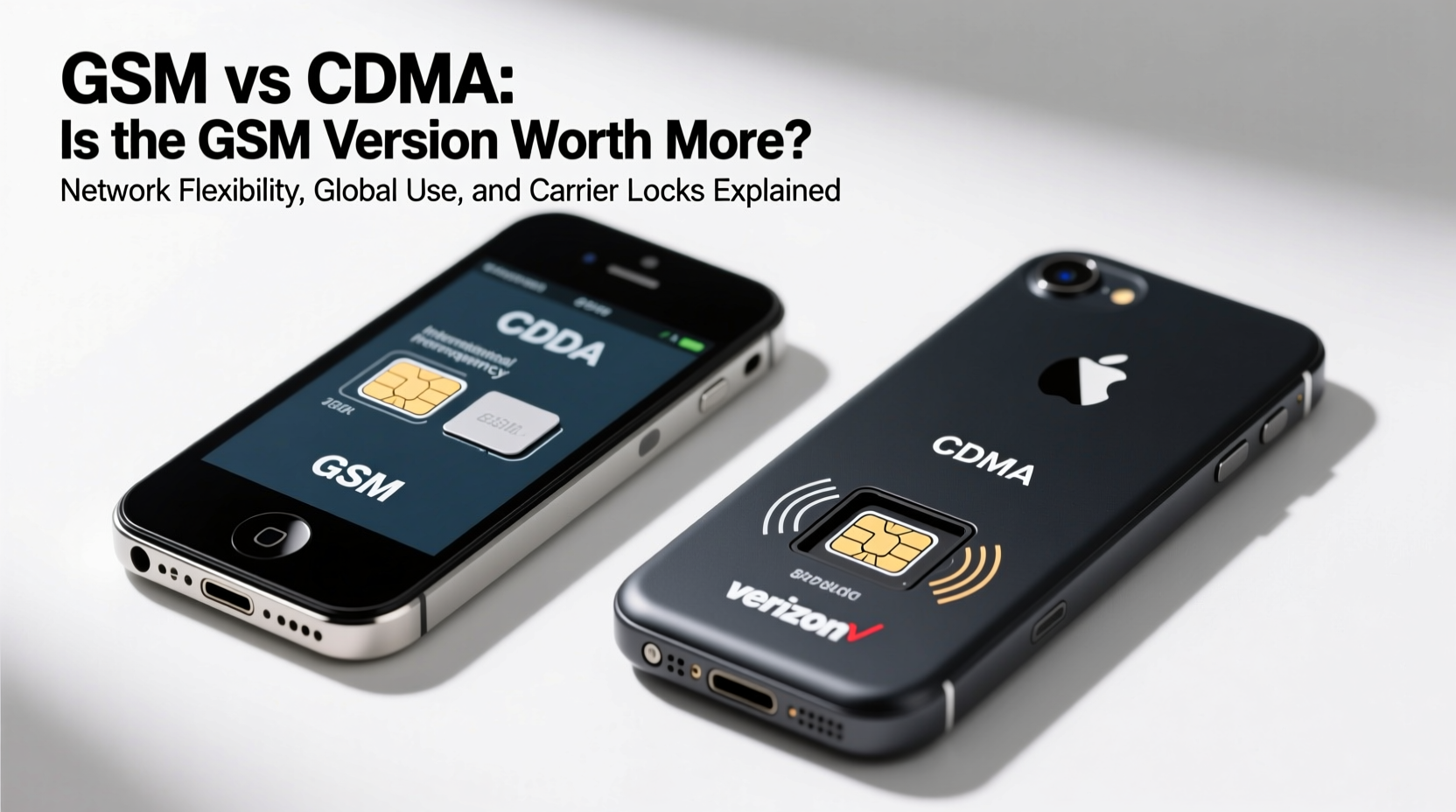
Before evaluating which iPhone 4 model holds greater value, it's essential to understand what CDMA and GSM actually mean.
- GSM (Global System for Mobile Communications): Used by carriers like AT&T and T-Mobile in the U.S., and most networks worldwide. Relies on SIM cards for user identification and service activation.
- CDMA (Code Division Multiple Access): Historically used by Verizon and Sprint in the U.S. Does not require a SIM card; instead, the phone is “activated” directly through the carrier’s system.
The iPhone 4 introduced Apple’s first dual-network strategy. The original GSM model (A1332) launched with AT&T in 2010. Then, in early 2011, Apple released a CDMA version (A1349) exclusively for Verizon. These aren't just software variants—they differ in hardware, including baseband processors, antennas, and supported frequency bands.
“Network technology at the hardware level dictates everything from roaming capability to future-proofing.” — David Lin, Wireless Infrastructure Analyst
Key Technical Comparison: GSM vs CDMA iPhone 4
| Feature | GSM iPhone 4 (A1332) | CDMA iPhone 4 (A1349) |
|---|---|---|
| Primary Carrier | AT&T (U.S.) | Verizon (U.S.) |
| SIM Card Support | Yes (Micro-SIM) | No (SIM-free; later firmware added limited support) |
| Network Bands | GSM 850/900/1800/1900 UMTS 850/900/1900/2100 |
CDMA EV-DO Rev. A (800/1900 MHz) UMTS 850/1900/2100 |
| International Roaming | Excellent – compatible with most global networks | Limited – lacks key European/Asian frequencies |
| Future Network Support | Decommissioned but broader legacy compatibility | Less adaptable due to CDMA shutdowns |
| Unlockability | Officially unlockable (if originally locked) | Harder to unlock; tied to carrier profiles |
The GSM model supports UMTS/HSPA on 2100 MHz—the standard band used across Europe and Asia. The CDMA version lacks 900 MHz UMTS support, making it significantly less effective outside North America. This alone makes the GSM variant far more versatile for international use—even today.
Real-World Use Case: Traveler’s Dilemma
Consider Mark, a vintage tech enthusiast who bought a CDMA iPhone 4 from a U.S. auction site for $75, believing all iPhone 4s were interchangeable. He planned to use it during a trip to Portugal as a nostalgic backup device. Upon arrival, he discovered the phone couldn’t connect to any local network—even with a Portuguese SIM card. After troubleshooting, he learned that his CDMA model didn’t support the 900 MHz UMTS band used by most Portuguese carriers.
He ended up purchasing a used GSM iPhone 4 locally for €120—nearly double his original investment. His mistake wasn’t budgeting; it was assuming network compatibility was universal. This scenario is common among retro device buyers unaware of regional hardware variations.
In contrast, the GSM iPhone 4 could have been unlocked, loaded with a local SIM, and used for calls and data without issue—demonstrating its superior flexibility.
Is the Price Premium Justified?
Today, the GSM iPhone 4 typically sells for $20–$40 more than the CDMA version on collector markets. That premium reflects real-world advantages:
- Broader Compatibility: Works on more networks globally, even where 3G still lingers.
- Easier Unlocking: Apple provided official unlocking tools for GSM models tied to AT&T.
- Better Resale Value: Collectors and modders prefer the GSM model for tinkering and restoration.
- Hardware Flexibility: Can be repurposed as a Wi-Fi-only device with occasional cellular fallback.
However, if your sole purpose is display, charging, or using the device strictly on Wi-Fi, the CDMA model performs identically in terms of camera, screen, iOS functionality, and app support. In such cases, the price difference may not matter.
But for anyone wanting functional cellular use—even occasionally—the GSM version offers tangible benefits that justify the higher cost.
Step-by-Step: How to Identify Your iPhone 4 Model
If you’re buying or verifying a unit, follow this quick guide:
- Check the Model Number: Go to Settings > General > About > Model. Tap it once to reveal the internal number (e.g., A1332 or A1349).
- A1332 = GSM (AT&T): Supports micro-SIM and global frequencies.
- A1349 = CDMA (Verizon): No SIM tray originally; later versions allowed SIM use but with limitations.
- Inspect the SIM Tray: GSM models have a removable micro-SIM tray on the right edge. CDMA units initially had a blank cover; some later revisions included a tray.
- Test with a SIM: Insert a valid micro-SIM. If the phone recognizes it and shows carrier options, it’s likely GSM or a later CDMA model with SIM support.
Frequently Asked Questions
Can I use a CDMA iPhone 4 with a SIM card today?
Some late-model CDMA iPhone 4 units (post-2012) received firmware updates enabling limited SIM use, but only on Verizon’s network or select MVNOs. They cannot roam internationally like GSM models. Full cross-carrier compatibility is not possible.
Are both models obsolete for regular use?
Yes. Major U.S. carriers have shut down 3G networks (AT&T in 2022, Verizon in 2023), rendering both models unable to make traditional calls or use mobile data. However, they remain functional for Wi-Fi calling, messaging apps, media playback, and as retro devices.
Does the GSM iPhone 4 support modern SIM cards?
It uses a micro-SIM, which is larger than today’s nano-SIM. You’ll need a micro-SIM or cut-down nano-SIM. Many carriers still offer micro-SIMs upon request, or you can use an adapter.
Final Verdict: Is the GSM Version Worth It?
For pure collectors who prioritize aesthetics over function, the CDMA model offers the same iconic design at a lower price. But for those seeking usability, adaptability, or international potential—even in a limited capacity—the GSM iPhone 4 is objectively superior.
The $20–$40 premium reflects lasting utility. Whether you’re testing legacy apps, demonstrating historical tech, or repurposing the device for IoT projects, the GSM model’s open SIM access and broader network support provide more pathways for creative use.
Moreover, as 3G sunsets continue globally, having a device that was built for wider interoperability means it retains relevance longer. In the world of vintage smartphones, that kind of flexibility doesn’t come cheap—and often proves worth every extra dollar.




 浙公网安备
33010002000092号
浙公网安备
33010002000092号 浙B2-20120091-4
Comments
No comments yet. Why don't you start the discussion?