
In the early 2010s, smartphones were evolving at a breakneck pace. Apple’s iPhone 4s arrived in 2011 as a refinement of an already polished design, while Samsung’s Galaxy Note 4 launched in 2014 with bold ambitions—larger screens, more power, and stylus integration. Today, comparing these two devices isn’t just about specs; it’s about perspective. Was the Galaxy Note 4 objectively better than the iPhone 4s, or does nostalgia for the era of rapid Android innovation color our memories?
The answer isn't simple. These phones weren’t direct competitors in their time—they belonged to different generations and served different audiences. Yet, years later, tech enthusiasts often debate whether the Note 4 represented a true leap forward or merely a flash in the pan of Android's golden age.
The Generational Gap: Not a Fair Fight?
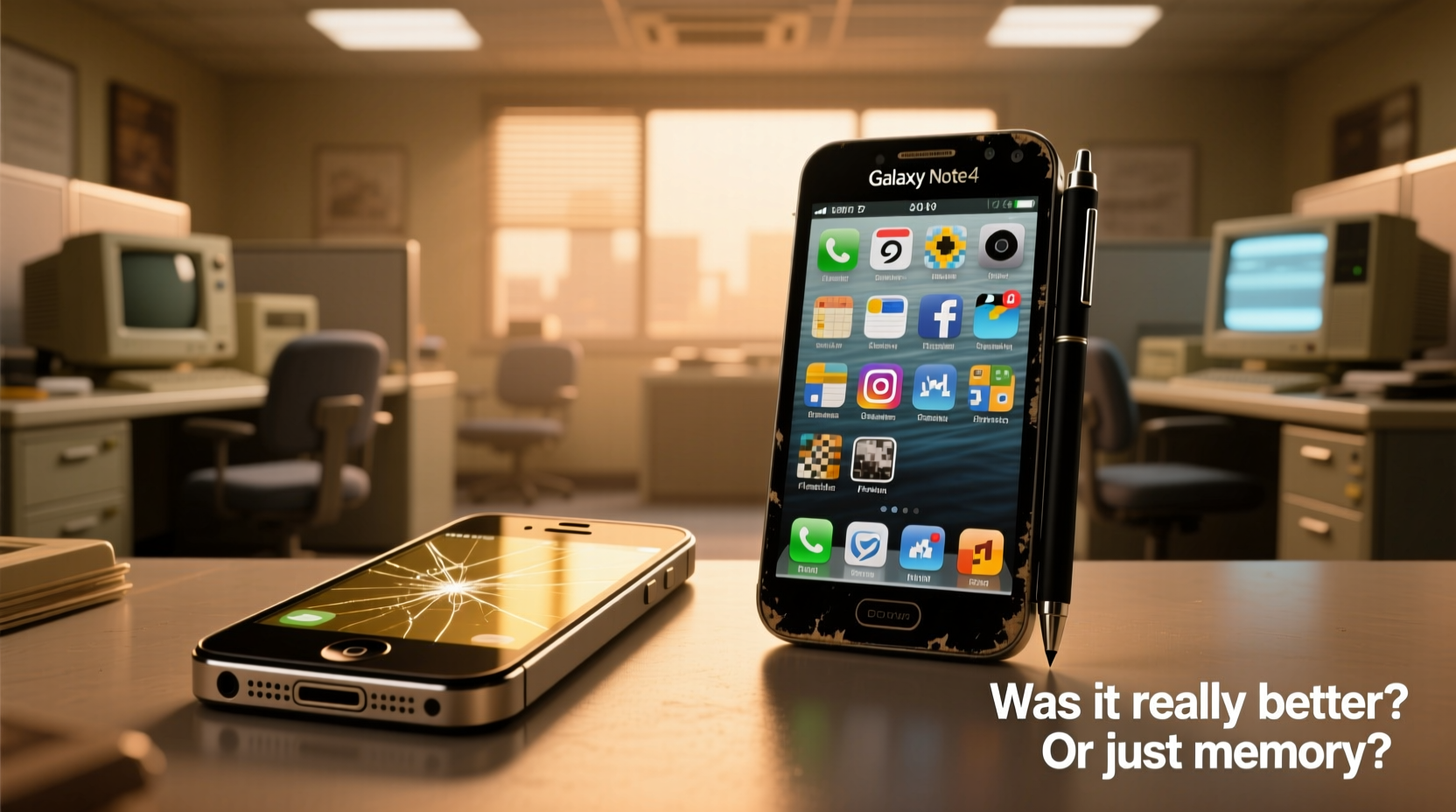
First, let’s clarify the timeline. The iPhone 4s debuted in October 2011. It featured a dual-core A5 chip, 512MB of RAM, and a 3.5-inch Retina display. By contrast, the Galaxy Note 4 arrived nearly three years later, in September 2014. It packed a quad-core Snapdragon 805 (or Exynos 5433), 3GB of RAM, and a 5.7-inch Quad HD Super AMOLED screen. Comparing them directly is like pitting a 2011 sedan against a 2014 sports car—different leagues, different expectations.
Yet, many users today reflect on the Galaxy Note 4 as a turning point—a device that felt “future-ready” in ways the iPhone 4s never could. But was that due to actual superiority, or the excitement of new technology at the time?
Hardware & Performance: A Clear Winner?
On paper, the Galaxy Note 4 dominates. Its 3GB of RAM allowed for smoother multitasking than the iPhone 4s’ 512MB. The 16-megapixel rear camera on the Note 4 outclassed the iPhone 4s’ 8MP sensor, especially in low-light conditions thanks to optical image stabilization. And the 5.7-inch QHD display offered four times the resolution of the iPhone 4s’ screen.
But raw specs don’t tell the whole story. iOS on the iPhone 4s remained snappy and responsive throughout its lifecycle, even as newer apps demanded more resources. Apple’s tight hardware-software integration ensured efficient performance despite lower specs. Meanwhile, some early Android devices—even high-end ones like the Note 4—could feel sluggish under heavy use due to background processes and inconsistent app optimization.
The S Pen on the Note 4 was a standout feature. It wasn’t just a stylus; it enabled screenshot annotations, quick notes, and precise drawing. For creatives and productivity users, this added tangible value. The iPhone 4s had no equivalent—Apple wouldn’t embrace external input tools until years later with the iPad Pencil.
“Samsung didn’t just make a bigger phone—they redefined what a mobile device could do with the S Pen and multi-window features.” — David Kim, Mobile Tech Analyst at GadgetInsight
User Experience & Ecosystem Comparison
iOS 5 on the iPhone 4s emphasized simplicity, consistency, and ease of use. Notifications were centralized, Siri made her debut, and iCloud began syncing data across devices. The App Store, though smaller than today, offered well-polished applications with uniform design standards.
Android 4.4 KitKat on the Galaxy Note 4 provided far more customization. Users could modify home screens, default apps, and system behaviors. Features like split-screen multitasking (a rarity at the time) gave the Note 4 a productivity edge. However, this flexibility came at the cost of fragmentation—updates were slow, and app quality varied more widely.
One area where the iPhone 4s still holds up surprisingly well is longevity. Many units continued running core functions smoothly into the late 2010s, supported by iOS updates until iOS 9. The Note 4, despite its power, received only two major Android updates (to Lollipop and Marshmallow), limiting long-term usability.
Specs Showdown: iPhone 4s vs Galaxy Note 4
| Feature | iPhone 4s | Galaxy Note 4 |
|---|---|---|
| Release Date | October 2011 | September 2014 |
| Display | 3.5\" IPS LCD, 960x640 (326 ppi) | 5.7\" QHD Super AMOLED (515 ppi) |
| Processor | Apple A5 (Dual-core) | Snapdragon 805 / Exynos 5433 (Quad-core) |
| RAM | 512 MB | 3 GB |
| Rear Camera | 8 MP, f/2.4 | 16 MP, f/2.2, OIS |
| Front Camera | 0.3 MP | 3.7 MP |
| Battery | 1432 mAh | 3220 mAh |
| OS at Launch | iOS 5 | Android 4.4.4 + TouchWiz |
| Software Updates | 5 major versions (iOS 5–9) | 2 major versions (KitKat → Marshmallow) |
| Premium Feature | Siri debut | S Pen, split-screen, heart rate sensor |
Nostalgia vs. Reality: Why We Remember Differently
Nostalgia plays a powerful role in how we remember technology. For many, the Galaxy Note 4 symbolized the peak of Android ambition—a device that pushed boundaries in size, functionality, and personalization. It was part of a wave of innovation that included curved edges, advanced cameras, and fitness tracking.
Conversely, the iPhone 4s is remembered fondly for introducing Siri and delivering a refined version of a beloved design. But it also marked the end of an era—the last iPhone with a 3.5-inch screen, the last with a physical glass front panel over the display.
Realistically, the Galaxy Note 4 was the more capable device in almost every measurable way—but not necessarily the better daily driver for all users. Those who valued battery life, screen real estate, and multitasking likely preferred the Note. But fans of smooth animations, consistent software, and app ecosystem reliability often stuck with iOS.
Mini Case Study: Two Users, Two Perspectives
Consider two hypothetical users from 2014. Mark, a college student, bought the Galaxy Note 4 for its large screen, which made reading textbooks and taking notes with the S Pen easier. He used split-screen to compare sources and appreciated the removable battery for long study sessions.
Jamie, a freelance photographer, kept her iPhone 4s even in 2014 because she relied on specific iOS-only editing apps that hadn’t been ported to Android. While she admired the Note 4’s camera specs, she trusted the color accuracy and workflow consistency of her iPhone.
This illustrates a key truth: superiority depends on use case. There was no universal \"better\"—only what worked best for individual needs.
What We Got Right—and Wrong—in the Hype
In 2014, tech media celebrated the Galaxy Note 4 as a flagship killer. Reviewers praised its display, build quality, and feature set. But some overlooked its heft, software bloat from TouchWiz, and average battery degradation over time.
Meanwhile, critics dismissed the iPhone 4s by 2014 as outdated. But millions still used it effectively. Apple’s focus on backward compatibility meant that even older devices ran new iOS versions reasonably well—something Android struggled with for years.
Frequently Asked Questions
Could the iPhone 4s compete with the Galaxy Note 4 in 2014?
No, not in hardware. By 2014, the iPhone 4s was three years old and lacked modern capabilities like high-resolution displays, ample RAM, or advanced cameras. However, it still functioned well for basic tasks and retained value for users invested in the iOS ecosystem.
Was the S Pen a gimmick or a game-changer?
For most users, it was a niche tool. But for students, artists, and professionals needing precise input, it was invaluable. Samsung’s continued investment in the S Pen across generations proves its staying power.
Which phone aged better?
The iPhone 4s aged more gracefully in terms of software support and consistent performance. The Note 4, while powerful, suffered from shorter update cycles and faster battery wear, limiting its lifespan for many users.
Final Thoughts: Legacy Over Specs
Looking back, the Galaxy Note 4 was clearly the more advanced phone in 2014. But calling it “much better” than the iPhone 4s ignores timing, audience, and purpose. They served different roles in the evolution of mobile computing.
The Note 4 represented Android’s confidence—bold, experimental, feature-rich. The iPhone 4s stood for refinement—focused, intuitive, reliable. Nostalgia may amplify the Note 4’s reputation, but it doesn’t diminish its achievements. At the same time, the iPhone 4s deserves credit for proving that thoughtful design can outweigh raw power.
Ultimately, both devices shaped the smartphones we use today. The Note 4 pushed the industry toward larger screens and stylus integration. The iPhone 4s cemented voice assistants and tight ecosystem integration as standard expectations.




 浙公网安备
33010002000092号
浙公网安备
33010002000092号 浙B2-20120091-4
Comments
No comments yet. Why don't you start the discussion?