
In 2015, smartphone debates were at their peak. Apple’s iPhone 5—though technically from 2012—was still widely used, while Samsung’s Galaxy Note 5 represented the cutting edge of Android innovation. Comparing a three-year-old flagship to a brand-new powerhouse seems unfair on paper. But in practice, user experience doesn’t always follow specs. So, was the Galaxy Note 5 truly that much better than the iPhone 5? The answer isn't just about megapixels or RAM—it's about how these devices served real users.
Design and Build: Glass vs Aluminum
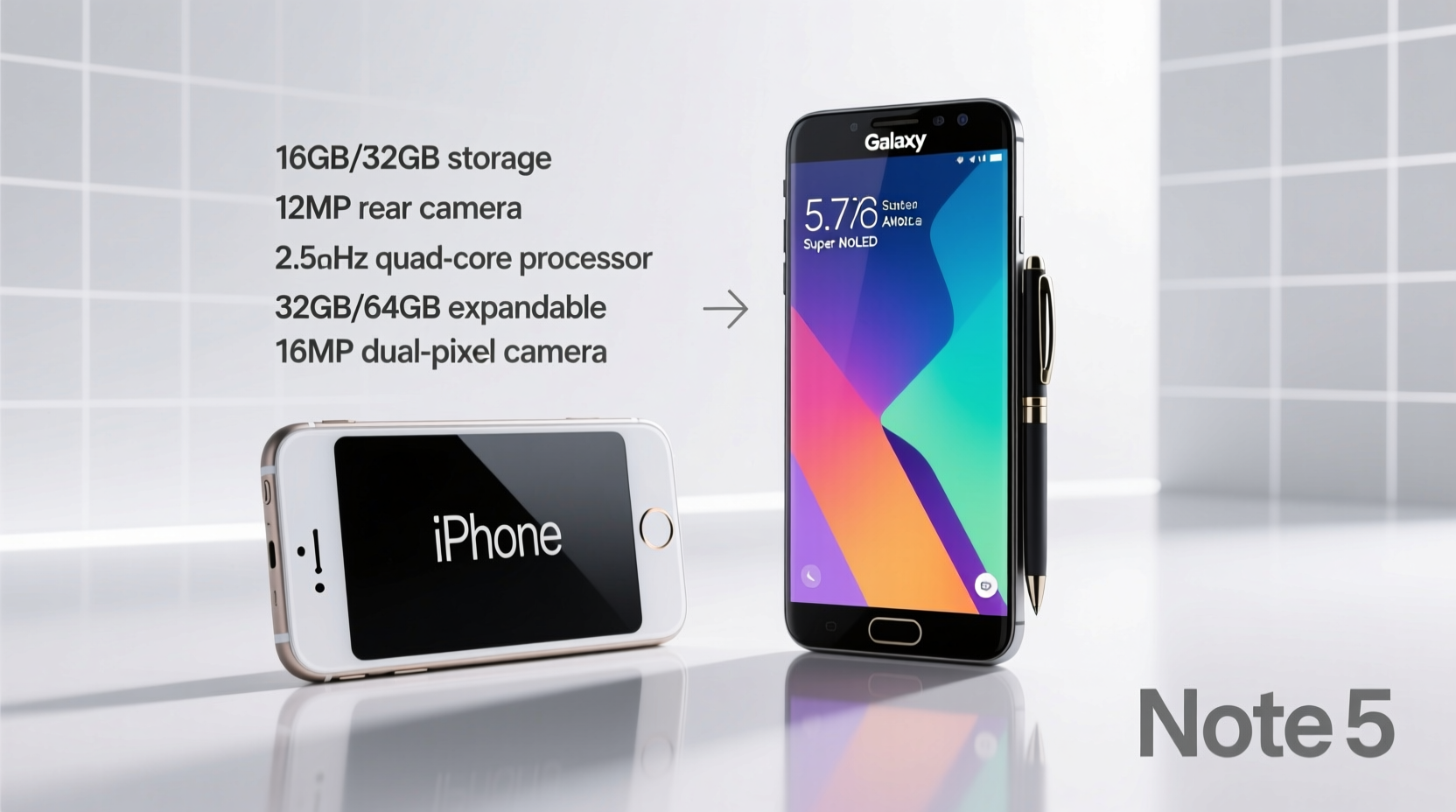
The iPhone 5 introduced Apple’s first aluminum unibody design, replacing the glass back of earlier models. At the time, it felt like a leap forward—lightweight, sleek, and durable for its size. Measuring 4.87 x 2.31 x 0.3 inches and weighing just 112g, it fit comfortably in one hand. Its 4-inch display with a 16:9 aspect ratio made navigation intuitive, especially for users transitioning from older iPhones.
In contrast, the Galaxy Note 5 arrived with a bold, premium aesthetic. It featured a glass front and back with an aluminum frame, supporting wireless charging—a rarity then. However, its 5.7-inch Quad HD Super AMOLED screen pushed it into \"phablet\" territory, measuring 6.04 x 3.07 x 0.3 inches and weighing 171g. This made single-handed use difficult, but rewarded users with immersive media consumption and multitasking capabilities.
Performance and Software: iOS Efficiency vs Android Power
The iPhone 5 ran on Apple’s A6 chip with 1GB of RAM. By 2015, this configuration struggled with newer versions of iOS, particularly iOS 8 and 9. Apps launched slower, multitasking became clunky, and background processes often reset. Yet, iOS’s tight hardware-software integration meant the iPhone 5 remained surprisingly responsive for basic tasks like calling, texting, and light browsing.
The Galaxy Note 5, equipped with Samsung’s Exynos 7420 (or Snapdragon 808 in some regions), 4GB of RAM, and Android 5.1.1 Lollipop, was a beast in comparison. It handled high-end games, split-screen apps, and heavy web browsing with ease. The addition of the S Pen opened new workflows—quick notes, screen annotations, and Air Command shortcuts gave it a unique productivity edge.
“Hardware power means little without optimization. The iPhone 5 showed that even outdated specs could deliver a smooth experience—if the software respects the device.” — David Lin, Mobile Systems Analyst
Camera Comparison: Simplicity vs Flexibility
The iPhone 5 featured an 8MP rear camera with improved backside illumination and a f/2.4 aperture. While modest by today’s standards, its image processing algorithms produced consistent, natural-looking photos with accurate colors and good dynamic range in daylight. Low-light performance was average, and video capped at 1080p at 30fps.
The Galaxy Note 5 upgraded to a 16MP sensor with OIS, an f/1.9 aperture, and advanced HDR. It captured sharper images with better detail, especially in low light. Its video recording supported 4K, a major selling point at the time. Front-facing cameras also diverged sharply: 1.2MP on the iPhone 5 versus 5MP on the Note 5, making selfies and video calls noticeably clearer.
| Feature | iPhone 5 | Galaxy Note 5 |
|---|---|---|
| Processor | A6 | Exynos 7420 / Snapdragon 808 |
| RAM | 1GB | 4GB |
| Display | 4\" IPS LCD, 640x1136 | 5.7\" QHD AMOLED, 1440x2560 |
| Rear Camera | 8MP, f/2.4, 1080p video | 16MP, f/1.9, OIS, 4K video |
| Front Camera | 1.2MP | 5MP |
| Battery | 1440mAh | 3000mAh |
| S Pen | No | Yes |
| Storage Options | 16/32/64GB (non-expandable) | 32/64GB (non-expandable) |
User Experience: Real-World Use Case
Consider Sarah, a college student in 2015. She inherited her brother’s iPhone 5 and used it for two years—email, social media, music, and occasional photography. It worked well enough, though she noticed slowdowns after updating to iOS 9. When she saved up for a new phone, she bought the Galaxy Note 5.
The change was dramatic. Her essays were easier to write using the S Pen’s quick memo feature. Watching lectures on the larger screen reduced eye strain. Multitasking between her browser and note-taking app doubled her efficiency. But she missed the iPhone’s compactness—dropping the Note 5 was a constant fear, and pockets had to be rethought.
This case illustrates a broader truth: “Better” depends on context. For users needing maximum functionality, the Note 5 was clearly superior. For those prioritizing simplicity, pocketability, and long-term reliability, the iPhone 5 still held value—even years later.
Battery Life and Charging: Endurance vs Innovation
The iPhone 5’s 1440mAh battery lasted about a day with moderate use. Without fast charging, a full recharge took over two hours. There was no option to replace the battery easily, so longevity depended heavily on charging habits.
The Note 5’s 3000mAh battery offered significantly longer life—up to 1.5 days under normal conditions. It supported both fast charging and wireless charging, features that felt futuristic at the time. However, Samsung controversially removed user-replaceable batteries, a move criticized by repair advocates.
FAQ
Could the iPhone 5 run modern apps in 2015?
Limitedly. Many newer apps either didn’t support iOS 6–7 (the last compatible versions) or ran poorly due to hardware constraints. App updates slowed down or stopped entirely by late 2015.
Was the S Pen worth it on the Note 5?
For students, artists, and professionals, yes. It enabled handwriting conversion, screen-off notes, and precise editing. Casual users might not have used it daily, but it added unique functionality no iPhone offered.
Which phone had better long-term software support?
The iPhone 5 received iOS updates until iOS 10 (2016), which severely hampered performance. The Note 5 got Android updates up to Nougat (Android 7), with security patches for several years. Neither offered long-term fluidity, but the Note 5 maintained usability longer.
Checklist: Choosing Between Legacy and Innovation
- ✅ Assess your primary use: communication, media, productivity?
- ✅ Consider pocket size and one-handed operation needs
- ✅ Evaluate how important camera quality and video resolution are
- ✅ Decide if stylus functionality adds value to your workflow
- ✅ Think about battery life and charging convenience
- ✅ Factor in app compatibility and future-proofing
Conclusion: Was the Note 5 Really That Much Better?
In raw specifications and technological advancement, the Galaxy Note 5 was undeniably superior. It offered a faster processor, more RAM, a higher-resolution display, better cameras, and innovative features like the S Pen and wireless charging. For users ready to embrace a larger device, it represented the future of mobile computing in 2015.
But the iPhone 5 wasn’t obsolete. Its build quality, iOS optimization, and compact design still appealed to many. It proved that thoughtful engineering can extend a device’s relevance beyond its technical age. For users who valued simplicity and reliability over power, the iPhone 5 remained a viable choice.
So yes—the Note 5 was much better in almost every measurable way. But “better” only matters if it aligns with how you use your phone. Technology should serve the user, not the other way around.




 浙公网安备
33010002000092号
浙公网安备
33010002000092号 浙B2-20120091-4
Comments
No comments yet. Why don't you start the discussion?