
For years, the iPhone 5s was a benchmark of reliability and performance in Apple’s lineup. Released in 2013, it remained a favorite among users who valued simplicity, longevity, and iOS consistency. Fast forward to today, and many long-time 5s owners are considering whether upgrading to an iPhone 8 — released five years later in 2017 — is truly worth the investment. While both phones share a similar aesthetic DNA, the technological gap between them is far wider than their physical resemblance suggests.
The decision to upgrade isn’t just about new features; it’s about usability, security, app compatibility, and future-proofing. As developers phase out support for older devices and iOS versions, even reliable hardware like the 5s begins to show its age. This article breaks down the key differences between the iPhone 5s and iPhone 8, evaluates real-world performance, and helps you decide if stepping up to the 8 delivers meaningful improvements or simply incremental changes.
Design and Build: Evolution Without Revolution
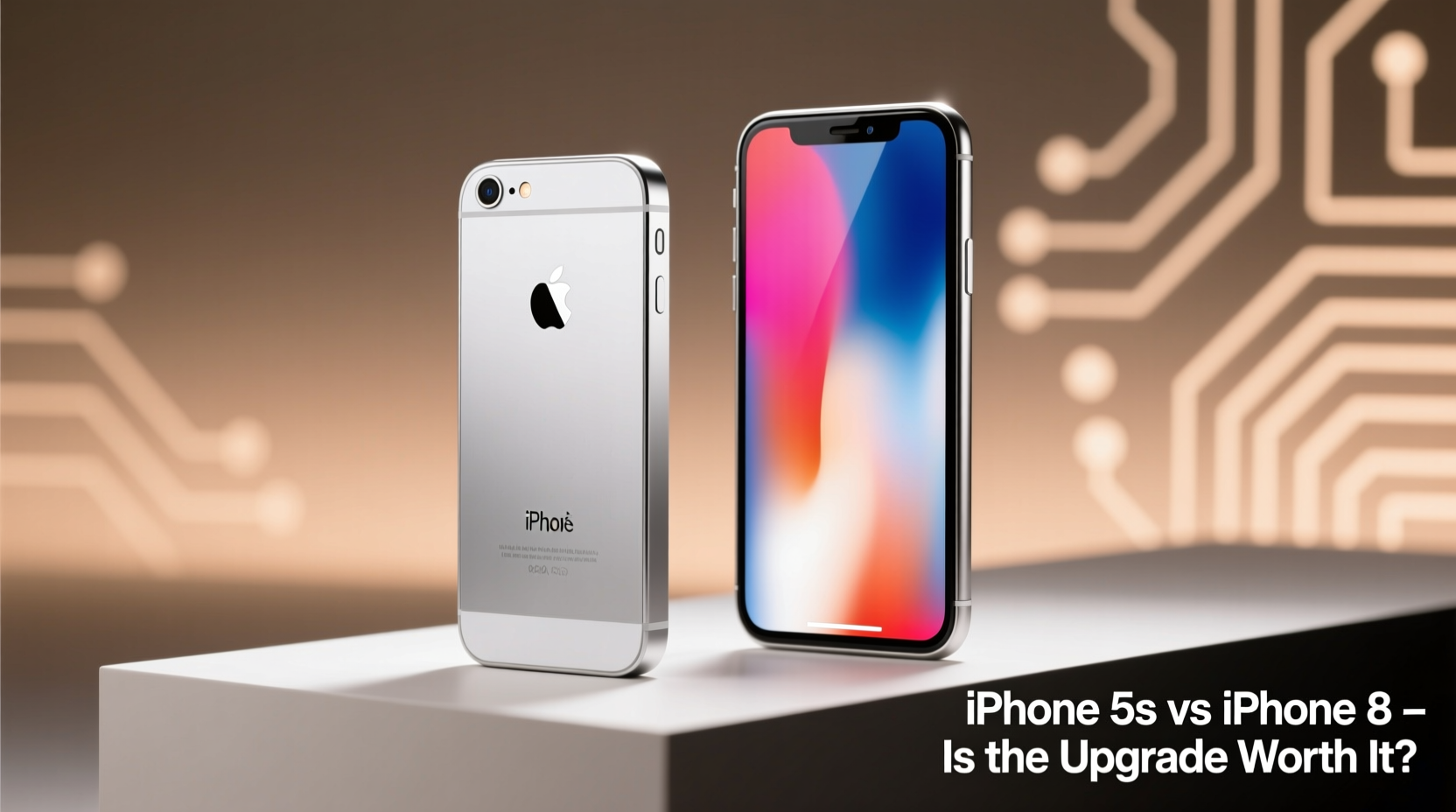
At first glance, the iPhone 5s and iPhone 8 look strikingly similar. Both feature aluminum bodies, physical home buttons, and nearly identical screen sizes (4.0 inches on the 5s vs. 4.7 inches on the 8). However, closer inspection reveals significant upgrades in materials and durability.
The iPhone 8 introduced a glass back, enabling wireless charging — a feature absent in the 5s. This also made the 8 slightly heavier and more prone to cracking if dropped, but Apple reinforced it with stronger glass and improved structural integrity. The front is protected by ion-strengthened glass, and the entire device is rated IP67 for dust and water resistance, meaning it can survive submersion in up to 1 meter of water for 30 minutes. The 5s has no such protection.
Performance and Hardware: A Quantum Leap
The most dramatic difference lies under the hood. The iPhone 5s runs on the A7 chip, a 64-bit processor that was groundbreaking in 2013 but now struggles with modern apps. By contrast, the iPhone 8 features the A11 Bionic chip — a six-core CPU with neural engine support, delivering over four times the CPU performance and eight times the graphics power of the A7.
This leap translates into real-world benefits: faster app launches, smoother multitasking, better gaming performance, and longer software support. iOS updates are optimized for newer chips, and as of 2023, the 5s hasn’t received a major iOS update since iOS 12. The iPhone 8 supports iOS 16 and may receive security patches into 2024.
“Upgrading from an A7-based device to an A11 is like switching from dial-up internet to broadband. The responsiveness alone makes everyday tasks feel effortless.” — Mark Tran, Mobile Performance Analyst at TechPulse Labs
Camera Comparison: From Decent to Competitive
Photography has evolved significantly between these models. The iPhone 5s features an 8MP rear camera without autofocus priority, flash improvements, or stabilization. Low-light performance is poor, and video maxes out at 1080p at 30fps.
The iPhone 8 improves on every front: a 12MP sensor with optical image stabilization (OIS), True Tone flash, Portrait mode (via software), and 4K video recording at 30fps or 1080p at 60fps. Front-facing video quality is also sharper, making FaceTime calls and selfies noticeably better.
| Feature | iPhone 5s | iPhone 8 |
|---|---|---|
| Rear Camera | 8MP, no OIS | 12MP, OIS |
| Front Camera | 1.2MP | 7MP |
| Video Recording | 1080p @ 30fps | 4K @ 30fps / 1080p @ 60fps |
| Portrait Mode | No | Yes (software-based) |
| Flash | Single LED | True Tone Quad-LED |
If you regularly take photos or record videos, the iPhone 8 offers a tangible upgrade in clarity, dynamic range, and versatility.
Battery Life and Charging: Incremental Gains
Battery life on the iPhone 8 is modestly better than the 5s — not because of a massive capacity increase, but due to more efficient hardware. Apple claims up to 13 hours of video playback on the 8, compared to around 10 on the 5s. In daily mixed use, the 8 typically lasts a full day, while the 5s often requires midday charging, especially with iOS bloat and aging batteries.
More importantly, the iPhone 8 supports faster charging (with a compatible adapter) and Qi wireless charging. These conveniences add flexibility, particularly for users who rely on public charging stations or want to reduce cable clutter.
Real-World Example: Sarah’s Upgrade Journey
Sarah had used her iPhone 5s since 2014. It worked fine for calls, texts, and light browsing — until she started noticing issues. Apps like Instagram and WhatsApp began crashing. Safari froze when loading news sites. Even typing in Messages felt delayed. After replacing the battery twice, she finally upgraded to a refurbished iPhone 8.
Her experience changed immediately. Maps loaded instantly. Photos uploaded to iCloud without freezing. She could finally join Zoom meetings without lag. “It’s still small enough to use one-handed,” she said, “but everything just works now.” For Sarah, the upgrade wasn’t about luxury — it was about functionality.
Checklist: Is It Time to Upgrade?
Ask yourself the following before deciding:
- Do apps frequently crash or run slowly?
- Have you stopped receiving iOS updates?
- Is your battery draining within half a day?
- Do you struggle with low-light photos or video quality?
- Are you unable to use modern features like iMessage effects, Animoji, or AR apps?
- Do websites fail to load properly or render incorrectly?
If three or more apply, the iPhone 8 represents a justified step forward.
FAQ
Can the iPhone 5s still be used in 2024?
Technically, yes — for basic functions like calling, texting, and offline music. However, lack of app and OS updates limits web browsing, social media, banking apps, and security. Many services now require newer iOS versions.
Is the iPhone 8 still supported by Apple?
Apple no longer sells the iPhone 8 new, but it continues to receive periodic security updates. As of late 2023, it supports iOS 16 and may get patches into 2024. Major feature updates have ended, but core functionality remains secure.
Should I upgrade to iPhone 8 or skip to a newer model?
If budget allows, consider iPhone SE (3rd gen) or iPhone 11. They offer 5G, better cameras, longer support, and newer chips. But if you prefer a compact design and lower cost, the iPhone 8 remains a capable middle ground between legacy and modern iOS devices.
Conclusion: Worth It for Functionality, Not Just Features
The iPhone 8 isn’t a radical departure from the 5s in form, but it’s a transformative upgrade in function. The combination of a faster processor, better camera, water resistance, wireless charging, and extended software support makes it a compelling successor — especially for users whose 5s is struggling with daily demands.
While newer iPhones offer more advanced capabilities, the 8 strikes a rare balance: modern performance in a familiar size and shape. For long-time 5s users hesitant about change, it provides a smooth transition without forcing adaptation to large screens or gesture navigation.




 浙公网安备
33010002000092号
浙公网安备
33010002000092号 浙B2-20120091-4
Comments
No comments yet. Why don't you start the discussion?