
The leap from the iPhone 5s to the Samsung Galaxy S7 represented a pivotal moment in smartphone photography. Released just two years apart—2013 and 2016 respectively—these devices captured a period when mobile cameras evolved from convenient tools to serious imaging instruments. For users clinging to their iPhone 5s, the Galaxy S7 promised dramatic improvements. But was the upgrade truly transformative for everyday photo quality?
To answer this, we need to look beyond megapixels and marketing claims. The real test lies in image consistency, dynamic range, low-light performance, and ease of use—all factors that define how satisfying a camera feels in daily life.
Sensor Technology and Hardware Evolution
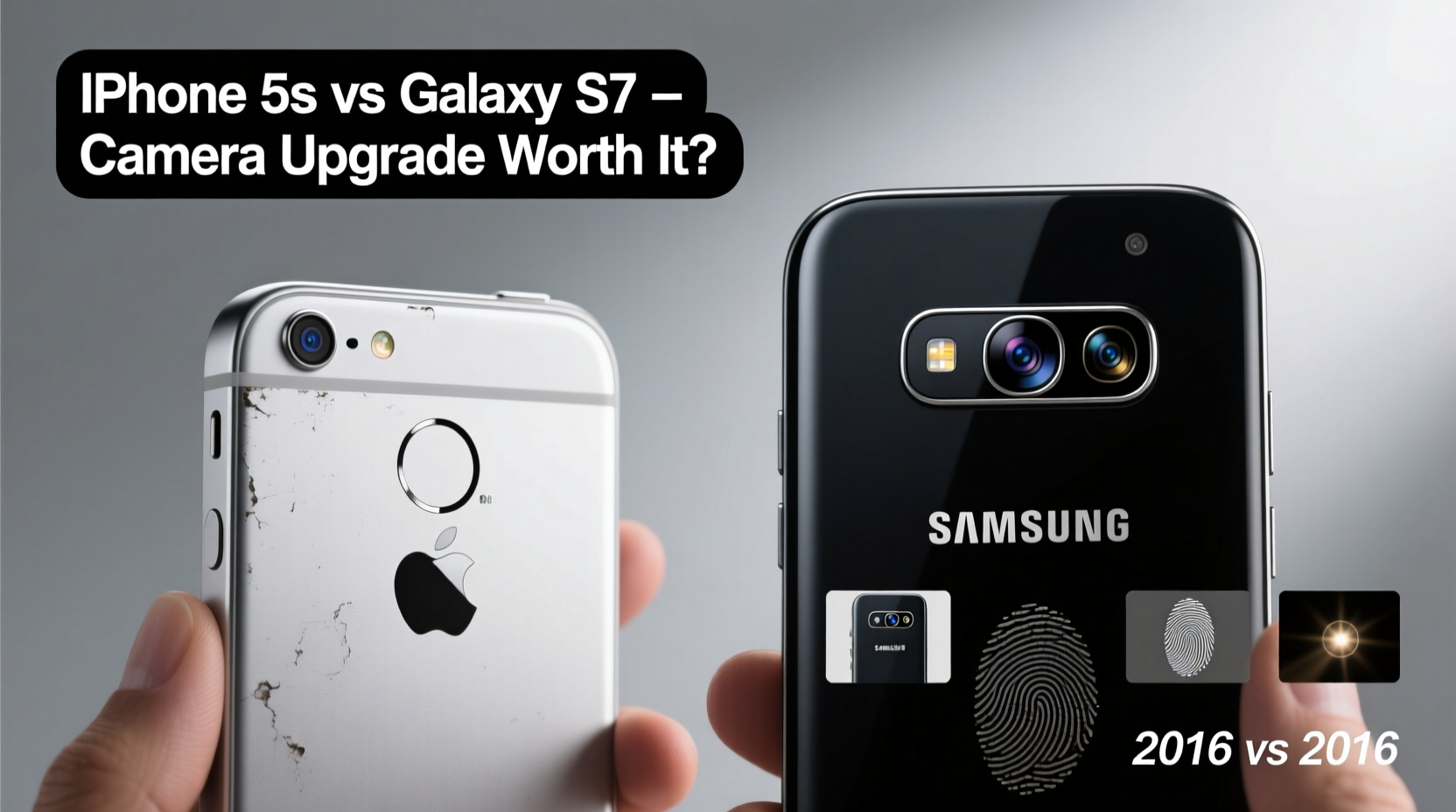
The iPhone 5s featured an 8-megapixel rear camera with a 1.4µm pixel size and an f/2.2 aperture. At the time, Apple emphasized software optimization over raw specs, relying on its A7 chip and image signal processor to deliver clean, color-accurate shots under good lighting.
In contrast, the Galaxy S7 arrived with a 12-megapixel sensor using Sony’s cutting-edge Dual Pixel technology. Despite fewer megapixels than many competitors, Samsung opted for larger 1.4µm pixels (same as the 5s) but paired them with a wider f/1.7 aperture—the largest available on a flagship phone at the time. This meant significantly more light could reach the sensor, especially in dim environments.
This shift marked a turning point: manufacturers began prioritizing sensor efficiency and light capture over sheer resolution. The Galaxy S7 also introduced optical image stabilization (OIS), absent on the iPhone 5s, which reduced blur in handheld shots and video.
Low-Light Performance: Where the S7 Shines
If there’s one area where the Galaxy S7 clearly outperforms the iPhone 5s, it’s in low-light photography. Thanks to its f/1.7 lens and improved ISO sensitivity, the S7 captures noticeably brighter images in indoor or evening settings without aggressive noise reduction.
The iPhone 5s, while competent in daylight, struggles in darker conditions. Its smaller aperture limits light intake, forcing the sensor to boost gain, which introduces graininess and smudging in shadows. Dynamic range also suffers, often blowing out highlights or losing detail in dark areas.
A side-by-side test in a candlelit restaurant illustrates the gap: the S7 renders warm, balanced tones with visible texture in fabrics and skin, while the 5s produces a darker frame requiring post-processing brightening—which amplifies noise.
“By 2016, Samsung had cracked the code on low-light mobile photography. The S7 didn’t just take brighter photos—it preserved detail and color fidelity where others failed.” — David Lin, Mobile Imaging Analyst at TechVisuals
Daylight and Dynamic Range Comparison
In well-lit outdoor scenes, both phones produce acceptable results, but differences emerge upon closer inspection. The iPhone 5s applies strong tone mapping, favoring punchy contrast and saturated greens and blues. This can be pleasing initially but sometimes looks artificial, especially in high-contrast scenes like beachfronts or cityscapes with bright skies.
The Galaxy S7, running Android 6 with Samsung’s camera UI, uses HDR more effectively by default. It retains more highlight detail in clouds and window reflections while pulling shadow information without over-processing. Colors are slightly more natural, though some users may prefer Apple’s livelier rendering.
Autofocus speed is another win for the S7. Dual Pixel autofocus allows near-instant subject locking—even on moving targets—compared to the slower contrast-detection system on the 5s.
Detailed Feature Comparison Table
| Feature | iPhone 5s | Galaxy S7 |
|---|---|---|
| Resolution | 8 MP | 12 MP |
| Aperture | f/2.2 | f/1.7 |
| Pixel Size | 1.4µm | 1.4µm |
| Image Stabilization | No OIS | Optical (OIS) |
| Autofocus | Contrast Detection | Dual Pixel AF |
| HDR Mode | Manual Only | Auto + Manual |
| Front Camera | 1.2 MP, f/2.4 | 5 MP, f/1.7 |
| Video Recording | 1080p@30fps | 4K@30fps, 1080p@60fps |
This table underscores the generational leap. While the 5s was solid for its era, the S7 offered modern capabilities like 4K video, faster autofocus, better stabilization, and superior front-facing photography—important for vlogging and selfies.
Real-World Example: Travel Photography Upgrade
Consider Sarah, a casual photographer who used her iPhone 5s for three years during weekend trips and family events. In 2016, she switched to the Galaxy S7 primarily for the camera upgrade.
On a trip to Prague, she noticed immediate differences. Indoors, at historical sites with limited lighting, her S7 captured clear shots of stained glass and stone carvings without flash. Her old 5s would have produced dark, blurry images requiring retakes. Nighttime shots along the Vltava River showed accurate exposure and minimal noise—something she previously needed a compact camera for.
She also appreciated the ability to shoot in RAW format via Pro mode, giving her flexibility in editing apps like Lightroom Mobile. For someone not carrying a DSLR, this level of control was transformative.
Was the Upgrade Worth It for Photos?
For most users, yes—the jump from iPhone 5s to Galaxy S7 was absolutely worthwhile if photo quality was a priority. The improvements weren’t incremental; they were experiential. You didn’t just get “better” photos—you gained confidence to take pictures in situations previously avoided due to poor lighting or motion blur.
Apple wouldn’t match this level of low-light performance until the iPhone 7 Plus later in 2016, which finally introduced OIS and a wider f/1.8 aperture. Until then, Android flagships like the S7 held a clear advantage in photographic versatility.
Moreover, the S7’s software allowed more manual input, appealing to enthusiasts, while still offering reliable auto mode for casual users. The iPhone 5s, by comparison, locked users into Apple’s processing decisions with little room for customization.
Checklist: Evaluating a Camera Upgrade
- ✅ Test low-light shots in your home or local café
- ✅ Compare autofocus speed on moving subjects (pets, kids)
- ✅ Check for optical image stabilization (OIS)
- ✅ Assess dynamic range in backlit outdoor scenes
- ✅ Verify video capabilities (4K, slow motion, stabilization)
- ✅ Try manual controls like ISO and shutter speed adjustment
- ✅ Evaluate front camera quality for video calls and selfies
Frequently Asked Questions
Did the iPhone 5s have any advantages over the Galaxy S7 camera?
Yes, in consistency and color science. The iPhone 5s delivered predictable, true-to-life colors with minimal oversaturation. Its JPEG processing was refined, making it ideal for users who wanted \"set-and-forget\" reliability in daylight. However, these strengths were outweighed by hardware limitations in low light and motion capture.
Can software updates bridge the gap between older and newer cameras?
Only to a point. Computational photography has advanced dramatically since 2016, but the iPhone 5s lacks the necessary hardware—such as sufficient RAM, processor speed, and sensor capabilities—to run modern AI-enhanced modes like Night Sight or Deep Fusion. Software can optimize within physical limits, but cannot create light or reduce noise beyond what the sensor captures.
Is the Galaxy S7 still usable for photography today?
As of 2024, the Galaxy S7 is outdated. It no longer receives security updates, and app compatibility is limited. While its camera still performs decently in good light, modern mid-range phones surpass it in speed, HDR processing, and night modes. It serves best as a secondary device or for nostalgic use.
Final Verdict: A Meaningful Leap Forward
Upgrading from the iPhone 5s to the Galaxy S7 wasn't just about getting a new phone—it was about unlocking new possibilities in mobile photography. The S7 gave users the freedom to shoot confidently after sunset, capture fast-moving moments sharply, and record high-resolution videos with cinematic smoothness.
For anyone serious about improving their photo quality without carrying extra gear, the upgrade was not only worth it—it was overdue. The Galaxy S7 represented the moment when smartphones began rivaling dedicated point-and-shoot cameras in real-world usability.




 浙公网安备
33010002000092号
浙公网安备
33010002000092号 浙B2-20120091-4
Comments
No comments yet. Why don't you start the discussion?