
The iPhone 5s was a landmark device in Apple’s smartphone evolution—its Touch ID sensor, 64-bit processor, and improved iSight camera set new standards for mid-tier smartphones in 2013. Fast forward to the release of the iPhone SE (first generation, 2016), and Apple positioned it as a spiritual successor: compact form factor, powerful internals, and crucially, a major leap in camera technology. But if you're still holding onto your trusty 5s, is upgrading to the SE justifiable purely for the camera improvements? The answer isn’t just about megapixels—it’s about real-world usability, low-light performance, video capabilities, and software enhancements that change how you capture moments.
Camera Hardware: A Generational Leap
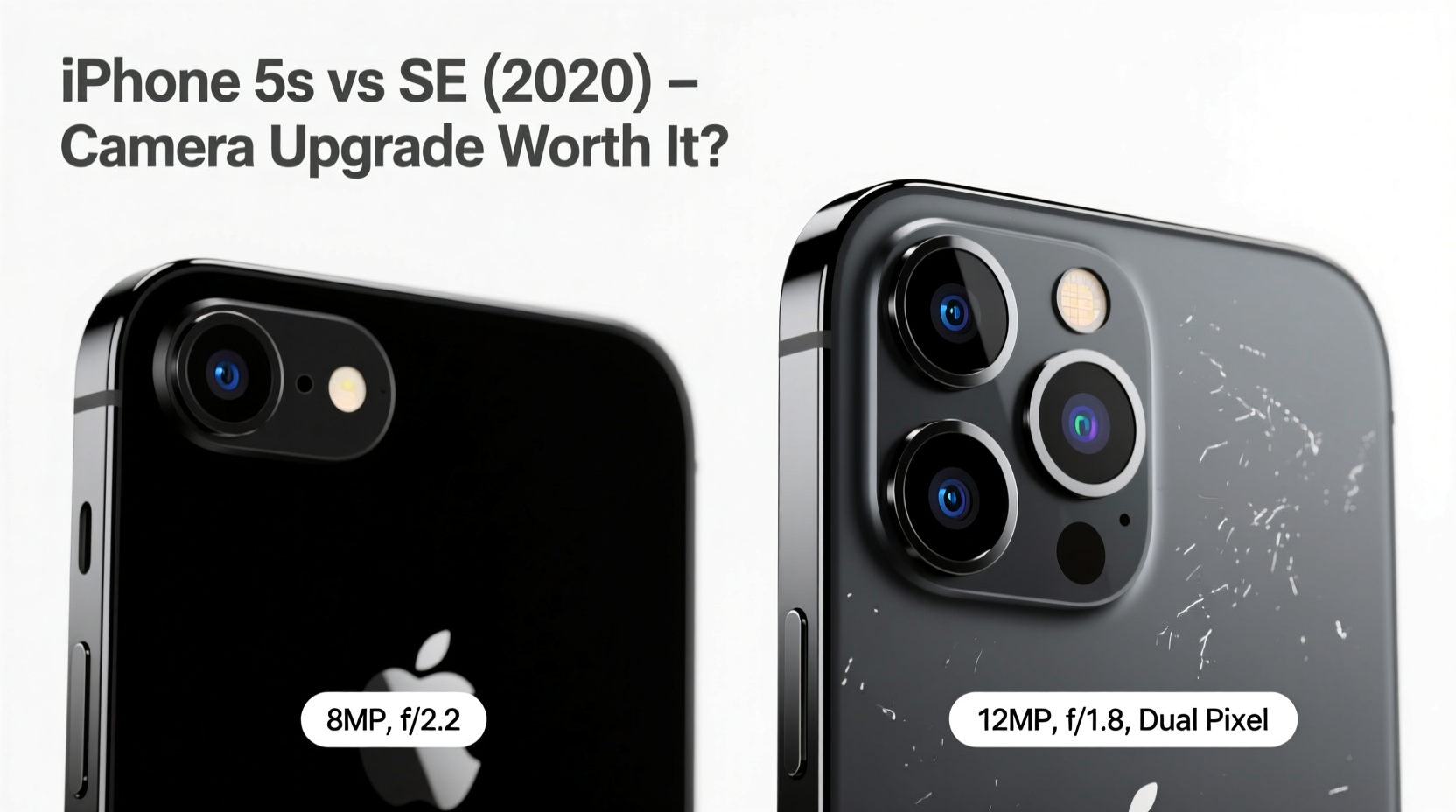
On paper, both devices feature 12-megapixel rear cameras, but this similarity is misleading. The iPhone 5s came with an 8-megapixel sensor lacking advanced focusing systems, optical image stabilization, or sophisticated computational photography. In contrast, the iPhone SE (2016) borrowed its entire camera module from the iPhone 6s—one of the most significant upgrades Apple had made up to that point.
The key hardware differences include:
- Sensor size and pixel quality: The SE uses a larger sensor with 1.22µm pixels compared to the 5s’s 1.4µm pixels—but thanks to improved backside illumination and processing, dynamic range and color accuracy are superior.
- Autofocus system: The SE supports Focus Pixels (Apple's version of phase detection autofocus), enabling faster lock-on and better subject tracking. The 5s relies solely on contrast detection, which often results in hunting and slower captures.
- True Tone flash: While both have dual LED flashes, the SE’s True Tone adjusts white balance using two different colored LEDs, producing more natural skin tones in low light.
- Aperture: The SE features an f/2.2 aperture, slightly wider than the 5s’s f/2.4, allowing more light intake—critical in dim environments.
Photo Quality Comparison: Real-World Results
When comparing sample photos side by side, the differences become immediately apparent. The iPhone SE consistently delivers sharper details, especially around edges and textures like fabric or foliage. Noise reduction is far more effective; images from the 5s tend to look grainy or smeared when pushed beyond daylight conditions.
In daylight, both phones can produce acceptable shots, but the SE exhibits richer color reproduction, better exposure balancing, and improved HDR processing. Shadows retain detail without blowing out highlights—a hallmark of Apple’s enhanced image signal processor introduced with the A9 chip.
Nighttime photography is where the gap widens dramatically. The combination of Focus Pixels, better noise algorithms, and True Tone flash means the SE can capture usable photos in situations where the 5s would return blurry, underexposed messes. Even without Night mode (which didn’t exist until years later), the SE manages surprisingly clean results indoors or during dusk.
“Even without flashy marketing terms like 'Night Mode,' the jump from iPhone 5s to SE represents one of the most tangible camera improvements in Apple’s history.” — David Kim, Mobile Imaging Analyst at TechLens Review
Detailed Feature Comparison Table
| Feature | iPhone 5s | iPhone SE (2016) |
|---|---|---|
| Rear Camera Resolution | 8 MP | 12 MP |
| Aperture | f/2.4 | f/2.2 |
| Autofocus Technology | Contrast Detection Only | Focus Pixels (Phase Detection) |
| Flash | Dual LED (White) | True Tone Flash (Dual Color) |
| Video Recording | 1080p at 30fps | 4K at 30fps, 1080p at 60fps |
| Burst Mode Speed | ~10 fps | Up to 30 fps with auto-selection |
| Exposure Control | Manual via tap-and-hold | Separate focus and exposure locking |
| Front Camera | 1.2 MP, 720p video | 1.2 MP, 1080p video, Retina Flash |
A Real Upgrade Story: Sarah’s Experience
Sarah, a freelance food blogger based in Portland, used her iPhone 5s for nearly four years to photograph dishes for her Instagram account. While she managed decent shots in well-lit cafes, indoor restaurant lighting always posed a challenge. After switching to the iPhone SE, she noticed immediate improvements. “I used to rely heavily on editing apps to brighten my photos,” she said. “Now, I take the shot and post it directly. The colors are truer, and there’s less noise. My engagement went up because the images looked more professional.”
She also began experimenting with 1080p slow-motion video clips—something impossible on the 5s—and incorporated them into her stories. For creators who depend on visual quality, the upgrade wasn't just technical—it was transformative.
Video Capabilities: Beyond Still Photos
If you value video recording, the upgrade becomes even more compelling. The iPhone 5s tops out at 1080p HD at 30 frames per second. The SE, however, supports three major advancements:
- 4K video at 30fps: Four times the resolution of 1080p, offering incredible detail for future-proofing content.
- 1080p at 60fps: Smoother motion capture ideal for action scenes or fast-moving subjects.
- Improved video stabilization: While not optical, the electronic stabilization on the SE is noticeably better due to faster processing and gyro data integration.
For vloggers, travelers, or parents filming their kids’ activities, these upgrades mean significantly higher-quality footage with minimal effort.
Software and Computational Photography Gains
The A9 chip in the iPhone SE enables computational photography features absent on the 5s’s A7. These include smarter face detection, scene recognition, and local tone mapping. Even though neither phone has AI-driven portrait modes or Deep Fusion, the SE benefits from iOS optimizations introduced post-2015, such as:
- Better auto-HDR activation
- Faster image processing pipeline
- Improved panorama stitching speed and accuracy
- More responsive Camera app launch and shot-to-shot intervals
These behind-the-scenes improvements reduce friction in daily use, making it easier to capture fleeting moments before they’re gone.
Upgrade Checklist: Is the SE Right for You?
Before making the switch, consider whether your needs align with what the SE offers. Here’s a checklist to help decide:
- ☐ Do you frequently shoot in low-light environments?
- ☐ Are you frustrated by slow autofocus or blurry action shots?
- ☐ Would 4K or smoother 1080p video improve your content?
- ☐ Do you want better front-facing camera quality for selfies or video calls?
- ☐ Is your current phone struggling with basic app responsiveness?
If three or more apply, the upgrade is likely worthwhile—not only for the camera but for overall user experience.
Frequently Asked Questions
Can the iPhone SE take portrait mode photos?
No, the first-generation iPhone SE does not support Portrait Mode. That feature requires either a dual-camera system (introduced in iPhone 7 Plus) or advanced facial depth mapping available in newer models.
Will my old accessories work with the SE?
Yes. The iPhone SE maintains the same form factor and port layout as the 5s, so cases, docks, and Lightning cables are fully compatible.
How much storage do I need for high-res photos and videos?
A single 4K video minute takes ~350MB. If you plan to record regularly, choose 64GB or higher. The original SE came in 16GB, 32GB, 64GB, and 128GB variants—avoid the 16GB model for media-heavy use.
Final Verdict: Yes, It’s Worth It
Upgrading from the iPhone 5s to the SE for camera performance alone is one of the most impactful single-device jumps Apple has ever offered within its lineup. The improvements aren’t incremental—they represent a complete overhaul in sensor design, processing power, and software intelligence. Whether you're documenting family memories, creating social media content, or simply want clearer, brighter photos every day, the SE delivers tangible benefits.
And while newer iPhones offer even greater advances, the SE remains a sweet spot for those seeking a compact, affordable device with modern camera capabilities. If you’re still clinging to your 5s, know this: the moment you snap your first sharp, vibrant photo in challenging light, you’ll wonder why you waited so long.




 浙公网安备
33010002000092号
浙公网安备
33010002000092号 浙B2-20120091-4
Comments
No comments yet. Why don't you start the discussion?