
The iPhone 6 was a landmark device in Apple’s smartphone evolution—sleek design, improved performance, and broader network support. But one question still lingers for users years after its release: Can I use my iPhone 6 on any carrier? The answer isn’t a simple yes or no. It depends heavily on whether your iPhone 6 model supports CDMA, GSM, or both—and what network technologies your target carrier uses today.
With many carriers phasing out older networks and shifting to LTE and 5G, understanding the technical distinctions between CDMA and GSM models of the iPhone 6 is more important than ever if you're planning to switch providers or travel internationally.
Understanding CDMA vs GSM: The Basics
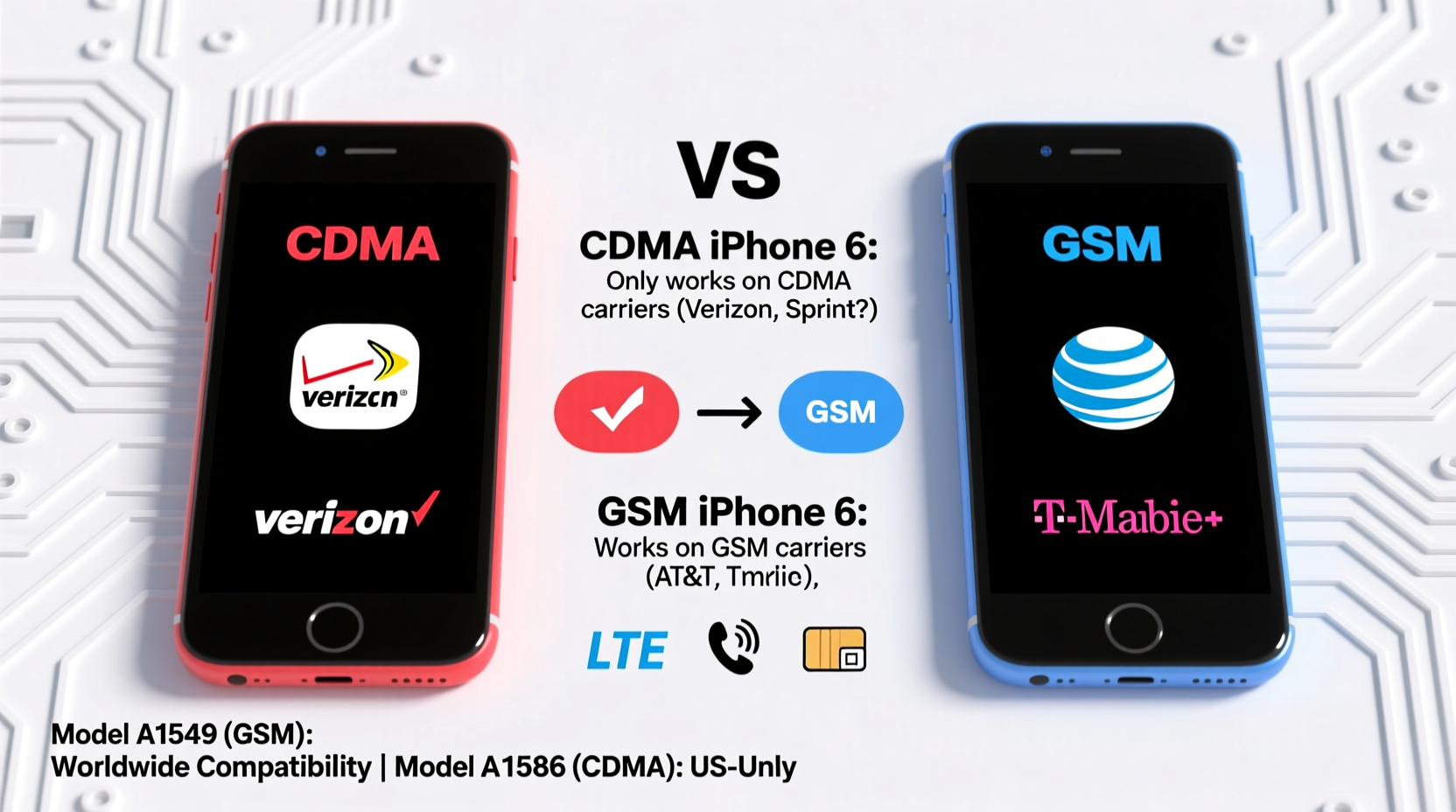
GSM (Global System for Mobile Communications) and CDMA (Code Division Multiple Access) are two distinct cellular technologies used by wireless carriers to transmit voice and data. Historically, they were incompatible with each other, meaning a phone built for one couldn't work on the other without special hardware.
- GSM relies on SIM cards to authenticate users on the network. Carriers like AT&T and T-Mobile in the U.S., as well as most international providers, have long used GSM.
- CDMA, on the other hand, traditionally didn’t use SIM cards (though modern versions do). Verizon and Sprint in the U.S. were the primary CDMA carriers.
The iPhone 6 marked a turning point because Apple released different models tailored to these networks—but also began building dual-mode devices capable of supporting both technologies.
iPhone 6 Models: A Closer Look at Compatibility
Apple released multiple iPhone 6 models in 2014, differentiated by model numbers and network capabilities:
| Model Number | Carrier | Network Support | SIM Type | Interchangeable? |
|---|---|---|---|---|
| A1549 | AT&T, International | GSM only | Nano-SIM | Limited to GSM carriers |
| A1586 | T-Mobile, International | GSM + CDMA | Nano-SIM | Most versatile; works on most carriers |
| A1589 | China Unicom | Hybrid GSM/CDMA | Dual SIM (nano + micro) | Region-locked features |
| A1524 | Verizon | CDMA + GSM | Nano-SIM | Highly flexible across U.S. carriers |
The key takeaway: Not all iPhone 6 models are created equal. If your device is model A1549 (sold by AT&T), it lacks CDMA support and may struggle on networks that rely on it. However, models A1524 (Verizon) and A1586 (T-Mobile/international) support both GSM and CDMA, making them far more adaptable when switching carriers.
Can You Use an iPhone 6 on Any Carrier Today?
The short answer: It depends on your specific model and the carrier’s current network infrastructure.
While GSM/CDMA differences once dictated carrier compatibility, the landscape has changed. Most U.S. carriers have shut down or are in the process of decommissioning their 3G CDMA networks. For example:
- Verizon ended CDMA service in December 2022.
- Sprint (now part of T-Mobile) retired its CDMA network earlier.
- AT&T and T-Mobile have phased out 3G GSM.
This means that even if your iPhone 6 supported CDMA, it can no longer connect via those legacy systems. Instead, connectivity now depends on LTE band support and whether the carrier allows older devices on its 4G network.
Thankfully, all iPhone 6 models support LTE, but they vary in the frequency bands they cover. For instance:
- Verizon’s LTE uses Band 13, which is supported by the A1524 and A1586 models.
- T-Mobile uses Bands 2, 4, and 12—also covered by most iPhone 6 variants.
- Rural carriers using Band 26 or 41 may not be fully compatible.
“Even though the iPhone 6 is over a decade old, its LTE capabilities allow it to function on modern networks—if the bands align and the carrier hasn’t blocked activation.” — David Lin, Wireless Network Analyst
Step-by-Step Guide: Switching Your iPhone 6 to a New Carrier
If you’re considering moving your iPhone 6 to a new provider, follow this practical sequence:
- Identify your model number (Settings > General > About > Model).
- Check carrier compatibility using Apple’s official specs or third-party tools like Kimovil or DeviceSpecifications.
- Ensure your phone is unlocked. If it’s tied to a carrier, contact them to request unlocking (after fulfilling contract terms).
- Obtain a SIM card from your new carrier. Many offer free trial kits.
- Insert the SIM and test service. Make a call, send a text, and load a webpage.
- Update carrier settings if prompted (Settings > General > About).
- Verify VoLTE support—required for calls on 4G-only networks.
Real-World Example: Moving from Verizon to T-Mobile
Consider Sarah, who bought an iPhone 6 (model A1524) from Verizon in 2015. After years with the same carrier, she wanted cheaper service and switched to T-Mobile via Mint Mobile.
She first confirmed her phone was unlocked through Verizon’s website. Then, she ordered a free SIM kit from Mint. Upon inserting the SIM, her phone connected immediately to T-Mobile’s LTE network. Calls worked thanks to VoLTE, and data speeds were acceptable for email and light browsing.
However, she noticed occasional signal drops in rural areas—likely due to limited low-band LTE support on the iPhone 6 compared to newer devices. Still, for urban use, the transition was seamless.
Checklist: Can Your iPhone 6 Work on Another Carrier?
- ✅ I know my iPhone 6 model number (A15xx)
- ✅ My model supports LTE bands used by the new carrier
- ✅ The phone is unlocked or eligible for unlocking
- ✅ The carrier supports VoLTE for voice calls
- ✅ I’ve tested the SIM in person or with a trial plan
- ✅ My iOS version is up to date (iOS 12.5.7 is the final supported version)
Frequently Asked Questions
Can a GSM-only iPhone 6 work on Verizon?
Yes—but only on LTE, not on legacy CDMA. Voice calls require VoLTE, which the iPhone 6 supports. However, the A1549 (GSM-only) lacks some LTE bands Verizon uses, so performance may be spotty. The A1524 or A1586 models are better suited.
Is the iPhone 6 still usable in 2024?
Yes, for basic tasks. It runs iOS 12.5.7, which includes critical security updates. While it can’t support newer apps requiring advanced hardware, it handles messaging, email, web browsing, and phone calls adequately—especially on Wi-Fi.
Will my iPhone 6 stop working when carriers turn off 3G?
It already has. 3G networks are gone, but the iPhone 6 uses 4G LTE for voice and data. As long as LTE remains active (expected for several more years), your phone will continue functioning—if the carrier permits it.
Final Thoughts: Maximizing Your iPhone 6’s Lifespan
The iPhone 6 may no longer be cutting-edge, but it remains a functional device for light users, travelers, or backup phones. Its ability to work across carriers hinges on three factors: model-specific hardware, LTE band alignment, and carrier policies on legacy device activation.
While you can’t use *any* iPhone 6 on *every* carrier without limitations, choosing the right model—particularly the A1586 or A1524—and pairing it with a compatible MVNO or major carrier can extend its usefulness well beyond expectations.




 浙公网安备
33010002000092号
浙公网安备
33010002000092号 浙B2-20120091-4
Comments
No comments yet. Why don't you start the discussion?