
For many long-time iPhone users, the decision to upgrade can feel like a balancing act between loyalty, functionality, and value. If you're still using an iPhone 6 Plus in 2024, you might be wondering whether making the jump to the iPhone 7 Plus is a meaningful improvement or just a minor refresh. After all, both devices are well past their prime support window, but for budget-conscious users or those in emerging markets, they may still represent viable options. This article takes a deep, practical look at the real differences between these two models—beyond marketing claims—and helps you determine if the upgrade delivers tangible benefits today.
Performance and Hardware: A Noticeable Leap?
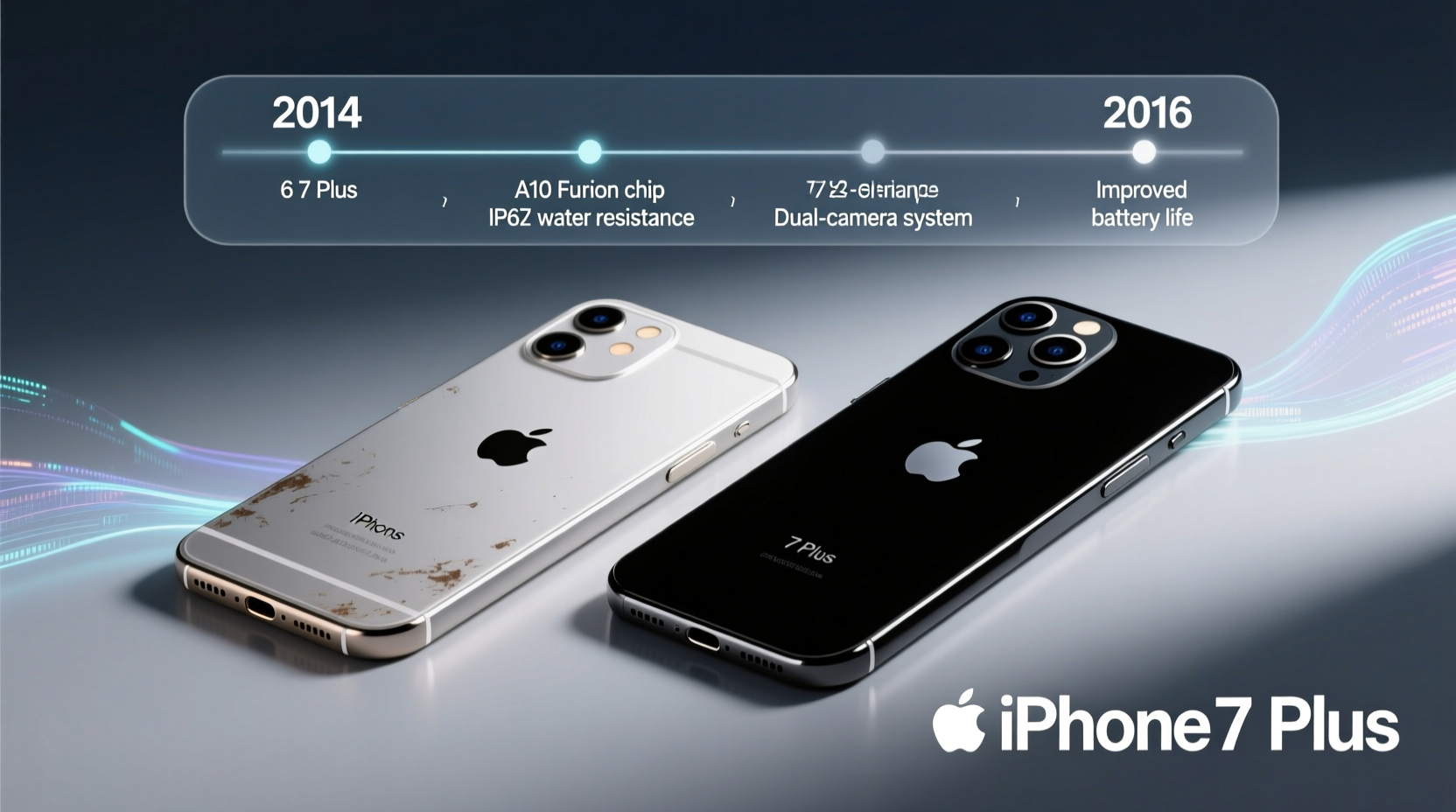
The core difference between the iPhone 6 Plus (released in 2014) and the iPhone 7 Plus (2016) lies in their internal hardware. The 6 Plus runs on Apple’s A8 chip with 1GB of RAM, while the 7 Plus features the more powerful A10 Fusion chip and 3GB of RAM. On paper, this represents a significant generational leap. In practice, the impact is even clearer when navigating modern apps and multitasking.
In 2024, iOS updates have long since stopped supporting both devices—iOS 15 was the last version compatible with the iPhone 7 Plus, while the 6 Plus topped out at iOS 12. However, even within those limitations, the A10 chip handles background processes, app launches, and Safari browsing far more smoothly than the aging A8. Users transitioning from the 6 Plus often report that the 7 Plus feels “snappier” and less prone to freezing or crashing under light loads.
Camera Comparison: Dual Lenses Make a Difference
One of the most compelling reasons to upgrade from the iPhone 6 Plus to the 7 Plus is the camera system. The 6 Plus features a single 8MP rear camera with basic autofocus and no optical image stabilization (OIS). The 7 Plus, by contrast, introduced Apple’s first dual-camera setup: a 12MP wide lens and a 12MP telephoto lens enabling 2x optical zoom and improved portrait mode effects (via software).
In real-world use, especially in low-light conditions, the 7 Plus captures noticeably sharper, brighter images with better dynamic range. The addition of OIS reduces blur from hand movement, which is particularly helpful in dim environments. Video recording also improves—from 1080p at 30fps on the 6 Plus to 4K at 30fps on the 7 Plus.
| Feature | iPhone 6 Plus | iPhone 7 Plus |
|---|---|---|
| Rear Camera | 8MP, f/2.2, no OIS | 12MP + 12MP dual, f/1.8 & f/2.8, OIS |
| Front Camera | 1.2MP | 7MP |
| Video Recording | 1080p @ 30fps | 4K @ 30fps, 1080p @ 60fps |
| Portrait Mode | Not available | Yes (software-based) |
“Even by 2024 standards, the iPhone 7 Plus’s camera holds up surprisingly well for casual photography. It’s a major step up from earlier models.” — David Lin, Mobile Photography Analyst
Battery Life and Durability: Real-World Longevity
Battery degradation is inevitable after nearly a decade of use. Most iPhone 6 Plus units in circulation today likely have batteries operating at less than 70% of their original capacity. Even if replaced, the smaller battery (2915 mAh) and inefficient A8 chip limit runtime.
The iPhone 7 Plus packs a slightly larger 2900 mAh battery, but thanks to the more power-efficient A10 chip, it typically delivers longer screen-on time. Independent tests from 2016 showed the 7 Plus lasting up to 2 hours longer than the 6 Plus in mixed usage. In 2024, assuming both devices have healthy batteries, the 7 Plus still offers more reliable daily endurance—especially when running modern versions of supported apps.
Another critical upgrade: water resistance. The iPhone 7 Plus has an IP67 rating, meaning it can survive immersion in up to 1 meter of water for 30 minutes. The 6 Plus has no official water resistance, making it far more vulnerable to spills or rain damage.
Software Support and App Compatibility
This is where the decision becomes complicated. Neither phone receives security updates from Apple anymore. The iPhone 7 Plus stopped receiving updates with iOS 15 in 2023, and the 6 Plus was dropped years earlier. Without ongoing patches, both devices are increasingly vulnerable to security exploits.
More pressing for usability: many modern apps now require iOS 15 or later. That means popular services like Google Maps, Instagram, and certain banking apps may no longer install or function properly on either device—but the 7 Plus, having run iOS 15, stands a better chance of maintaining partial compatibility through cached versions or lightweight alternatives.
Real User Experience: A Mini Case Study
Consider Maria, a freelance photographer assistant who relied on her iPhone 6 Plus for client coordination, note-taking, and occasional photo previews. By early 2023, her device struggled to load emails, crashed during video calls, and couldn't open updated PDFs from her cloud storage. She upgraded to a used iPhone 7 Plus for $80.
Her experience shifted dramatically. Apps launched faster, she could review full-resolution JPEGs without lag, and the improved camera allowed her to capture quick reference shots for sets. While not a flagship by any stretch, the 7 Plus extended her workflow efficiency by over a year before she eventually moved to a newer model. For her, the upgrade was absolutely worth it—not because the 7 Plus was powerful, but because it bridged the gap between obsolescence and usability.
Step-by-Step: Should You Upgrade in 2024?
Deciding whether to make the switch requires evaluating your current needs. Follow this timeline to assess your situation:
- Assess your current iPhone 6 Plus health: Check battery condition in Settings > Battery. If it's below 80%, consider a replacement battery first—it might extend usability cheaply.
- Test app performance: Try opening your top five most-used apps. Do they crash or freeze? Slow loading times indicate hardware strain.
- Check iOS version: If you’re still on iOS 12 or lower, many new app versions won’t install. The 7 Plus supports up to iOS 15, giving broader access.
- Evaluate cost: A used iPhone 7 Plus typically sells for $60–$100. Compare that to repair costs or potential productivity loss from a failing device.
- Consider future-proofing: Even the 7 Plus is outdated, but it may buy you another 12–18 months of semi-reliable use compared to the 6 Plus.
Frequently Asked Questions
Can the iPhone 7 Plus run iOS 16 or later?
No. The iPhone 7 Plus supports up to iOS 15.6.1, the final update released in October 2023. It does not support iOS 16 or any later versions.
Is the home button difference significant?
Yes. The iPhone 7 Plus features a solid-state home button that simulates a click using haptic feedback, unlike the physical button on the 6 Plus. This design is more durable and resistant to wear, though some users prefer the tactile feel of a moving button.
Will either phone work well in 2024?
Limitedly. Both can handle basic tasks like calling, texting, offline music, and simple web browsing. However, expect degraded performance with modern apps, reduced security, and limited access to new features. They’re best suited as backup phones or for users with minimal digital demands.
Final Verdict: Is the Upgrade Worth It?
If you're clinging to an iPhone 6 Plus and facing daily frustrations—slow performance, app crashes, poor camera quality, or battery anxiety—the move to an iPhone 7 Plus can provide a meaningful quality-of-life improvement. It’s not a future-proof solution, but for a modest investment, it offers better processing power, a superior camera, improved battery efficiency, and greater durability.
However, if you rely on up-to-date apps, need strong security, or plan to keep your phone for more than a year, neither device is ideal. Consider looking at iPhone 8 or newer models, which support modern iOS versions and offer significantly better longevity.
For those on tight budgets or in regions where newer smartphones are prohibitively expensive, the iPhone 7 Plus remains the smarter choice over the 6 Plus in 2024. It represents the last truly functional iteration of Apple’s classic design before the shift to Face ID and edge-to-edge displays.




 浙公网安备
33010002000092号
浙公网安备
33010002000092号 浙B2-20120091-4
Comments
No comments yet. Why don't you start the discussion?