
For millions of users still holding onto their iPhone 6 Plus devices, the question isn’t just about nostalgia—it’s about practicality. Released in 2014, the iPhone 6 Plus was a landmark device, offering Apple’s first large-screen experience. But nearly a decade later, its hardware struggles with modern apps, security updates have slowed, and battery life has degraded significantly. Enter the iPhone SE (2022), marketed as the “budget powerhouse” with flagship-level internals. But for someone transitioning from an iPhone 6 Plus, is the jump to the iPhone SE (2022) truly worthwhile in 2024?
The answer depends on what you value most: familiarity, screen size, performance, or longevity. This article breaks down the key differences between these two models—not just on paper, but in everyday use—to help you decide if the upgrade makes sense now.
Performance: A Quantum Leap Forward
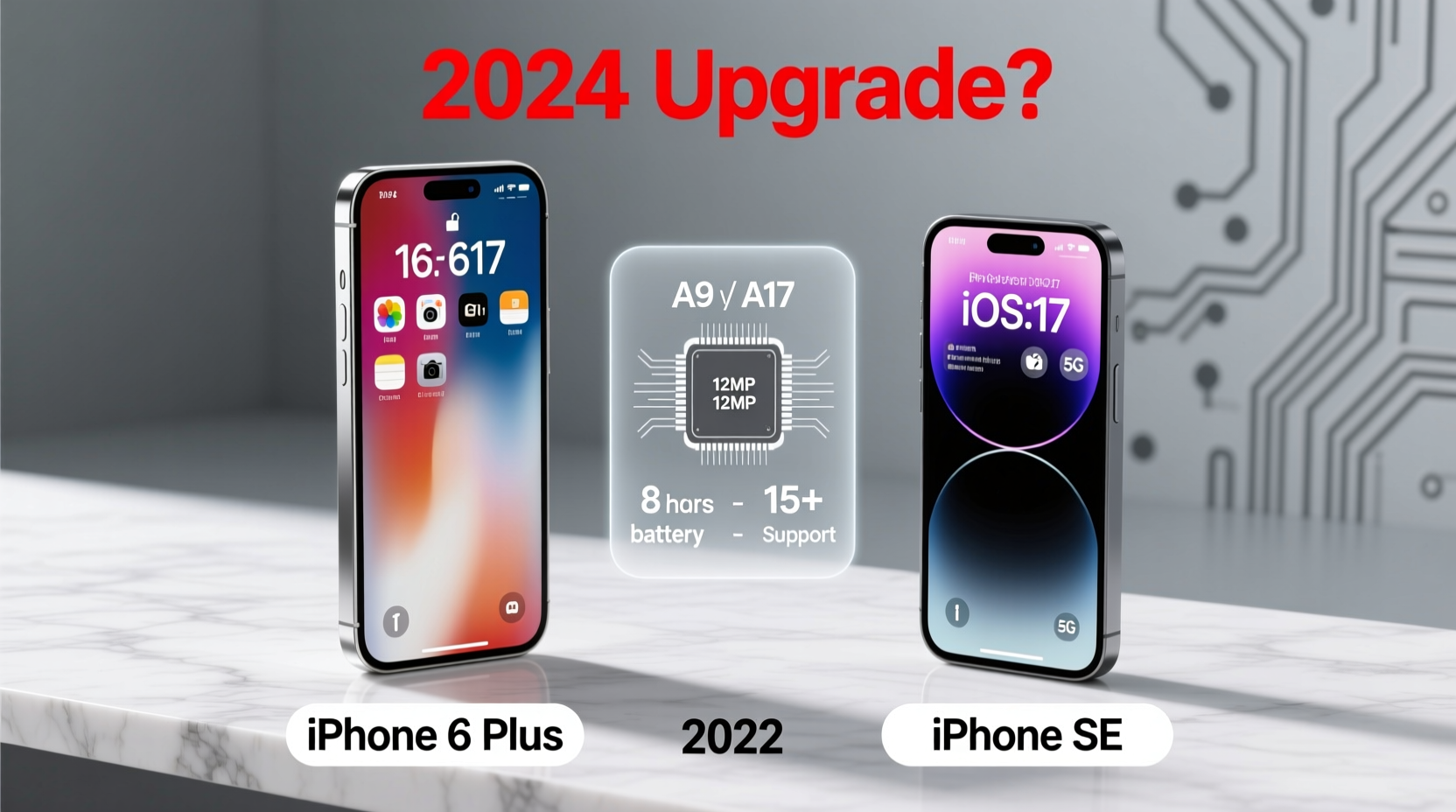
The most dramatic difference between the iPhone 6 Plus and the iPhone SE (2022) lies under the hood. The 6 Plus runs on Apple’s A8 chip, which was impressive in 2014 but today can barely keep up with basic multitasking. Opening multiple Safari tabs, switching between messaging apps, or even launching the camera can feel sluggish.
In contrast, the iPhone SE (2022) features the A15 Bionic chip—the same processor found in the iPhone 13 series. This means faster app launches, smoother animations, and seamless handling of graphics-intensive games and AR applications. iOS 17 runs fluidly on the SE, while the 6 Plus hasn’t supported major updates since iOS 12.
Benchmarks confirm this gap: the A15 scores over 170,000 on Geekbench 5, compared to the A8’s modest 2,800. That’s not a generational leap—it's a transformation. For users stuck with constant lags and crashes, the SE delivers a genuinely modern smartphone experience.
Display and Design: Bigger Isn’t Always Better
The iPhone 6 Plus boasts a 5.5-inch display, significantly larger than the SE’s 4.7-inch screen. On paper, that sounds like a downgrade. However, the context matters. While the 6 Plus offered spacious viewing in 2014, its LCD panel has a resolution of just 1920x1080 (401 ppi), and lacks True Tone or wide color support.
The SE retains the same physical dimensions and screen size as the iPhone 8, including the thick bezels and home button design—familiar territory for 6 Plus users. But its Retina HD display is brighter, supports Haptic Touch, and benefits from better color accuracy and anti-reflective coating. More importantly, the smaller footprint makes one-handed use far easier than the stretched form factor of the 6 Plus.
Despite lacking Face ID, the SE includes Touch ID embedded in the home button—just like the 6 Plus—making the transition intuitive. You won’t need to relearn how to unlock your phone or authenticate payments.
“The iPhone SE proves that powerful tech doesn’t require massive screens. Sometimes, less is more when the core experience remains accessible.” — David Ng, Mobile Analyst at TechPulse Weekly
Camera Capabilities: From Decent to Competitive
The iPhone 6 Plus featured an 8MP rear camera without optical image stabilization (OIS), resulting in soft images in low light and frequent blur from hand movement. Video maxed out at 1080p at 30fps.
The iPhone SE (2022) upgrades to a 12MP sensor with OIS, Smart HDR 4, and Deep Fusion. It captures sharper photos in daylight and dramatically better results in dim environments. Night mode, absent on the 6 Plus, allows usable shots in near-dark conditions. Video recording jumps to 4K at 60fps, enabling high-quality content creation.
While the single-lens setup limits versatility compared to dual-camera iPhones, the computational photography engine makes a huge difference. Portrait mode works via software analysis, and selfies from the front-facing 7MP camera are noticeably clearer.
Detailed Comparison Table
| Feature | iPhone 6 Plus (2014) | iPhone SE (2022) |
|---|---|---|
| Chipset | A8 | A15 Bionic |
| RAM | 1GB | 4GB |
| Storage Options | 16/64/128GB | 64/128/256GB |
| Display Size & Type | 5.5\" LCD | 4.7\" Retina HD LCD |
| Front Camera | 1.2MP | 7MP |
| Rear Camera | 8MP, no OIS | 12MP, OIS, Night Mode |
| Video Recording | 1080p@30fps | 4K@60fps |
| Battery Life | Up to 16 hrs talk time (new) | Up to 15 hrs video playback |
| iOS Support | Max: iOS 12 | Supports iOS 17+, future updates expected |
| Water Resistance | None | IP67 rated (up to 1m for 30 mins) |
| Starting Price (Launch) | $299 (on contract) | $429 (unlocked) |
Real-World Example: Maria’s Upgrade Journey
Maria, a schoolteacher from Portland, had been using her iPhone 6 Plus since 2015. By late 2023, she noticed her phone couldn’t load classroom apps reliably, the battery died by noon, and taking student activity photos often resulted in blurry or dark images.
She considered switching to an Android device but worried about losing iMessage and iCloud integration. After researching compact iPhones, she opted for the iPhone SE (2022). Within days, she noticed immediate improvements: her grading app launched instantly, she could record short videos of class projects in 4K, and her phone lasted through the entire school day—even with heavy usage.
“I was scared the screen would be too small,” she said, “but I actually prefer it now. It fits in my pocket, and everything feels snappier. I wish I’d upgraded sooner.”
Is the iPhone SE Worth It in 2024?
Yes—but with caveats. If you’re clinging to an iPhone 6 Plus primarily due to comfort with the form factor or budget concerns, the SE (2022) offers the smoothest possible upgrade path. It keeps the home button, similar size, and familiar iOS layout while delivering performance that will remain relevant through at least 2027.
However, consider your long-term needs. The SE lacks a modern design, has only one rear camera, and doesn't support ultra-wideband or Wi-Fi 6E. If you value screen real estate for streaming or reading, you might find the 4.7-inch display limiting. Alternatives like the iPhone 11 or even refurbished iPhone 13 offer larger displays and more advanced features for only slightly higher prices.
Upgrade Checklist: Are You Ready?
- ✅ Is your iPhone 6 Plus experiencing frequent crashes or app timeouts?
- ✅ Does the battery last less than half a day on moderate use?
- ✅ Have you stopped receiving major iOS updates?
- ✅ Do you want better photo and video quality?
- ✅ Are you comfortable with a compact, home-button design?
If you answered “yes” to three or more, upgrading to the iPhone SE (2022) is a smart move.
Frequently Asked Questions
Can the iPhone SE (2022) run the latest apps smoothly?
Absolutely. Thanks to the A15 Bionic chip and 4GB RAM, it handles all current iOS apps—including demanding ones like Adobe Lightroom, TikTok, and mobile games—without lag.
Will my accessories work with the SE?
Most Lightning-based accessories (chargers, headphones, docks) are compatible. However, cases designed for the 6 Plus won’t fit due to subtle dimensional differences and updated antenna lines.
Is the iPhone SE (2022) still being sold in 2024?
Apple officially discontinued the 2022 model after releasing the iPhone SE (2024) with the A15 replaced by the A16. However, the 2022 version remains available through third-party retailers and carriers, often at reduced prices.
Final Thoughts: Future-Proofing Your Experience
Upgrading from an iPhone 6 Plus to the iPhone SE (2022) in 2024 isn’t just about getting a newer phone—it’s about reclaiming reliability, speed, and security. The SE breathes new life into an aging ecosystem, letting you stay within Apple’s software environment without breaking the bank.
You’ll gain years of continued iOS updates, vastly improved cameras, and a responsive interface that adapts to how people use phones today. While it may not dazzle with edge-to-edge screens or triple lenses, it delivers where it counts: daily usability, longevity, and seamless integration.




 浙公网安备
33010002000092号
浙公网安备
33010002000092号 浙B2-20120091-4
Comments
No comments yet. Why don't you start the discussion?