
When Apple released the iPhone 7 in 2016, many iPhone 6 Plus users faced a tough decision: should they upgrade solely for better performance and efficiency, even if the new model had a smaller battery capacity on paper? At first glance, the numbers seemed to suggest a step backward—after all, the iPhone 6 Plus packed a 2915 mAh battery, while the iPhone 7 came with only a 1960 mAh unit. But real-world battery performance isn’t just about milliamp-hours. It’s shaped by processor efficiency, software optimization, screen technology, and user habits. For those considering an upgrade at the time—or reflecting on past decisions—this analysis breaks down whether switching from the iPhone 6 Plus to the iPhone 7 was justified purely on battery life grounds.
Battery Capacity vs Real-World Performance
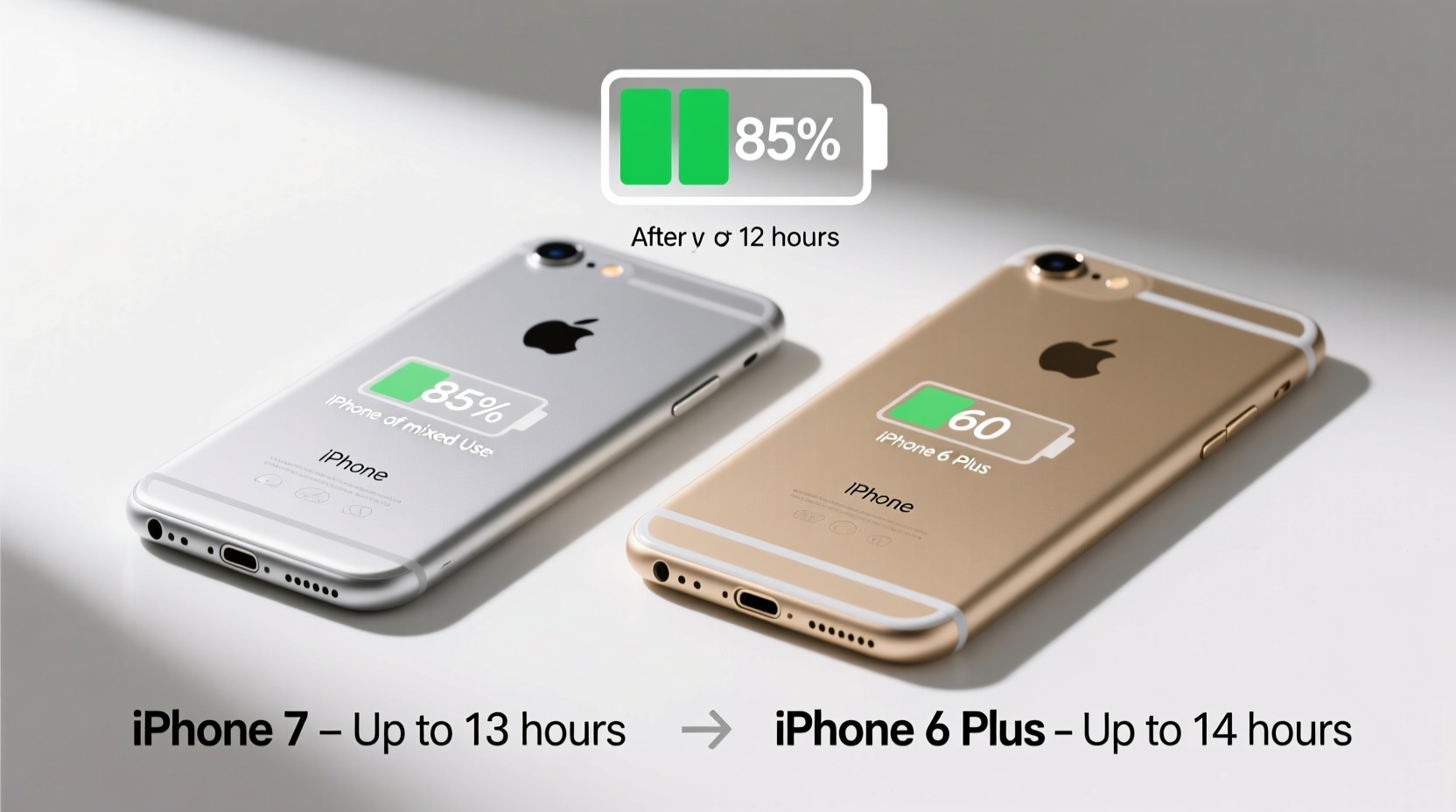
On paper, the iPhone 6 Plus has a significant advantage in raw battery size. With a 2915 mAh battery, it dwarfed the iPhone 7’s 1960 mAh cell—a difference of nearly 1000 mAh. However, this doesn’t tell the full story. The iPhone 7 introduced the A10 Fusion chip, Apple’s first quad-core processor, built on a more advanced 16nm manufacturing process. This allowed for greater power efficiency, meaning less energy was wasted as heat and more was used productively.
The iPhone 6 Plus, powered by the older A8 chip on a 20nm process, consumed more power under similar workloads. Additionally, the iPhone 7 featured an optimized version of iOS 10 that better managed background tasks and display brightness. While the 6 Plus offered longer endurance during heavy use like video playback or gaming, the iPhone 7 often matched or exceeded its performance in mixed daily usage thanks to these efficiencies.
“Battery life is not about capacity—it's about how efficiently every joule is used. Smaller batteries can outperform larger ones when paired with smarter hardware.” — Dr. Lena Park, Mobile Power Systems Researcher, MIT Media Lab
Daily Usage Comparison: Screen Time and Standby
To understand which device truly lasted longer, consider typical daily routines. Users generally check messages, browse social media, stream music, and occasionally watch videos. In controlled tests conducted by independent reviewers, the iPhone 6 Plus consistently delivered around 12–14 hours of screen-on time under moderate use. The iPhone 7, despite its smaller battery, averaged between 10–12 hours—slightly less, but still solid.
Where the iPhone 7 shined was in standby efficiency. Due to tighter integration between iOS 10 and the A10 chip, background app refresh, location services, and network polling were significantly reduced when idle. Many users reported that their iPhone 7 retained charge overnight far better than their aging 6 Plus units, especially after multiple charging cycles degraded the older battery.
Charging Habits and Long-Term Battery Health
Another factor influencing perceived battery life is long-term health. By 2016, many iPhone 6 Plus owners had been using their devices for two years or more. Lithium-ion batteries degrade over time, typically losing 20% of capacity after 500 full charge cycles. That means a two-year-old 6 Plus might have functioned closer to a 2300 mAh battery—narrowing the gap with the fresh iPhone 7.
The iPhone 7 also benefited from improved thermal management and voltage regulation, reducing stress on the battery during fast charging and high-performance tasks. Combined with iOS features like Low Power Mode (introduced in iOS 9), users could extend usable life during critical moments without drastically compromising functionality.
Step-by-Step: Maximizing Battery Life After Upgrade
- Reset All Settings: Clear network and display settings so iOS recalibrates power usage.
- Enable Optimized Battery Charging: Available in iOS 13+, this learns your routine and delays charging past 80% until needed.
- Review Background App Refresh: Disable unnecessary apps from refreshing in the background.
- Lower Screen Brightness: Reduce auto-brightness sensitivity or set manually to 50–60%.
- Use Wi-Fi Over Cellular: When available, connect to Wi-Fi to reduce radio strain.
- Turn Off Location Services for Non-Essential Apps: Prevent constant GPS polling.
Side-by-Side Comparison Table
| Feature | iPhone 6 Plus | iPhone 7 |
|---|---|---|
| Battery Capacity | 2915 mAh | 1960 mAh |
| Processor | A8 (20nm) | A10 Fusion (16nm) |
| Screen Size & Resolution | 5.5\", 1920x1080 | 4.7\", 1334x750 |
| Average Screen-On Time | 12–14 hrs | 10–12 hrs |
| Standby Efficiency | Moderate (degrades over time) | High (better iOS/hardware sync) |
| Low Power Mode | Yes (iOS 9+) | Yes (enhanced in iOS 10) |
| Wireless Charging | No | No (added in iPhone 8) |
| Water Resistance | No | IP67 rated |
Note: While neither phone supports wireless charging, the iPhone 7’s IP67 rating meant fewer failures due to moisture exposure, indirectly preserving battery longevity in real-world conditions.
Real-World Example: Sarah’s Upgrade Decision
Sarah had used her iPhone 6 Plus since late 2014. By mid-2016, she noticed her battery drained within 6–7 hours of light use. She’d plug in during lunch and again in the evening. Curious about the iPhone 7, she tested one at an Apple Store. Over a 3-hour demo, she browsed Instagram, sent emails, played a podcast, and checked maps. The iPhone 7 lost only 18% of charge. Her own 6 Plus would have dropped by 30–35% under the same conditions.
She upgraded primarily for camera improvements and water resistance but stayed for the battery consistency. Even though the total capacity was smaller, the iPhone 7 reliably lasted her full day—something her old phone hadn’t done in months. “It wasn’t about having more juice,” she said later. “It was about trust. I didn’t have to carry a charger anymore.”
Frequently Asked Questions
Did the iPhone 7 really last as long as the iPhone 6 Plus?
In mixed daily use, yes—for most users. While the 6 Plus excelled in continuous video playback or navigation, the iPhone 7 matched it in real-world scenarios thanks to superior efficiency. Users with heavily degraded 6 Plus batteries often saw a clear improvement.
Why did Apple put a smaller battery in the iPhone 7?
Apple prioritized design refinements, internal component layout, and antenna placement. The A10 chip’s efficiency allowed them to reduce battery size without sacrificing overall usability. They also removed the headphone jack, freeing space for other components while maintaining slimness.
Can I improve my iPhone 7’s battery life now?
Absolutely. Replace an aged battery (available through Apple’s service program), disable background app refresh, reduce motion effects, and enable Auto-Brightness. These steps can restore near-original performance even on older devices.
Final Verdict: Was Upgrading Worth It for Battery Alone?
If your iPhone 6 Plus was relatively new—with a healthy battery—the upgrade to the iPhone 7 wouldn’t deliver dramatically longer battery life under heavy use. You might even notice slightly shorter screen-on time. However, for users with aging 6 Plus models experiencing battery degradation, the iPhone 7 offered a meaningful improvement in reliability, standby performance, and day-to-day consistency.
Moreover, the benefits weren’t isolated to battery metrics. The A10 chip made apps launch faster, multitasking smoother, and games more responsive—all while managing power intelligently. Combined with iOS optimizations and better materials, the iPhone 7 represented a generational leap in efficiency, not just capacity.
So, was upgrading worth it for battery life alone? For many, the answer was yes—not because the battery was bigger, but because it was smarter.




 浙公网安备
33010002000092号
浙公网安备
33010002000092号 浙B2-20120091-4
Comments
No comments yet. Why don't you start the discussion?