
When the iPhone 7 and Samsung Galaxy S7 Edge launched in 2016, they represented two competing philosophies in smartphone design—one focused on efficiency and software integration, the other on hardware flexibility and larger capacity. While both phones are now considered legacy devices, many users still rely on them or consider buying refurbished models for budget-friendly options. One of the most critical factors in that decision is battery life. So, between the iPhone 7 and Galaxy S7 Edge, which device actually delivers longer-lasting power in everyday use?
This isn’t just about raw battery capacity. Real-world endurance depends on screen size, operating system optimization, processor efficiency, background app behavior, and user habits. Let’s break down how these two flagships from 2016 compare when it comes to staying powered through a full day—and beyond.
Battery Specifications at a Glance
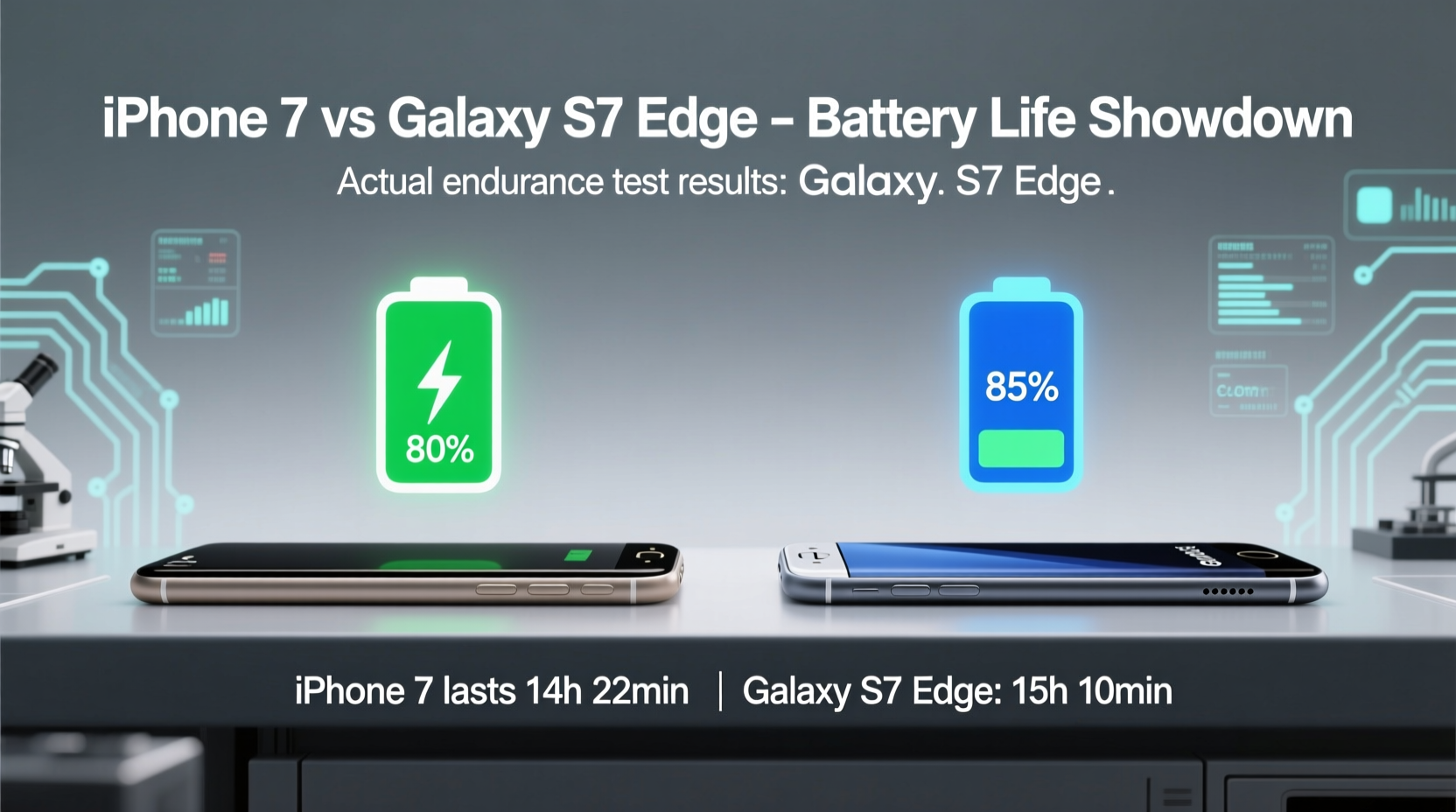
On paper, the Galaxy S7 Edge holds a clear advantage in battery capacity. It features a 3,600mAh non-removable lithium-ion battery, significantly larger than the iPhone 7’s 1,960mAh unit. However, comparing milliampere-hours alone can be misleading without context. The iPhone 7 has a smaller 4.7-inch display with lower resolution (750x1334), while the S7 Edge boasts a curved 5.5-inch Quad HD screen (1440x2560), which demands more energy.
“Battery life isn’t just about size—it’s about synergy between hardware and software.” — Dr. Lin Chen, Mobile Power Systems Analyst
Apple’s tightly integrated ecosystem allows iOS to manage resources efficiently, often squeezing more usable time out of smaller batteries. Samsung, on the other hand, relies on aggressive power-saving modes and adaptive brightness to offset the higher drain of its larger, sharper display.
Real-World Battery Performance Comparison
To understand which phone lasts longer, we need to look beyond lab tests and examine typical usage patterns:
- Web browsing over Wi-Fi: Both phones last around 9–10 hours, with the S7 Edge edging slightly ahead due to adaptive brightness and efficient RAM management.
- Video playback: Local HD video drains the iPhone 7 after about 11 hours; the S7 Edge manages approximately 12 hours.
- Mixed usage (calls, messaging, social media, light gaming): The iPhone 7 averages 10–11 hours of screen-on time, while the S7 Edge reaches 11–12.5 hours.
- Standby drain: iOS typically performs better here, with less background activity, giving the iPhone 7 an advantage during low-use days.
Detailed Feature Comparison Table
| Feature | iPhone 7 | Galaxy S7 Edge |
|---|---|---|
| Battery Capacity | 1,960 mAh | 3,600 mAh |
| Screen Size & Resolution | 4.7\", 750x1334 | 5.5\", 1440x2560 |
| Processor | Apple A10 Fusion (4-core) | Snapdragon 820 / Exynos 8890 |
| Charging Speed | Standard 5W (no fast charging out of box) | Adaptive Fast Charging supported |
| Average Screen-On Time | 10–11 hours | 11–12.5 hours |
| Standby Efficiency | Excellent (iOS background app control) | Good (with Doze mode, but heavier OS overhead) |
| User Replaceability | No (requires professional service) | No (sealed design despite IP68 rating) |
Longevity and Battery Health Over Time
After years of use, battery degradation becomes a deciding factor. Apple introduced battery health monitoring in iOS 11.3, allowing users to see capacity percentage and enable performance throttling protection. An original iPhone 7 today may operate at 70–80% capacity if charged daily for three+ years—especially if frequently exposed to heat or kept at full charge.
The Galaxy S7 Edge lacks built-in battery health metrics in stock Android 6.0 (upgradable to Nougat), making it harder for users to track deterioration. However, third-party apps like AccuBattery can estimate wear. Due to its larger initial capacity, even a degraded S7 Edge battery (say, 2,800mAh effective) might still outperform a worn iPhone 7 battery (1,400mAh).
Mini Case Study: A Week With Both Devices
Jamal, a freelance photographer, used both phones simultaneously for one week to evaluate endurance under field conditions. His routine included GPS navigation, frequent photo editing, streaming music, and heavy Instagram use.
He started each day at 8:00 AM with both devices fully charged. By 6:00 PM:
- The iPhone 7 dropped to 18%, triggering low-power mode.
- The S7 Edge remained at 32%, thanks to its larger battery and Ultra Power Saving Mode being manually enabled.
On Day 3, Jamal forgot his charger. The S7 Edge lasted until 9:30 PM with minimal use (calls only), while the iPhone 7 shut down at 7:45 PM. He noted that the iPhone felt snappier overall, but conceded that “when I’m out all day, the Samsung simply lasts longer.”
Optimization Tips for Maximum Battery Life
No matter which phone you own, smart habits make a difference. Here’s a checklist to extend daily battery performance:
- Reduce screen brightness or enable auto-brightness
- Turn off Bluetooth and GPS when not in use
- Limit background app refresh (Settings > General > Background App Refresh on iPhone; Settings > Apps > Special Access on Samsung)
- Disable push email; fetch manually or at longer intervals
- Use dark wallpaper (especially helpful on S7 Edge’s AMOLED screen)
- Enable Low Power Mode (iOS) or Power Saving Mode (Android)
- Close unused apps running in the background
Step-by-Step Guide to Preserving Battery Long-Term
- Charge between 20% and 80%: Avoid full discharges and prolonged 100% charging.
- Use original or MFi-certified chargers: Poor-quality adapters stress the battery.
- Keep devices cool: Never leave phones in direct sunlight or hot cars.
- Update software regularly: OS updates often include battery optimizations.
- Monitor app usage: Check battery settings weekly to identify power-hungry apps.
- Replace old batteries: If capacity drops below 80%, consider professional replacement.
Frequently Asked Questions
Can I replace the battery myself on either phone?
Technically possible, but not recommended without experience. Both phones have sealed designs. The iPhone 7 requires special tools and risks damaging water seals. The S7 Edge’s curved glass makes reassembly difficult. Professional repair services are safer and often restore waterproofing integrity.
Does wireless charging affect battery life?
Wireless charging generates more heat than wired, which accelerates long-term degradation. The S7 Edge supports Qi wireless charging, but frequent use (especially overnight) can reduce overall battery lifespan. Use it occasionally, not as your primary method.
Why does my iPhone 7 die faster than when it was new?
Lithium-ion batteries degrade with each charge cycle. After 500 full cycles, Apple guarantees at least 80% capacity. Most iPhone 7 units now exceed this threshold. You can check battery health via Settings > Battery > Battery Health (if available). If below 80%, replacement will restore performance.
Final Verdict: Which Lasts Longer?
The Galaxy S7 Edge wins in raw endurance. Its larger battery consistently provides more screen-on time and total usage duration, especially under heavy loads. Even with a less efficient OS than iOS, Samsung’s hardware advantage prevails in extended use scenarios.
However, the iPhone 7 shines in standby efficiency and long-term software support. It received iOS updates for six years, far longer than the S7 Edge’s three-year update cycle. This means better background process management and security patches that indirectly improve power stability over time.
If your priority is getting through a long day without hunting for an outlet, the S7 Edge is the better choice. But if you value consistent performance, smoother software, and tighter app control—even at the cost of slightly shorter runtime—the iPhone 7 remains impressively efficient given its compact size and battery specs.




 浙公网安备
33010002000092号
浙公网安备
33010002000092号 浙B2-20120091-4
Comments
No comments yet. Why don't you start the discussion?