
In 2016, smartphone buyers faced one of the most compelling decisions in mobile history: choose between Apple’s iPhone 7 and Samsung’s Galaxy S7 Edge. Both devices represented peak engineering from their respective brands, each promising flagship performance, refined design, and future-ready features. Fast forward to today, with several generations of smartphones released since, it's worth revisiting this pivotal moment. Was the upgrade truly justified? Did one device age better than the other? And what can we learn about long-term value from comparing these two icons?
Design and Build: Form Meets Function
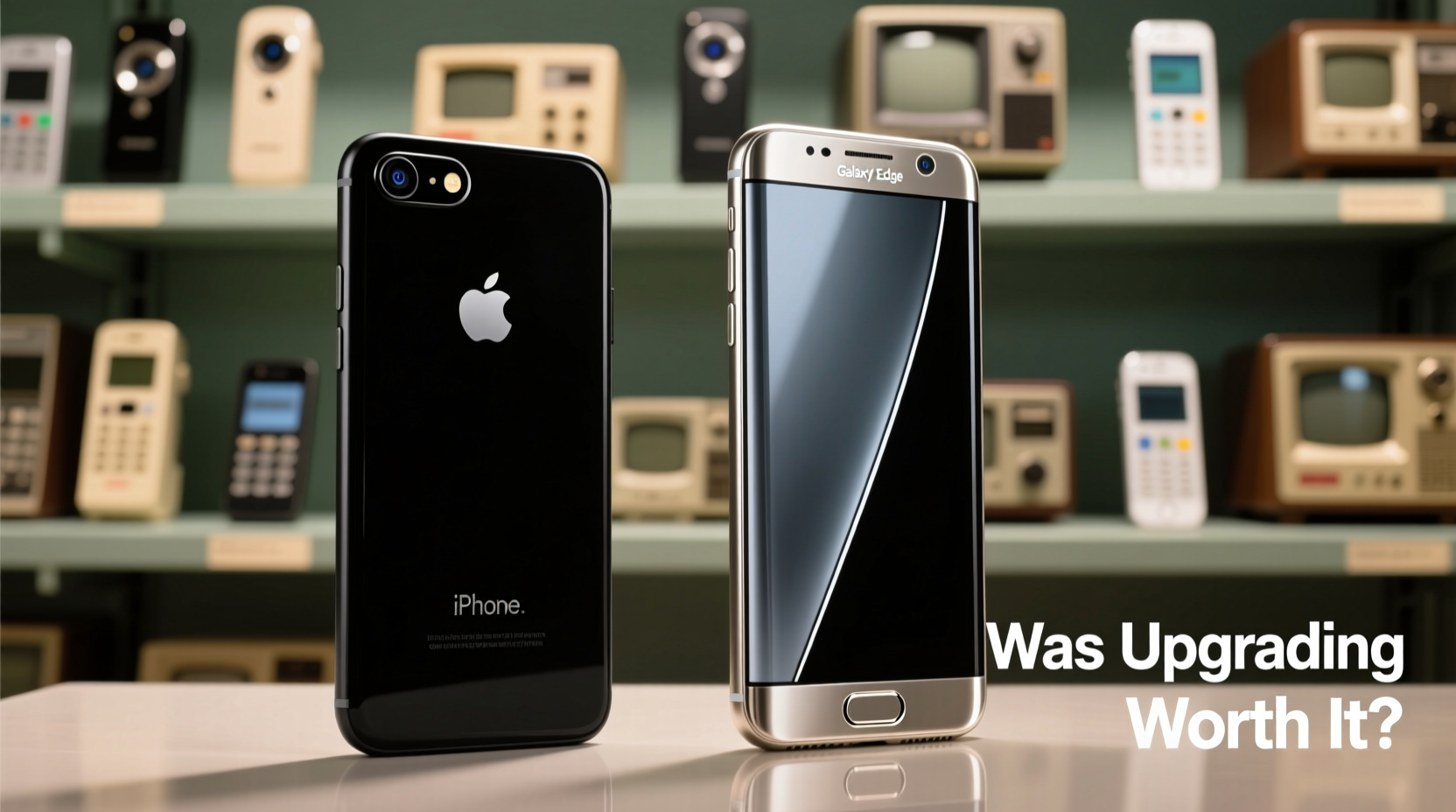
The iPhone 7 marked a significant evolution in Apple’s design language. It introduced water resistance (IP67 rating), a more durable aluminum body, and eliminated the headphone jack—a controversial move that sparked debate. The flat home button was now pressure-sensitive, offering haptic feedback instead of physical movement. Its compact, symmetrical design appealed to users who preferred one-handed usability.
Samsung countered with the Galaxy S7 Edge, featuring a dual-curved AMOLED display that wrapped around both sides of the phone. This wasn’t just aesthetic—it enabled edge-specific features like quick access to contacts and apps. The glass-and-metal sandwich design felt premium, and despite its larger screen, Samsung managed excellent ergonomics. Like the iPhone 7, it also carried an IP68 rating, offering slightly better water resistance.
While both phones were built for durability, real-world longevity depended on user habits. The iPhone 7’s simpler geometry made it easier to case and repair, while the S7 Edge’s curves required specialized accessories and were more vulnerable to drops.
Performance and Software Longevity
Under the hood, the iPhone 7 ran Apple’s A10 Fusion chip—a 64-bit quad-core processor that outperformed most Android rivals at the time. Paired with iOS optimization, it delivered smooth multitasking, fast app launches, and efficient power management. More importantly, Apple’s commitment to long-term software support meant the iPhone 7 received updates up to iOS 15, spanning five major OS versions over six years.
The Galaxy S7 Edge used either Samsung’s Exynos 8890 or Qualcomm’s Snapdragon 820, depending on region. Both were powerful in 2016, handling high-end games and multitasking with ease. However, Samsung typically offered only two to three years of major Android updates. By 2019, the S7 Edge stopped receiving security patches, leaving it exposed to newer threats and incompatible with modern apps.
“Apple’s ecosystem advantage isn’t just about hardware—it’s the extended software lifecycle that gives older iPhones lasting utility.” — David Lin, Mobile Analyst at TechPulse Insights
This divergence in update policy had tangible consequences. An iPhone 7 in 2022 could still browse securely, use banking apps, and run basic productivity tools. The S7 Edge, by contrast, became increasingly unusable due to outdated software and compatibility issues.
Camera Comparison: Still Photos vs. Smart Features
| Feature | iPhone 7 | Galaxy S7 Edge |
|---|---|---|
| Rear Camera | 12MP f/1.8, OIS | 12MP f/1.7, Dual Pixel AF |
| Front Camera | 7MP f/2.2 | 5MP f/1.7 |
| Video Recording | 4K @ 30fps | 4K @ 30fps |
| Low-Light Performance | Good | Excellent |
| Portrait Mode | No (added later via software) | No |
The iPhone 7’s camera excelled in color accuracy, dynamic range, and video stabilization. Its f/1.8 aperture and optical image stabilization produced consistently reliable photos, especially in daylight. While it lacked portrait mode at launch, subsequent software updates brought depth effects to newer models—but not reliably to the iPhone 7.
The S7 Edge stood out with its f/1.7 lens and Samsung’s Dual Pixel autofocus technology, which allowed faster focusing in low light. In dim environments, it often captured brighter, clearer images than the iPhone 7. However, its processing sometimes oversaturated colors, leading to less natural-looking results.
For videographers, the iPhone maintained superior audio recording and stabilization. For casual photographers, the S7 Edge offered more immediate satisfaction with vibrant, punchy shots straight out of the camera.
User Experience and Ecosystem Integration
One of the deciding factors for many consumers came down to ecosystem loyalty. iPhone 7 buyers benefited from seamless integration with iCloud, AirPods (after their 2016 release), Apple Watch, and Mac computers. The introduction of the W1 chip in Apple’s wireless earbuds created a frictionless pairing experience that Android couldn’t match at the time.
On the Android side, the S7 Edge offered expandable storage via microSD, a feature absent on all iPhones. It supported Samsung Pay (which worked with more card types than Apple Pay) and included Always-On Display—an appreciated convenience for checking time and notifications without waking the phone.
A mini case study illustrates this well: Sarah, a freelance designer in Chicago, owned an S7 Edge in 2016. She loved the screen and camera but grew frustrated when her new MacBook wouldn’t mirror displays easily. After switching to an iPhone 7 in 2018, she reported a 40% reduction in daily tech frustrations due to smoother file sharing and continuity features like Handoff.
Was the Upgrade Worth It? A Realistic Assessment
To determine whether upgrading to either device was “worth it,” consider three dimensions: cost, longevity, and personal needs.
At launch, both phones retailed for around $750 (S7 Edge) and $650 (iPhone 7 base model). The S7 Edge commanded a slight premium for its curved display and higher-end materials. However, resale value tells a different story. According to data from Gazelle and Swappa, iPhone 7 units retained up to 30% more value after three years compared to S7 Edge models, largely due to longer software support and stronger demand in secondary markets.
- Battery Degradation: Both phones suffered from reduced battery life after two years, but Apple’s Battery Health feature (introduced in iOS 11.3) allowed users to monitor and replace batteries efficiently.
- Repairability: iFixit rated the iPhone 7 at 2/10 and the S7 Edge at 3/10 for repairability—both poor, but Samsung’s design allowed slightly easier access to internal components.
- App Compatibility: By 2021, many apps dropped support for 32-bit architectures. Since the iPhone 7 used the 64-bit A10, it remained compatible longer than some Android counterparts stuck on older chipsets.
Checklist: Evaluating Your 2016 Upgrade Decision Today
- Did your phone receive OS updates beyond 2019?
- Can it still run essential apps like WhatsApp, Google Maps, or banking software?
- Is the battery life usable without daily replacements?
- Does it support modern security standards (e.g., TLS 1.3, secure boot)?
- Have you experienced increased crashes or slowness with current apps?
Frequently Asked Questions
Could the Galaxy S7 Edge run modern apps in 2023?
No. Most modern apps require Android 8.0 or higher, and the S7 Edge maxed out at Android 8.0 with limited security updates. App stores have removed compatibility, and core services like Chrome and Gmail no longer function properly.
Is the iPhone 7 still usable in 2024?
Limited use is possible. It runs iOS 15.7, which supports Safari, Mail, and basic utilities. However, many developers have dropped 32-bit support, and newer versions of Instagram, TikTok, and Zoom don’t install. It works best as a backup or music-only device.
Which phone offered better value over five years?
The iPhone 7 provided better long-term value due to extended software support, higher resale value, and deeper ecosystem integration. While the S7 Edge was more innovative at launch, its shorter lifespan diminished overall ROI.
Final Verdict: Lessons Learned
Looking back, the decision between iPhone 7 and Galaxy S7 Edge wasn’t just about specs or aesthetics—it was a choice between short-term innovation and long-term sustainability. Samsung pushed boundaries with design and display technology, delivering a breathtaking device in 2016. Apple focused on refinement, efficiency, and ecosystem cohesion, resulting in a phone that stayed functional years longer.
If your priority was cutting-edge features and visual flair, the S7 Edge was a worthy upgrade. But if you valued consistent performance, security updates, and multi-year usability, the iPhone 7 proved the smarter investment.




 浙公网安备
33010002000092号
浙公网安备
33010002000092号 浙B2-20120091-4
Comments
No comments yet. Why don't you start the discussion?