
When Apple released the iPhone 7 in 2016, its dual-lens system on the Plus model set a new benchmark for smartphone photography. Three years later, Huawei responded with the P20 Pro—a device that didn’t just match expectations but redefined them. With its triple-camera setup and Leica collaboration, the P20 Pro was hailed as a photographic powerhouse. But for users still clinging to their iPhone 7, the question remains: is upgrading to the P20 Pro’s camera truly worth it?
This isn’t just about megapixels or marketing claims. It's about how each phone performs in real-life conditions—low light, dynamic range, portrait mode accuracy, and ease of use. Let’s break down the key differences and determine whether the leap from iPhone 7 to Huawei P20 Pro delivers a meaningful improvement.
Camera Hardware: A Fundamental Shift
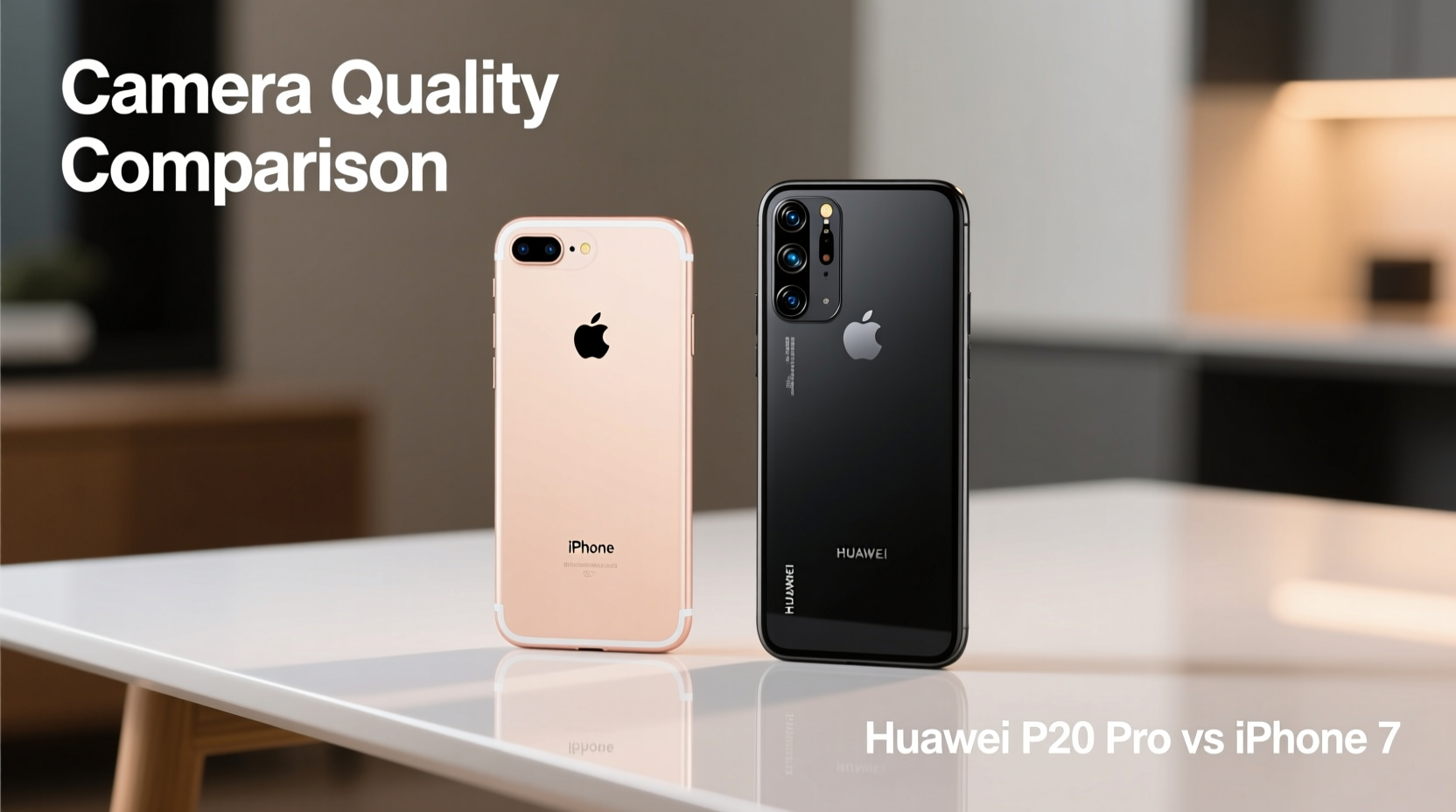
The iPhone 7 features a single 12MP rear sensor with an f/1.8 aperture, optical image stabilization (OIS), and 4K video recording. While impressive for its time, it lacks the versatility seen in modern flagships. The Huawei P20 Pro, by contrast, introduced a revolutionary triple-lens system developed in partnership with Leica:
- Main Camera: 40MP RGB sensor, f/1.8 aperture
- Monochrome Sensor: 20MP, f/1.6 – captures detail and contrast without color noise
- Telephoto Lens: 8MP, f/2.4, 3x optical zoom with periscope design
This configuration allows the P20 Pro to combine inputs from all three sensors using AI-powered algorithms, resulting in sharper images, better dynamic range, and enhanced zoom capabilities—none of which the iPhone 7 can match natively.
Low-Light Performance: Where the P20 Pro Shines
If there’s one area where the P20 Pro clearly outclasses the iPhone 7, it’s low-light photography. Huawei introduced \"Night Mode\" with this device—an industry-first feature that uses long exposure and multi-frame stacking to brighten dark scenes while preserving detail.
The iPhone 7 relies on faster shutter speeds and digital noise reduction, often leading to grainy or blurred results in dim environments. In contrast, the P20 Pro’s larger pixel binning (from its 40MP sensor) and wider f/1.6 monochrome lens allow significantly more light capture. Independent tests by DxOMark at the time gave the P20 Pro a record-breaking score of 109, largely due to its night performance.
“Huawei’s Night Mode changed the game. For the first time, smartphone users could take usable photos in near-darkness without a flash.” — David Gilson, Mobile Imaging Analyst, TechRadar
Image Quality Comparison: Real-World Scenarios
To understand the practical impact of these upgrades, consider three common shooting situations:
Landscape Photography
The P20 Pro’s 3x optical zoom enables tighter framing without losing quality. Combined with AI scene recognition that automatically enhances greens and skies, landscapes appear more vivid and detailed. The iPhone 7, limited to digital zoom, quickly degrades image sharpness beyond 2x magnification.
Portrait Mode Accuracy
While the iPhone 7 introduced Portrait Mode via software simulation on the Plus model, edge detection was inconsistent, especially around hair or glasses. The P20 Pro uses depth data from two dedicated lenses, producing more accurate subject separation and natural bokeh effects.
Dynamic Range
In high-contrast scenes—like backlit subjects or sunsets—the P20 Pro applies HDR more effectively thanks to its hybrid sensor array. Highlights are preserved, shadows lifted, and colors remain balanced. The iPhone 7 struggles here, often blowing out skies or underexposing foregrounds.
Detailed Feature Comparison Table
| Feature | iPhone 7 | Huawei P20 Pro |
|---|---|---|
| Rear Cameras | Single 12MP, f/1.8 | Triple: 40MP (f/1.8) + 20MP B&W (f/1.6) + 8MP tele (f/2.4) |
| Zoom | Digital only (up to 5x) | 3x optical, 5x hybrid, 10x digital |
| Night Mode | No | Yes, AI-enhanced long exposure |
| Video Recording | 4K at 30fps | 4K at 30fps, slow motion up to 960fps |
| Front Camera | 7MP, f/2.2 | 24MP, f/2.0, AI beautification |
| AI Features | Limited (iOS-level enhancements) | Scene detection, auto HDR, smart composition |
Mini Case Study: Travel Photographer Upgrading from iPhone 7
Consider Sarah Lin, a freelance travel blogger who used her iPhone 7 for content creation across Southeast Asia. She frequently shot markets, temples, and street food in mixed lighting. After switching to the P20 Pro, she noticed immediate improvements:
- Her sunset shots no longer required post-processing to recover blown-out skies.
- Indoor restaurant photos were brighter and clearer, even without flash.
- Zooming in on distant architecture retained usable detail, allowing tighter crops in editing.
“I used to carry a compact camera everywhere because my iPhone couldn’t handle tricky lighting,” Sarah said. “With the P20 Pro, I left the extra gear at home. The convenience and quality made the upgrade worthwhile—even if I missed some iOS ecosystem perks.”
Practical Checklist Before Upgrading
Before deciding whether the P20 Pro’s camera justifies leaving the iPhone 7 behind, consider the following:
- Evaluate your current pain points: Do you regularly struggle with blurry night shots or poor zoom?
- Assess ecosystem loyalty: Are you invested in iCloud, iMessage, or AirDrop? Switching to Android disrupts these.
- Check app compatibility: Some iOS-exclusive apps don’t have full-featured Android counterparts.
- Test sample photos: Download real-world P20 Pro images online and compare them side-by-side with your own iPhone 7 shots.
- Consider longevity: The P20 Pro launched in 2018 and no longer receives major updates. Is this a short-term fix or long-term solution?
Frequently Asked Questions
Can the Huawei P20 Pro replace a DSLR?
No smartphone fully replaces a DSLR, especially for professional work requiring manual control, interchangeable lenses, or RAW flexibility. However, for casual and social media photography, the P20 Pro comes remarkably close—particularly in daylight and well-lit indoor settings.
Is the iPhone 7 camera still good today?
Yes, for basic photography needs. If you primarily shoot in good light, share on social media, or prefer minimal editing, the iPhone 7 produces clean, color-accurate images. But it falls short in low light, zoom, and advanced features like Night Mode.
Does the P20 Pro support modern cloud backups?
Yes, it works with Google Drive, Dropbox, and Huawei Cloud. However, syncing with Apple services like iCloud requires manual uploads via browser or third-party tools.
Conclusion: Is the Upgrade Worth It?
The answer depends on what you value most. If you're someone who takes frequent photos in challenging lighting, enjoys capturing distant subjects, or wants greater creative control through AI-assisted photography, then yes—the Huawei P20 Pro’s camera is absolutely worth the upgrade from the iPhone 7.
However, if you prioritize seamless integration with Apple devices, consistent software updates, or simplicity over cutting-edge camera tech, staying with the iPhone 7—or upgrading within the iPhone ecosystem—might be the smarter move.
Ultimately, the P20 Pro represented a pivotal moment in mobile imaging. It proved that computational photography could surpass traditional optics in real-world usability. For photographers seeking that leap in capability, even years later, the difference remains visible—and valuable.




 浙公网安备
33010002000092号
浙公网安备
33010002000092号 浙B2-20120091-4
Comments
No comments yet. Why don't you start the discussion?