
For users still relying on the iPhone 8 Plus, the leap to the iPhone 14 Plus may seem like a generational shift — and in many ways, it is. Released in 2017, the iPhone 8 Plus was a flagship device that set standards for build quality, camera performance, and iOS reliability. Nearly six years later, the iPhone 14 Plus arrived as Apple’s first mid-tier “Plus” model since the 8 Plus, offering larger batteries, modern displays, and significantly upgraded internals. But is upgrading from the 8 Plus to the 14 Plus justified by the technical specifications alone? The answer depends on how you use your phone and what you value most in a mobile experience.
Performance: A Quantum Leap in Processing Power
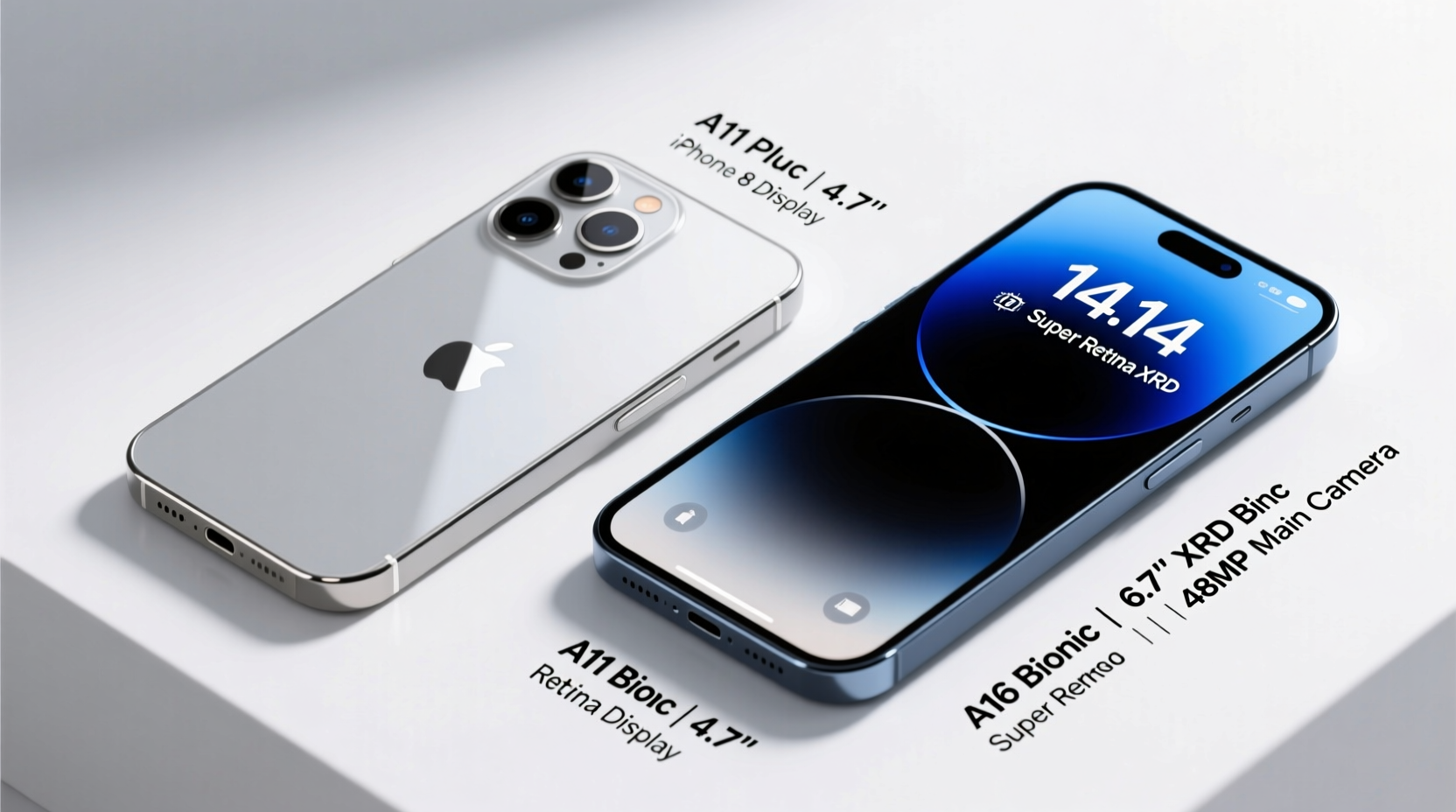
The heart of any smartphone lies in its processor, and here, the difference between the iPhone 8 Plus and the iPhone 14 Plus couldn’t be more dramatic. The 8 Plus runs on Apple’s A11 Bionic chip, built on a 10nm process with a hexa-core CPU and a three-core GPU. At its launch, it was among the fastest mobile processors available. Today, it struggles with modern multitasking, high-end gaming, and even some background app reloads due to limited RAM (only 3GB).
In contrast, the iPhone 14 Plus features the A15 Bionic chip — the same processor found in the iPhone 13 Pro models — manufactured on a refined 5nm process. It includes a 6-core CPU, 5-core GPU, and a 16-core Neural Engine for machine learning tasks. Benchmarks show the A15 delivers over four times the CPU performance and nearly ten times the graphics power of the A11.
This isn't just about speed; it's about longevity. Apps are becoming increasingly demanding. The A15 ensures smoother operation today and better support for future iOS updates, likely extending the usable life of the 14 Plus by several years compared to the aging 8 Plus.
Display and Design: From Home Button to All-Screen Experience
The design philosophy between these two phones reflects a broader industry evolution. The iPhone 8 Plus retains the traditional home button, thick bezels, and a 4.7-inch LCD display with a resolution of 1920x1080. While sharp for its time, it lacks HDR support, True Tone, and high refresh rates.
The iPhone 14 Plus, meanwhile, features a 6.7-inch Super Retina XDR OLED display — brighter, more color-accurate, and far more immersive. It supports advanced features like Dynamic Island (though not functional in all apps), True Tone, and HDR10 playback. The switch to an edge-to-edge design without a home button means Face ID replaces Touch ID, which may take some getting used to for long-time 8 Plus users.
| Feature | iPhone 8 Plus | iPhone 14 Plus |
|---|---|---|
| Display Size | 5.5 inches | 6.7 inches |
| Display Type | LCD (Retina HD) | OLED (Super Retina XDR) |
| Brightness (HDR) | 625 nits peak | 1000 nits sustained, 1600 nits peak HDR |
| Biometric Security | Touch ID | Face ID |
| Water Resistance | IP67 (1m for 30 mins) | IP68 (6m for 30 mins) |
The larger screen on the 14 Plus isn’t just about size — it enhances media consumption, navigation, and productivity. For users who stream videos, read e-books, or manage emails on their phones, this upgrade alone can justify the move.
Camera Capabilities: Evolution Meets Intelligence
The iPhone 8 Plus introduced Apple’s first dual-camera system: a 12MP wide and 12MP telephoto setup, enabling 2x optical zoom and Portrait Mode. It was groundbreaking in 2017, but today it lacks key features like Night mode, Deep Fusion, and Smart HDR.
The iPhone 14 Plus improves dramatically with a 12MP main sensor featuring larger pixels, sensor-shift stabilization, and computational photography enhancements. It adds Photographic Styles, Action Mode for stabilized video, and improved low-light performance across both photos and video (up to 4K at 60fps). While it still uses a single telephoto lens, the software-driven Smart HDR 4 and深度融合 (Deep Fusion) produce richer textures and dynamic range.
“Modern iPhone cameras don’t just capture images — they interpret scenes using AI. The difference in photo quality between 2017 and 2023 isn’t just hardware; it’s intelligence.” — David Lin, Mobile Imaging Analyst at TechVision
If you regularly share photos on social media, document family moments, or rely on your phone for work-related visuals, the camera upgrade is substantial. Low-light shots, portrait lighting controls, and video stabilization offer tangible improvements that go beyond megapixels.
Battery Life and Charging: Real-World Endurance
One area where the iPhone 14 Plus shines is battery life. Despite similar-sized physical batteries, the efficiency of the A15 chip and larger display optimization allow the 14 Plus to deliver up to 26 hours of video playback — nearly double the 8 Plus’s 14-hour rating.
Real-world usage confirms this: streaming music, browsing, and mixed app use often last two full days on the 14 Plus, whereas the 8 Plus typically requires daily charging, especially if the battery has degraded over time.
Charging has also evolved. The 8 Plus supports only 7.5W wireless charging and 12W wired (with fast charging possible via third-party adapters). The 14 Plus supports 20W+ fast charging (reaching 50% in ~30 minutes) and MagSafe compatibility, making charging faster and more convenient.
Mini Case Study: Sarah’s Upgrade Journey
Sarah, a freelance photographer and long-time iPhone 8 Plus user, initially hesitated to upgrade. Her phone still worked, but she noticed delays when transferring large image files, slow app launches, and poor performance in low light. After switching to the iPhone 14 Plus, she reported immediate improvements: faster export times in Lightroom Mobile, crisper night shots during events, and the ability to shoot 4K video for client reels. “It’s not just newer — it feels like a professional tool now,” she said.
Software Support and Future-Proofing
Apple typically provides five to six years of iOS updates. The iPhone 8 Plus received updates up to iOS 16, but dropped support with iOS 17. This means no new features, security patches, or compatibility with future apps requiring newer OS versions.
The iPhone 14 Plus launched with iOS 16 and is fully supported through iOS 17, 18, and likely up to iOS 22 or beyond. This extended software lifecycle ensures access to new privacy tools, accessibility features, and emerging technologies like AI integrations and enhanced Siri capabilities.
Frequently Asked Questions
Will my accessories work with the iPhone 14 Plus?
Most Lightning-based accessories will work, but cases won’t fit due to different dimensions and lack of home button. Wireless chargers and audio gear remain compatible. However, older docks or stands designed for the home button cutout may not align properly.
Is the iPhone 14 Plus waterproof?
Yes, it has an IP68 rating, meaning it can withstand submersion in up to 6 meters of water for 30 minutes. The iPhone 8 Plus is rated IP67 (1 meter for 30 minutes), so the 14 Plus offers significantly better water resistance.
Can I expect better cellular performance?
Yes. The iPhone 14 Plus includes updated LTE bands and Gigabit-class speeds. More importantly, it supports Emergency SOS via Satellite — a feature absent on the 8 Plus — which can be critical in remote areas.
Checklist: Is Upgrading Right for You?
- ✅ Are you experiencing slow app performance or frequent crashes?
- ✅ Do you want better photo quality, especially in low light?
- ✅ Is battery life becoming a daily struggle?
- ✅ Do you plan to keep your phone for 3+ years?
- ✅ Have you lost iOS update eligibility?
If you answered yes to two or more, the upgrade is likely worthwhile — not just for specs, but for overall usability and peace of mind.
Conclusion: Specs Tell Only Part of the Story
The raw specifications clearly favor the iPhone 14 Plus: superior chip, vastly better display, advanced camera system, longer battery life, and ongoing software support. On paper, the upgrade is unquestionably justified. But beyond numbers, the real value lies in daily experience — faster interactions, clearer photos, longer screen time, and confidence in security and compatibility.
While the iPhone 8 Plus was a reliable device in its era, technology has moved forward. The iPhone 14 Plus isn’t just faster; it’s smarter, safer, and built for the way we use smartphones today. If you're still holding onto an 8 Plus, upgrading isn’t just about keeping up — it’s about unlocking a more capable, enjoyable, and future-ready device.




 浙公网安备
33010002000092号
浙公网安备
33010002000092号 浙B2-20120091-4
Comments
No comments yet. Why don't you start the discussion?