
For millions of iPhone 8 Plus owners still holding onto a device released in 2017, the question isn’t just about features—it’s about value. With iOS updates continuing to support newer models more aggressively and app demands growing, the pressure to upgrade grows. But does jumping from the iPhone 8 Plus to the iPhone 11 truly deliver meaningful improvements in 2024 and beyond? The answer depends on your usage, expectations, and how much longer you plan to keep your phone.
The iPhone 8 Plus was a powerhouse in its time—offering dual cameras, solid build quality, and excellent battery life. But technology moves fast. The iPhone 11, released just two years later in 2019, brought significant upgrades across the board. Now, several years after both devices launched, it's time to assess whether the leap is still justified—not based on hype, but on real-world usability today.
Performance and Longevity: A Clear Generational Leap
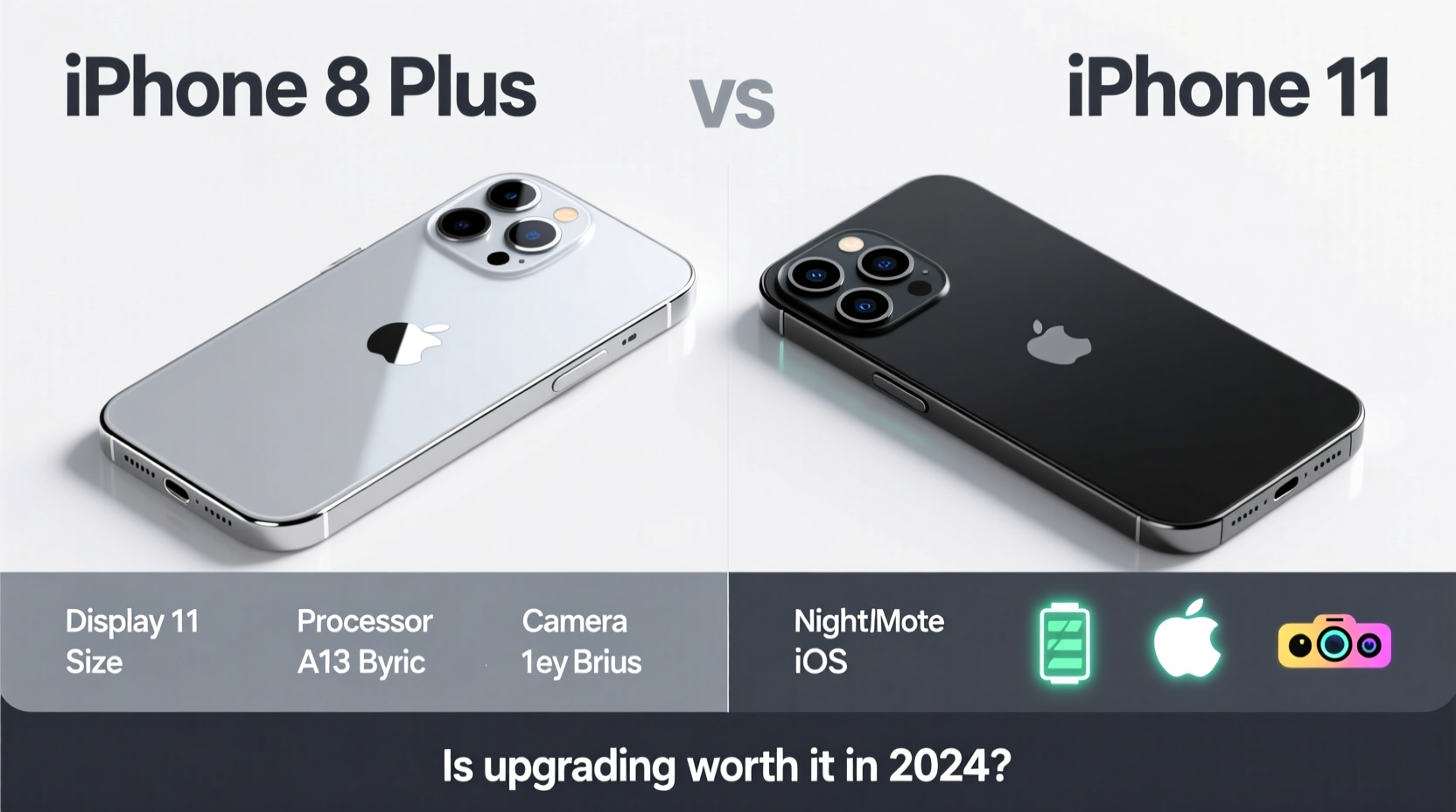
The most immediate difference between these two phones lies under the hood. The iPhone 8 Plus runs on Apple’s A11 Bionic chip, while the iPhone 11 uses the A13 Bionic. On paper, this may seem like a modest upgrade, but in practice, it translates into a dramatically smoother experience.
Apps launch faster, multitasking feels seamless, and newer iOS features run without lag on the iPhone 11. More importantly, Apple typically provides around five years of major iOS updates. The iPhone 8 Plus received its last major update with iOS 16, while the iPhone 11 continues to receive updates—including iOS 17 and expected support for iOS 18. This extended software lifecycle means better security, access to new features, and improved compatibility with modern apps.
Camera Comparison: From Good to Great
The iPhone 8 Plus featured one of the best dual-camera systems of its era: a 12MP wide and 12MP telephoto setup enabling 2x optical zoom and Portrait Mode. It delivered sharp images and reliable low-light performance for its time.
The iPhone 11 upgraded this system significantly. It retains the same dual-lens concept but improves both sensors. The primary wide lens jumps to 12MP with a larger sensor and wider f/1.8 aperture, capturing 50% more light. The second ultra-wide lens (f/2.4, 120° field of view) adds creative flexibility, letting users capture landscapes, architecture, or group shots without stepping back.
Night Mode, introduced with the iPhone 11, is a game-changer. It automatically activates in low light, producing brighter, clearer photos with accurate colors—something the iPhone 8 Plus simply cannot do. Smart HDR and Deep Fusion further enhance dynamic range and detail in mixed lighting.
“Even in 2024, the iPhone 11’s Night Mode outperforms many mid-range Android phones. It’s not just an upgrade—it’s a night-and-day difference.” — Mark Lin, Mobile Photographer & Tech Reviewer
Battery Life and Charging: Real-World Endurance
Battery degradation affects all smartphones over time, especially those using older lithium-ion cells like the iPhone 8 Plus. Even with a replacement battery, the original design limited total capacity. Apple rated the iPhone 8 Plus for up to 13 hours of video playback.
The iPhone 11 improves on this with up to 17 hours of video playback—an increase driven by both a larger battery and the power efficiency of the A13 chip. In daily use, this often means getting through a full day of heavy usage (social media, navigation, streaming) without needing a recharge.
Another practical advantage: the iPhone 11 ships with a USB-C to Lightning cable and supports faster charging (up to 50% in 30 minutes with an 18W adapter, sold separately). The iPhone 8 Plus technically supports fast charging too, but Apple didn’t include the necessary adapter in the box, making adoption less common among users.
Detailed Feature Comparison
| Feature | iPhone 8 Plus | iPhone 11 |
|---|---|---|
| Release Year | 2017 | 2019 |
| Chipset | A11 Bionic | A13 Bionic |
| Rear Cameras | Dual 12MP (Wide + Telephoto) | Dual 12MP (Wide + Ultra-Wide) |
| Front Camera | 7MP | 12MP TrueDepth with 4K video |
| Display | 5.5\" LCD (1920×1080) | 6.1\" Liquid Retina HD LCD (1792×828) |
| Water Resistance | IP67 (1m for 30 mins) | IP68 (2m for 30 mins) |
| Fast Charging | Yes (adapter not included) | Yes (cable included, adapter sold separately) |
| Wireless Charging | Yes (Qi-compatible) | Yes (Qi-compatible) |
| iOS Support (as of 2024) | Up to iOS 16 | Supports iOS 17, likely iOS 18 |
| Battery Life (Video Playback) | Up to 13 hours | Up to 17 hours |
Real-World Scenario: Sarah’s Upgrade Dilemma
Sarah has used her iPhone 8 Plus since 2018. She replaced the battery in 2021 and avoided cracks with a rugged case. But lately, she’s noticed issues: Instagram takes seconds to load, FaceTime calls drop unexpectedly, and her phone gets hot during simple tasks. She also misses being able to take clear photos at her daughter’s evening soccer games.
She considered buying another used iPhone 8 Plus, but realized that even refurbished models would face the same limitations. After testing an iPhone 11 at the Apple Store, she was struck by how quickly apps opened, how bright the screen looked outdoors, and how effortlessly Night Mode captured crisp images in dim light. For $350 (refurbished), she upgraded—and hasn’t looked back.
Sarah’s story reflects a broader trend: as apps become more demanding and cloud services rely on background processing, older chips struggle even if the hardware appears intact.
When Upgrading Makes Sense: A Practical Checklist
Not every iPhone 8 Plus user needs to upgrade. Use this checklist to decide:
- ✅ Do apps frequently crash or freeze?
- ✅ Have you stopped receiving major iOS updates?
- ✅ Is your battery life now under 6 hours of screen-on time?
- ✅ Do you want better low-light photos or wider-angle shots?
- ✅ Are you planning to keep your phone for 2+ more years?
- ✅ Do you use your phone for work, navigation, or social content creation?
If three or more apply, upgrading to the iPhone 11 (or a similar modern device) will likely improve your daily experience significantly.
Frequently Asked Questions
Can the iPhone 8 Plus still handle basic tasks in 2024?
Yes, for calls, texts, email, and light web browsing, the iPhone 8 Plus remains functional. However, performance degrades with newer apps, and lack of future iOS updates limits security and feature access.
Is the iPhone 11 waterproof?
It’s water-resistant, rated IP68—meaning it can survive up to 2 meters underwater for 30 minutes. This is an improvement over the iPhone 8 Plus (1 meter), but no iPhone should be submerged intentionally.
Will the iPhone 11 get iOS 18?
While Apple hasn’t confirmed the full list, historical patterns suggest the iPhone 11 will likely receive iOS 18, given that iOS 17 supports it. This makes it a safer long-term investment than the iPhone 8 Plus.
Final Verdict: Is the Upgrade Worth It?
For most users still on the iPhone 8 Plus, upgrading to the iPhone 11 is not just worthwhile—it’s practical. You gain two additional years of iOS support, vastly improved cameras, noticeably better battery life, and a chip that handles modern apps with ease. The larger, brighter display enhances media consumption, and the addition of Night Mode alone justifies the move for photography enthusiasts.
The cost of a refurbished or lightly used iPhone 11 (typically $250–$400 in 2024) is reasonable for the leap in functionality and longevity. When viewed as a two-to-three-year device, it offers strong value.
However, if your usage is minimal—mostly calls, messages, and occasional browsing—and your current phone still performs adequately, holding on a little longer may make sense. But recognize that each passing month reduces app optimization and security patch availability for the A11 chip.




 浙公网安备
33010002000092号
浙公网安备
33010002000092号 浙B2-20120091-4
Comments
No comments yet. Why don't you start the discussion?