
Low light photography has become a critical benchmark for smartphone cameras. As users increasingly capture moments at night—cityscapes, dinner gatherings, or moonlit walks—the ability to produce clean, detailed, and natural-looking images in dim conditions separates the good from the great. Apple’s iPhone and top-tier Android flagships like the Samsung Galaxy S24 Ultra, Google Pixel 8 Pro, and OnePlus 12 represent the pinnacle of mobile imaging. But when the sun goes down, which platform truly delivers?
The answer isn’t as simple as declaring one brand superior. Each manufacturer approaches computational photography differently, balancing hardware, software, and processing philosophy. This article breaks down the strengths and limitations of both ecosystems in low-light scenarios, backed by technical insights, real-world behavior, and expert analysis.
Understanding Low Light Photography Challenges
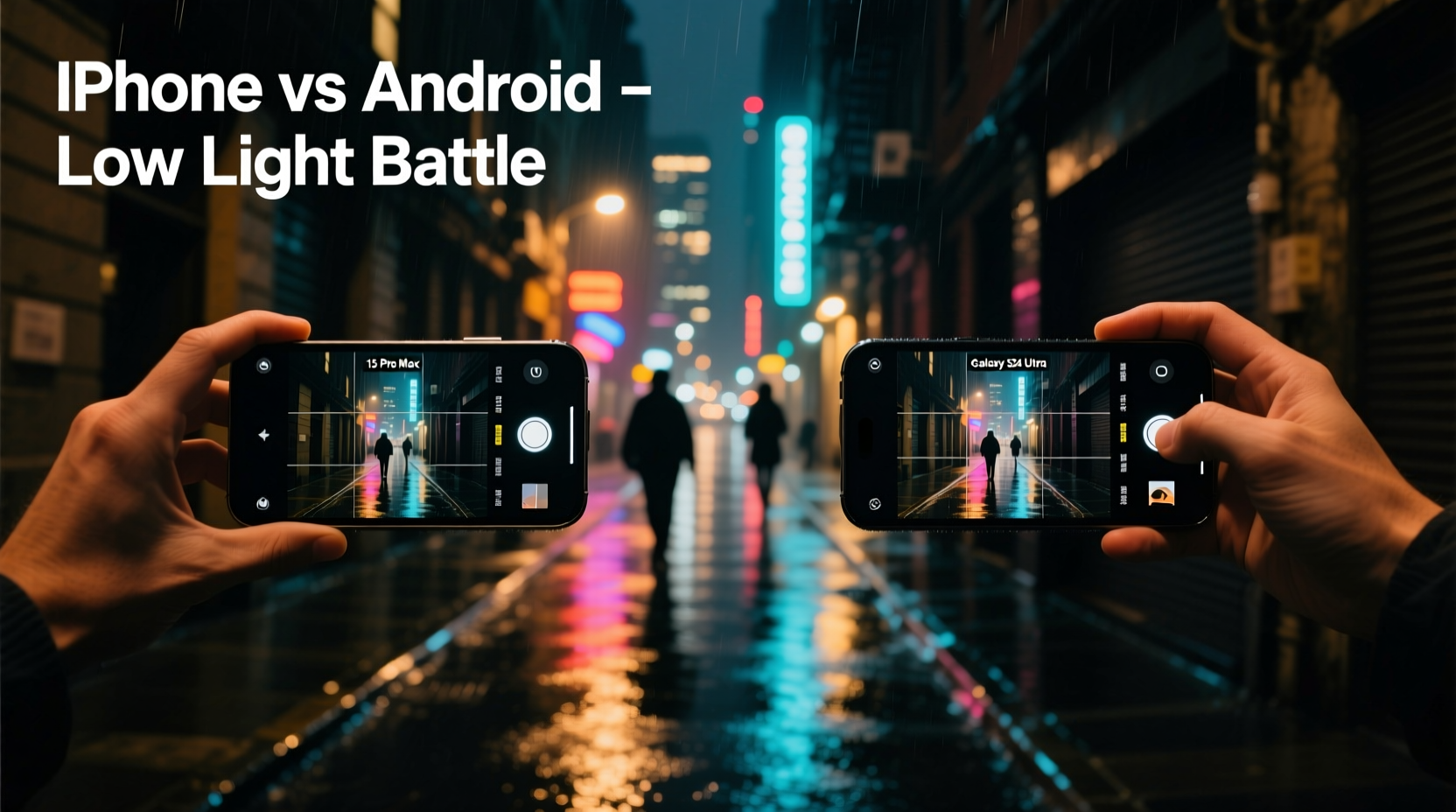
In darkness, smartphone sensors face three major hurdles: noise, motion blur, and inaccurate color reproduction. Small sensors struggle to gather enough light, forcing the camera to boost ISO (sensitivity), which introduces grain. Long exposures needed to compensate can result in blurry photos if either the subject or phone moves. Additionally, artificial lighting—like sodium vapor streetlights or warm indoor bulbs—can distort skin tones and make whites appear yellow or green.
To overcome these issues, manufacturers rely on a combination of:
- Larger sensor size – captures more photons per shot.
- Wider aperture lenses – allow more light into the sensor.
- Optical Image Stabilization (OIS) – reduces blur from hand shake.
- Advanced HDR and multi-frame stacking – combines multiple shots for better dynamic range and lower noise.
- AI-powered tone mapping and denoising – enhances details while suppressing artifacts.
While all modern flagships use these tools, their implementation varies significantly between iOS and Android devices.
iPhone's Approach: Consistency Over Aggression
Apple prioritizes realism and consistency across its camera system. The iPhone 15 Pro Max, equipped with a 48MP main sensor, larger pixels (1.22µm), and second-generation sensor-shift stabilization, shows marked improvement in low light over previous models. Its Photonic Engine pipeline processes images earlier in the stack, preserving texture and reducing noise without oversharpening.
What sets the iPhone apart is its restraint. Unlike some Android competitors, it avoids aggressive brightness boosts that wash out shadows or create unnatural halos around lights. Skin tones remain accurate under mixed lighting, and white balance rarely shifts erratically between shots.
However, this conservative approach has trade-offs. In extremely dark environments, the iPhone may underexpose scenes slightly, requiring manual adjustment via the exposure slider. Shadows retain detail but often lack punch compared to rivals that brighten aggressively. Night mode activates automatically below certain light thresholds and typically uses 3–5 second exposures, long enough to capture data but short enough to minimize blur.
“Apple doesn’t chase high scores; they chase reliability. You know what you’ll get every time.” — David Pogue, Tech Journalist and Former New York Times Columnist
Android Flagships: Pushing Brightness and Detail
Top Android phones take a bolder stance in low light. Samsung, Google, and OnePlus leverage powerful processors and custom image pipelines to extract visibility from near-darkness.
The Samsung Galaxy S24 Ultra uses a 200MP sensor (default binning to 12MP) with large 1.3µm pixels and advanced AI denoising. Its night mode brightens scenes dramatically, revealing textures in shadow areas most phones would render black. However, this sometimes comes at the cost of realism—fine details like fabric weave can appear sharpened or synthetic, and skies may show chroma noise.
The Google Pixel 8 Pro remains a standout thanks to its Super Res Zoom and Magic Eraser integration within Night Sight. Google’s HDR+ with bracketing captures multiple frames at different exposures, merging them seamlessly. It excels in preserving highlight detail (e.g., street signs or window lights) while lifting shadows naturally. Recent updates have improved skin tone accuracy, addressing past criticisms of greenish casts.
OnePlus 12, partnering with Hasselblad, emphasizes color science and analog-inspired rendering. Its Nightscape mode produces warm, cinematic images with pleasing bokeh effects. While not always the most technically precise, it appeals to users who value mood and aesthetic over clinical neutrality.
Key Differences in Processing Philosophy
| Feature | iOS (iPhone) | Android (Flagship Trio) |
|---|---|---|
| Exposure Handling | Natural, slightly conservative | Brighter, more aggressive lift |
| Noise Reduction | Moderate, preserves grain structure | Heavy, can soften fine textures |
| Color Accuracy | Highly consistent, neutral bias | Varies by brand; Pixel closest to neutral |
| Night Mode Speed | 3–5 seconds (fast activation) | 4–8 seconds (longer processing) |
| Zoom Performance (Low Light) | Solid up to 5x optical | S24 Ultra leads with 10x periscope clarity |
Real-World Example: City Night Walk Comparison
Consider a scenario where a photographer walks through downtown after sunset, capturing storefronts, pedestrians, and neon signage. Ambient light ranges from 5 lux (dark alleys) to 50 lux (well-lit avenues).
Using an iPhone 15 Pro Max, the resulting images maintain balanced contrast. A red awning stays vivid without bleeding into adjacent areas. People passing under lampposts show accurate facial tones, though their jackets in shadow appear darker than perceived by the eye. The overall impression is trustworthy—what you saw is what you get.
With the Galaxy S24 Ultra, the same scene appears brighter. Text on distant signs becomes readable. Shadow recovery reveals pavement cracks invisible to the naked eye. But upon closer inspection, edges around metal railings show slight haloing, and the sky above takes on a faint purple tint—a side effect of overzealous noise suppression.
The Pixel 8 Pro strikes a middle ground. It lifts shadows intelligently, avoiding the “flashlight effect” seen on Samsung. Colors are vibrant yet grounded. Its biggest advantage emerges in post-processing: using Magic Eraser to remove a passerby mid-exposure doesn’t degrade background quality, even in dim light.
This example illustrates a fundamental divide: the iPhone aims to document reality faithfully, while premium Androids aim to enhance perception.
Step-by-Step Guide to Maximizing Low Light Results
Regardless of device, technique plays a crucial role. Follow this sequence to get the best possible shot in dim conditions:
- Stabilize your phone – Rest it against a wall, table, or use both hands firmly. Even minor shakes ruin long exposures.
- Tap to focus – Choose a mid-brightness area (not pure black or white) to set focus and metering.
- Adjust exposure manually – Swipe up or down on-screen to brighten or darken before shooting.
- Wait for Night Mode countdown – Don’t move until the timer finishes (indicated by a shutter sound or vibration).
- Avoid digital zoom – Use the widest lens unless optical zoom is available.
- Shoot in RAW (if supported) – Provides greater flexibility in editing shadows and highlights later.
- Review immediately – Check for blur or banding under LED lights (common at night due to frequency mismatch).
Frequently Asked Questions
Do iPhones have worse low light performance than Android phones?
Not categorically. iPhones tend to produce less bright images, which some interpret as inferior. However, they maintain better color fidelity, dynamic range, and consistency. In moderate low light, the difference is minimal. Only in near-darkness do Android flagships typically pull ahead in visibility.
Is Night Mode the same across all smartphones?
No. While the principle—capturing multiple frames and combining them—is universal, execution differs. Apple’s Night mode integrates tightly with Deep Fusion and Smart HDR. Google uses machine learning to align frames and reduce noise. Samsung applies AI-enhanced super-resolution. These differences affect processing speed, detail retention, and artifact levels.
Can software updates change low light performance?
Yes. Both Apple and Google regularly refine camera algorithms via software. For example, the Pixel 8 received a \"Night Sight Astrophotography\" update months after launch, improving star detection. Similarly, iOS 17 enhanced Smart HDR for moving subjects in dim light. Keeping your phone updated ensures optimal performance.
Checklist: Optimizing Your Smartphone for Night Shots
- ✅ Clean the camera lens with a microfiber cloth
- ✅ Disable flash in camera settings
- ✅ Enable Pro or Manual mode (for exposure control)
- ✅ Use a tripod or stable surface for exposures over 3 seconds
- ✅ Avoid shooting through glass (causes reflections and blur)
- ✅ Shoot in cooler temperatures (reduces sensor noise)
- ✅ Limit app usage before photography (prevents thermal throttling)
Who Wins? A Balanced Verdict
Declaring a single winner depends on priorities.
If you value natural colors, reliable white balance, and consistent output across varying lighting, the **iPhone** is likely your best choice. Photographers who dislike heavy post-processing will appreciate its point-and-shoot excellence. Its videos in low light also remain class-leading, with smooth transitions between light zones and minimal flicker.
If your goal is to extract maximum detail from darkness, especially in static scenes, then **Android flagships—particularly the Galaxy S24 Ultra and Pixel 8 Pro—offer stronger performance**. They brighten more aggressively, resolve finer textures, and provide greater creative control through features like manual controls, astrophotography modes, and AI editing tools.
For zoom photography at night, there’s no contest: the S24 Ultra’s 10x optical periscope lens outperforms the iPhone’s 5x telephoto in clarity and light gathering. Meanwhile, the Pixel continues to impress with computational innovations that make complex edits accessible to casual users.
In essence, Apple wins on predictability; Android wins on capability.
Conclusion
The battle between iPhone and Android flagship cameras in low light reflects deeper design philosophies. Apple trusts the user to understand lighting and compose well, delivering honest representations. Android brands empower users to see beyond human vision, illuminating darkness with algorithmic confidence.
Neither approach is objectively better. Instead, choose based on how you use your phone. If you shoot quickly and share instantly, the iPhone’s reliability shines. If you love tinkering, editing, and pushing boundaries, Android offers more room to explore.




 浙公网安备
33010002000092号
浙公网安备
33010002000092号 浙B2-20120091-4
Comments
No comments yet. Why don't you start the discussion?