
When Apple released the iPhone SE (2022), it reignited a long-standing debate: Can a budget-friendly iPhone truly compete with its more expensive siblings? At $429, the iPhone SE offers flagship-level performance in a familiar design. Meanwhile, the iPhone 13 starts at $599—$170 more—and boasts modern features like a better camera, larger display, and longer battery life. But does that gap in price translate to a meaningful difference in daily use? For many users, the answer depends on priorities: raw speed and affordability versus a more complete, future-proof experience.
Performance: Power Under the Hood
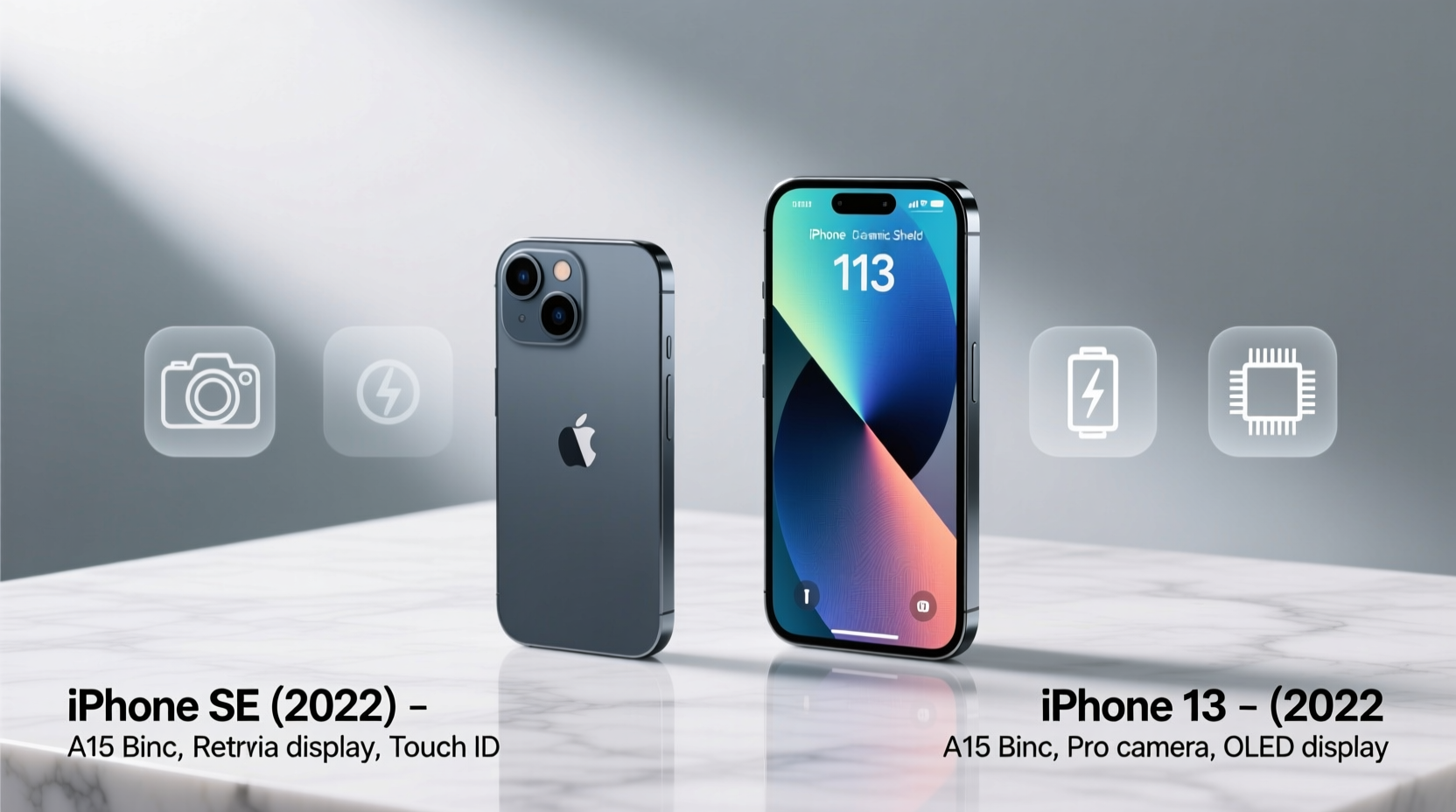
At first glance, the iPhone SE (2022) looks like a steal. It packs the same A15 Bionic chip found in the iPhone 13—Apple’s powerhouse processor built on a 5nm architecture. This means both phones handle demanding tasks like video editing, gaming, and multitasking with ease. In benchmark tests, their CPU and GPU scores are nearly identical.
However, there’s one key limitation: Apple reduced the RAM in the SE to 4GB compared to the iPhone 13’s 6GB. While iOS manages memory efficiently, this can affect app switching and long-term performance, especially as apps grow more resource-intensive over time.
Design and Display: Old School vs Modern
The most noticeable difference between these two phones is design. The iPhone SE sticks with the classic iPhone 8-style body: a 4.7-inch LCD screen, thick bezels, and a Touch ID home button. It’s compact and comfortable for one-handed use, but the screen feels outdated next to modern smartphones.
In contrast, the iPhone 13 features a 6.1-inch Super Retina XDR OLED display with slimmer bezels and Face ID. The screen is brighter, sharper, and supports HDR—making streaming, photo viewing, and web browsing significantly more immersive.
“Display quality isn’t just about size—it affects readability, eye strain, and overall user satisfaction.” — David Lin, Mobile UX Analyst
If you spend hours on your phone each day, the iPhone 13’s display upgrade alone may justify the extra cost.
Camera Comparison: More Than Just Megapixels
Both phones have a 12MP main sensor, but that’s where similarities end. The iPhone 13 includes sensor-shift optical image stabilization, a feature previously reserved for Pro models. This results in sharper photos in low light and smoother video capture.
The iPhone 13 also has a second 12MP ultra-wide lens, enabling wider shots and greater creative flexibility. The SE, limited to a single rear camera, relies on digital zoom and software tricks—often producing lower-quality results.
Video capabilities further widen the gap. The iPhone 13 supports Cinematic Mode, Dolby Vision HDR recording, and advanced stabilization. The SE maxes out at 4K at 60fps without these extras.
Real-World Example: Travel Photography
Sarah, a travel blogger, used the iPhone SE (2022) during a trip through Iceland. While she appreciated its durability and pocket-friendly size, she struggled to capture wide-angle landscapes without stitching multiple shots. Low-light shots inside glaciers were grainy, and portrait mode often failed to detect edges accurately. When she borrowed an iPhone 13 for her next trip to Portugal, the ultra-wide lens allowed full-frame shots of cliffside villages, and Night mode produced clean, vibrant images of Lisbon’s alleyways—even after sunset.
For casual shooters, the SE’s camera is sufficient. But for anyone who values photography, the iPhone 13 delivers a tangible upgrade.
Battery Life and Charging
Apple doesn’t publish official battery capacities, but real-world usage tells a clear story. The iPhone SE lasts about 10–12 hours under moderate use—a full day for light users. The iPhone 13, however, consistently delivers 14–17 hours, thanks to a larger battery and more efficient power management across its components.
Charging is another differentiator. Both support Fast Charging and Qi wireless charging, but the iPhone 13 charges slightly faster due to hardware optimizations. Neither includes a charger in the box, so you’ll need to supply your own.
Detailed Feature Comparison
| Feature | iPhone SE (2022) | iPhone 13 |
|---|---|---|
| Price (Starting) | $429 | $599 |
| Chip | A15 Bionic (same as iPhone 13) | A15 Bionic |
| RAM | 4GB | 6GB |
| Display | 4.7” Retina HD LCD | 6.1” Super Retina XDR OLED |
| Front Sensor | Touch ID (home button) | Face ID |
| Rear Cameras | Single 12MP (wide) | Dual: 12MP wide + 12MP ultra-wide |
| Video Recording | 4K@60fps, no Cinematic Mode | 4K@60fps, Dolby Vision, Cinematic Mode |
| Battery Life | ~10–12 hours | ~14–17 hours |
| Water Resistance | IP67 (up to 1m for 30 mins) | IP68 (up to 6m for 30 mins) |
| Storage Options | 64GB, 128GB, 256GB | 128GB, 256GB, 512GB |
Who Should Choose Which Phone?
The decision ultimately hinges on how you use your phone and what trade-offs you’re willing to make.
- Choose the iPhone SE (2022) if: You want maximum performance at minimum cost, prefer a smaller phone, rely on Touch ID, or need a secondary device.
- Choose the iPhone 13 if: You value camera quality, watch a lot of video, take long trips without charging access, or plan to keep your phone for 4+ years.
It’s also worth noting that the iPhone 13 runs the latest iOS versions with full feature support—something that may last longer than the SE due to hardware headroom.
Checklist: Which iPhone Fits Your Lifestyle?
- Do you prioritize photo and video quality? → iPhone 13
- Do you dislike Face ID or prefer a physical home button? → iPhone SE
- Is budget a primary concern under $450? → iPhone SE
- Do you stream movies or play games on your phone? → iPhone 13 (better screen & battery)
- Do you want a phone that will likely receive updates until 2027+? → iPhone 13
- Do you value water resistance beyond basic spills? → iPhone 13 (IP68 rating)
Frequently Asked Questions
Can the iPhone SE (2022) run the same apps as the iPhone 13?
Yes—both run the same version of iOS and support all current apps. However, future apps may begin to favor devices with more RAM, potentially affecting long-term smoothness on the SE.
Is the iPhone 13’s camera really that much better?
In daylight, both take good photos. But in low light, portraits, and video, the iPhone 13 pulls ahead significantly due to better sensors, dual lenses, and computational photography enhancements.
Will the iPhone SE get iOS updates as long as the iPhone 13?
Possibly, but not guaranteed. Apple typically supports iPhones for 5–6 years, but the SE’s lower RAM could lead to earlier deprecation of certain features, even if OS updates continue.
Final Verdict: Is the Extra Money Worth It?
The iPhone SE (2022) is an exceptional value. It proves you don’t need to spend top dollar to get core iPhone performance. For students, budget-conscious buyers, or those upgrading from older models like the iPhone 6 or 7, it’s a compelling choice.
But the iPhone 13 isn’t just “more expensive”—it’s more capable across the board. The larger, higher-quality display, superior cameras, longer battery, and enhanced durability create a noticeably better daily experience. That $170 premium buys tangible improvements that compound over time.
If you can afford the iPhone 13, it’s the smarter long-term investment. You’ll enjoy better photos, longer usability, and a more modern interface. But if every dollar counts and you value simplicity and compact size, the iPhone SE remains a powerful, legitimate option.




 浙公网安备
33010002000092号
浙公网安备
33010002000092号 浙B2-20120091-4
Comments
No comments yet. Why don't you start the discussion?