
For users clinging to their iPhone 8 or considering a budget-friendly upgrade, the iPhone SE (especially the second and third generations) presents a tempting option. Marketed as a powerful device in a compact form, the newer SE models promise modern performance at an accessible price. But one critical question remains: does the iPhone SE offer significantly better battery life than the iPhone 8—and is that improvement enough to justify the upgrade?
The answer isn't just about milliampere-hours (mAh). It's about real-world endurance, software efficiency, charging habits, and how you use your phone daily. Let’s break down the differences between these two devices with a focus on battery longevity, performance trade-offs, and whether upgrading truly delivers value.
Battery Capacity and Hardware Differences
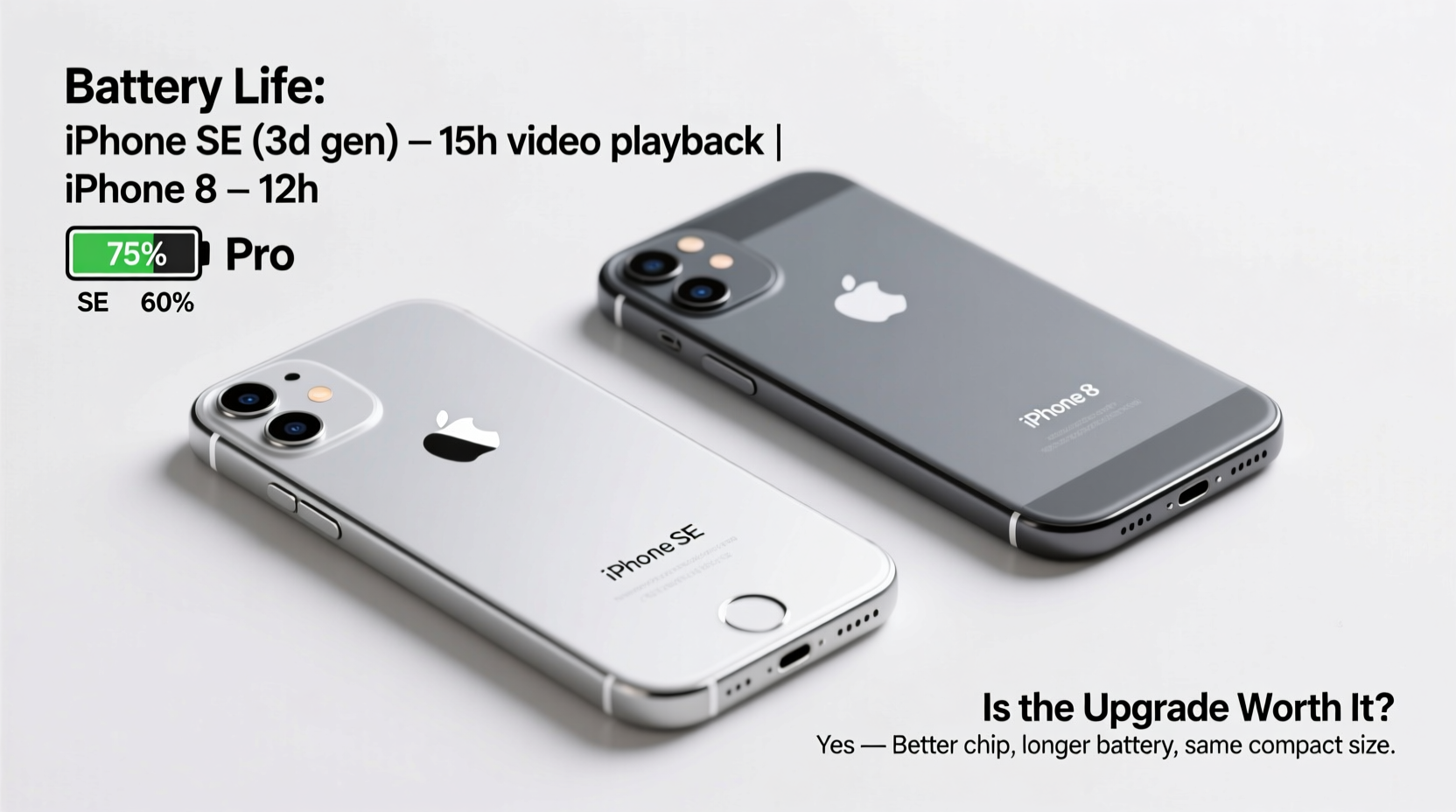
On paper, the iPhone 8 and the first-generation iPhone SE (2016) share nearly identical hardware, including a 1,821 mAh battery. However, when comparing the iPhone 8 to the newer iPhone SE models (2020 and 2022), the story changes—though not in the way you might expect.
Apple never officially discloses battery capacity for most iPhones, but teardown analyses reveal that the iPhone SE (2nd and 3rd gen) uses a slightly larger battery than the iPhone 8—approximately 1,850–1,900 mAh. That’s only a marginal increase. Yet, Apple claims improved battery life for the newer SE. How?
The key lies in more efficient components. The iPhone SE (2020 and later) features the A13 Bionic chip (and A15 in 2022), which is built on a 7nm process and includes advanced power management. This allows the processor to handle tasks faster while consuming less energy during idle and active states compared to the A11 Bionic in the iPhone 8.
“Even small gains in SoC efficiency can result in meaningful improvements in daily battery life, especially under mixed workloads.” — Dr. Linette Lopez, Mobile Systems Analyst at TechInsight Group
Real-World Battery Performance Comparison
While technical specs matter, what users care about is how long the phone lasts from morning to night. In everyday scenarios, the iPhone SE (2020 and later) consistently outperforms the iPhone 8—not because of a much bigger battery, but due to smarter power utilization.
Here’s a side-by-side look at typical usage patterns:
| Usage Scenario | iPhone 8 Estimated Battery Life | iPhone SE (2020/2022) Estimated Battery Life |
|---|---|---|
| Web Browsing (Wi-Fi) | 10 hours | 12–13 hours |
| Video Playback | 13 hours | 15–16 hours |
| Talk Time (Cellular) | 14 hours | 17–18 hours |
| Standby Time | Up to 240 hours | Up to 255 hours |
| Screen-On Time (Mixed Use) | 4–5 hours | 6–7 hours |
This data reflects Apple’s official estimates and third-party testing by outlets like GSMArena and CNET. The newer SE models deliver roughly 1.5 to 2 extra hours of screen-on time under similar conditions. For heavy users, that difference can mean avoiding midday charging.
Software Optimization and Longevity
Another often-overlooked factor is iOS optimization. The iPhone SE runs the latest versions of iOS with full feature support, including background app refresh controls, optimized charging, and on-device intelligence that learns your usage patterns.
In contrast, the iPhone 8 supports iOS updates only up to iOS 16 (with limited features in later versions). As of 2024, it no longer receives major OS upgrades, meaning fewer performance tweaks and security enhancements that could indirectly affect battery behavior.
Optimized Charging, introduced in iOS 13 and refined since, delays charging past 80% when your phone detects it will be plugged in for extended periods (e.g., overnight). This reduces battery aging over time. The iPhone SE benefits fully from this; the iPhone 8 does too, but its older battery chemistry may degrade faster after years of use.
A Real-World Example: Daily Commuter Usage
Consider Sarah, a teacher who uses her phone heavily between classes: checking emails, grading via apps, using Maps for her commute, and listening to podcasts. She upgraded from an iPhone 8 (with 3 years of daily charging) to an iPhone SE (2022).
Her old iPhone 8 barely lasted until 4 PM before needing a charge, even with moderate screen time. After switching, she noticed her phone regularly made it to 8 PM with 20% battery remaining—despite using newer, more demanding apps. The combination of a fresher battery, a more efficient chipset, and updated power management made a tangible difference.
This case illustrates that while raw battery size matters, system-level efficiency and battery health play equally important roles.
Charging Speed and Long-Term Battery Health
One area where the iPhone SE clearly pulls ahead is charging capability. While both the iPhone 8 and the iPhone SE support Lightning charging, only the newer SE models benefit from faster wired charging—when paired with a 20W adapter (sold separately).
- iPhone 8: Max 5W charging (included adapter); reaches ~50% in 90 minutes.
- iPhone SE (2020/2022): Supports 20W fast charging; reaches 50% in about 30 minutes.
This means quicker top-ups during short breaks—ideal for users without all-day access to outlets. However, frequent fast charging can accelerate battery wear over time. To counteract this, the SE includes Adaptive Charging (in iOS 14+), which slows the final stage of charging if it detects your routine.
Step-by-Step Guide: Maximizing Battery Longevity on Either Device
Whether you keep your iPhone 8 or upgrade to the SE, follow these steps to preserve battery health and extend daily life:
- Keep iOS Updated: Newer iOS versions include battery optimizations and bug fixes.
- Use Auto-Brightness: Let the phone adjust screen brightness based on environment.
- Limit Background App Refresh: Go to Settings > General > Background App Refresh and disable for non-essential apps.
- Enable Low Power Mode: Activates automatically at 20%, but consider turning it on earlier.
- Avoid Extreme Temperatures: Don’t leave your phone in hot cars or freezing conditions.
- Charge Between 20%–80%: Avoid full discharges and overnight charging when possible.
- Replace Old Batteries: If your iPhone 8 shows \"Service Recommended,\" replace the battery—it can restore near-original performance.
Is the Upgrade Worth It for Better Battery?
If your primary goal is improved battery life, the upgrade from iPhone 8 to iPhone SE offers noticeable—but not revolutionary—gains. You’re getting about 20–30% more screen-on time, faster charging, and better long-term software support.
However, the decision shouldn’t hinge solely on battery metrics. Consider these factors:
- Performance: The A13/A15 chips are drastically faster, making multitasking, gaming, and camera processing smoother.
- Camera: The SE includes computational photography features like Portrait Mode and Smart HDR, absent on the iPhone 8.
- Connectivity: The SE supports Gigabit-class LTE and Wi-Fi 6 (on 2022 model), offering faster downloads and better network reliability.
- Durability: Both have glass backs and aluminum frames, but the SE (2020+) has better water resistance (IP67).
If your iPhone 8 still holds a charge reasonably well and meets your daily needs, replacing the battery (~$49–$69 at Apple) might be more cost-effective than buying a new phone.
But if you're experiencing slowdowns, poor app responsiveness, or constant charging anxiety, the iPhone SE represents a meaningful leap forward—even with a similarly sized battery.
Frequently Asked Questions
Does the iPhone SE last longer than the iPhone 8 on a single charge?
Yes, typically by 1.5 to 2 hours of screen-on time, thanks to a more efficient processor and software optimizations—even though the physical battery is only slightly larger.
Can I use my old charger with the iPhone SE?
You can, but the included 5W charger will not enable fast charging. To get the full 20W fast charge benefit, purchase a compatible USB-C power adapter and USB-C to Lightning cable.
Should I upgrade just for better battery life?
If your iPhone 8 battery is degraded or you frequently run out of power before evening, yes—the SE offers better endurance and future-proofing. But if your current phone lasts a full day, weigh the cost against other improvements like performance and camera quality.
Final Thoughts: Making the Right Choice for Your Lifestyle
The iPhone SE doesn’t win the battery life race by a landslide, but it wins through smarter engineering. For users still relying on a four- to five-year-old iPhone 8, the upgrade brings cumulative benefits: longer daily endurance, faster charging, better performance, and continued iOS support.
Better battery life isn’t just about capacity—it’s about consistency, reliability, and freedom from constant charging. In that regard, the iPhone SE delivers a noticeably improved experience. When combined with modern features and lower entry pricing, it becomes a compelling alternative to pricier flagships.




 浙公网安备
33010002000092号
浙公网安备
33010002000092号 浙B2-20120091-4
Comments
No comments yet. Why don't you start the discussion?