
When Apple released the second-generation iPhone SE in 2020, it reignited a debate that had been simmering since the iPhone 8’s debut in 2017: in an era where smartphones are growing larger by the year, is compact design still worth sacrificing modern features for? The iPhone SE and iPhone 8 share nearly identical exteriors, but under the surface, they diverge significantly. For users torn between nostalgia, pocketability, and performance, the choice isn’t just about specs—it’s about lifestyle.
The iPhone 8 was once Apple’s mainstream workhorse—solid build, Touch ID, and wireless charging—but quickly overshadowed by taller, sleeker models with Face ID and edge-to-edge displays. The iPhone SE, however, took that same chassis and packed it with the A13 Bionic chip from the iPhone 11, making it one of the most powerful small phones ever made. So, when comparing these two devices, does physical size outweigh advancements in speed, camera quality, and software longevity?
Design and Ergonomics: The Case for Compactness
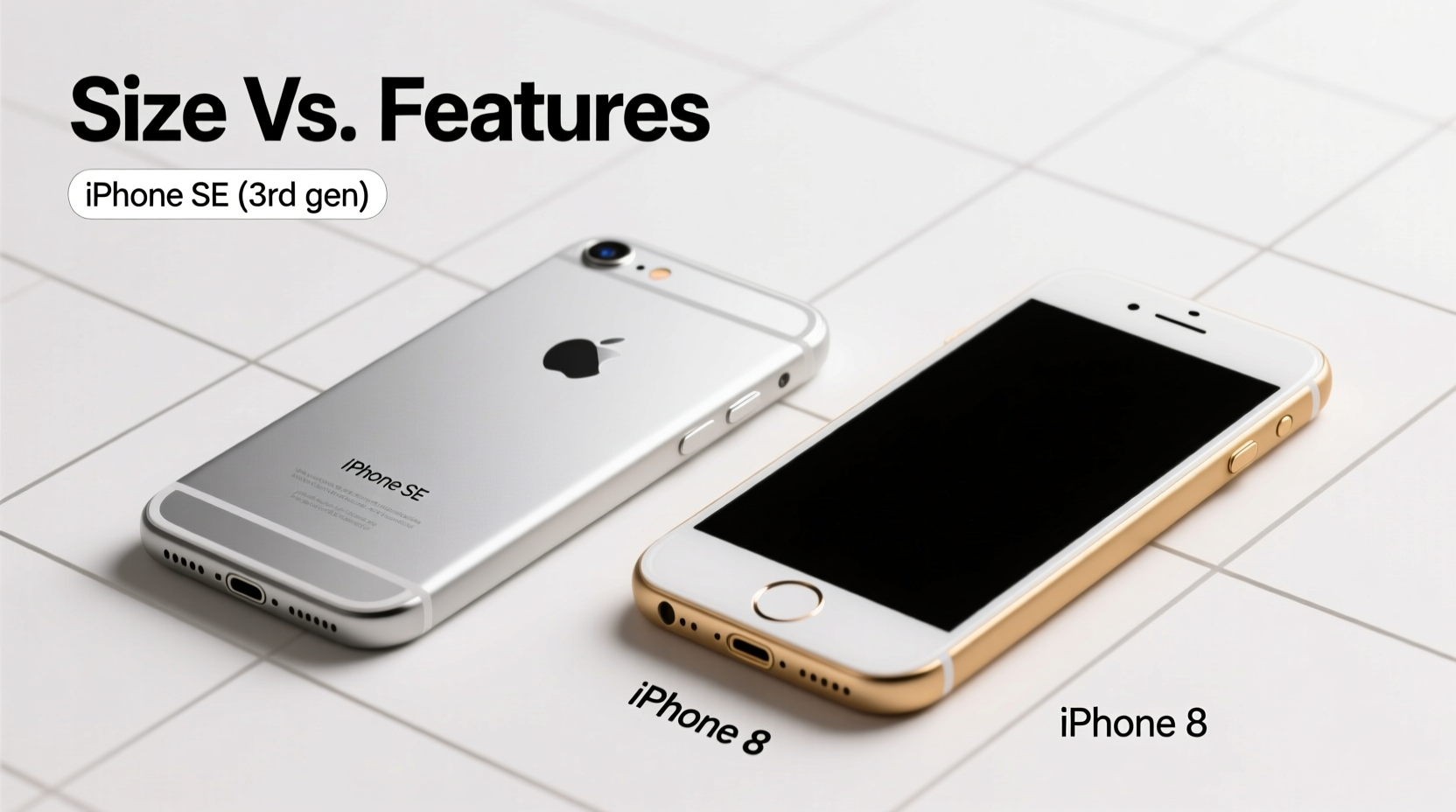
The iPhone 8 and iPhone SE (2nd gen) are almost indistinguishable at first glance. Both measure 138.4 x 67.3 x 7.3 mm and weigh 148 grams. They feature aluminum frames, glass backs for wireless charging, and 4.7-inch Retina HD displays with a 16:9 aspect ratio. In a market dominated by 6-inch+ screens, this form factor stands out as refreshingly manageable.
For many users, especially those with smaller hands or who value one-handed use, the size difference is a game-changer. Typing, scrolling, and navigating menus require less stretching and fewer adjustments. It slips easily into tight pockets, fits comfortably in small purses, and doesn’t dominate your field of vision when held upright.
However, the trade-off is clear: a smaller screen limits multitasking, media immersion, and gaming experience. Watching videos on YouTube or editing documents becomes more cramped. And while the 750p resolution is sharp for its size, it lacks the visual impact of modern OLED displays.
Performance and Software: Power Trumps Form
Under the hood, the gap between these two phones is vast. The iPhone 8 launched with the A11 Bionic chip; the iPhone SE (2020) runs the A13 Bionic—the same processor found in the iPhone 11 series. This means up to 2.5x faster CPU performance and 4x faster graphics processing.
In practical terms, the iPhone SE handles modern apps, augmented reality experiences, and multitasking with ease. It supports iOS updates longer—Apple confirmed iOS 17 compatibility for the SE, while the iPhone 8 topped out at iOS 16. That extra year or two of software support can be crucial for security, app compatibility, and feature access.
“Hardware longevity isn’t just about build quality—it’s about silicon efficiency. The A13 extends usable life far beyond what the iPhone 8 could achieve.” — David Chen, Mobile Analyst at TechPulse Insights
Both phones have 2GB of RAM, which constrains background app retention, but the SE’s superior processor mitigates this limitation better. Games like Genshin Impact run smoother, and photo processing in Lightroom or Snapseed is noticeably quicker.
Camera Comparison: More Than Megapixels
The iPhone 8 has a capable 12MP rear camera with optical image stabilization, f/1.8 aperture, and 4K video recording. It was excellent in its time. But the iPhone SE enhances this foundation with computational photography powered by the A13 chip.
The SE introduces Portrait Mode, Depth Control, and Smart HDR—features absent on the iPhone 8. While both use single-lens setups, the SE leverages machine learning to simulate depth mapping and improve dynamic range. Low-light performance is also improved thanks to better noise reduction algorithms.
| Feature | iPhone 8 | iPhone SE (2020) |
|---|---|---|
| Rear Camera | 12MP, f/1.8, OIS | 12MP, f/1.8, OIS |
| Front Camera | 7MP, f/2.2 | 7MP, f/2.2 |
| Portrait Mode | No | Yes (via software) |
| Smart HDR | No | Yes |
| Video Recording | 4K@60fps | 4K@60fps + Extended Dynamic Range |
In side-by-side tests, photos from the SE exhibit richer highlights, better shadow detail, and more natural skin tones. The front camera also benefits from Retina Flash and improved autofocus, making selfies and video calls clearer.
Real-World Usage: Who Actually Benefits From Each?
Consider Sarah, a freelance photographer who uses her phone for quick edits, client communication, and portfolio sharing. She owned an iPhone 8 for three years but found herself frustrated with slow app launches and inconsistent battery life. After switching to the iPhone SE, she noticed immediate improvements: faster export times in Adobe Lightroom, reliable FaceTime quality during outdoor shoots, and confidence that her device would receive updates through 2024.
On the other hand, Mark, a retiree who primarily uses his phone for calls, texts, and checking weather, stuck with his iPhone 8 long after others upgraded. He values simplicity and familiarity. The home button feels intuitive, and he doesn’t miss features like Portrait Mode or AR apps. For him, upgrading offered minimal benefit at additional cost.
This contrast illustrates a key insight: the decision between iPhone SE and iPhone 8 isn’t purely technical—it’s behavioral. Users who rely on their phones as productivity tools will appreciate the SE’s power. Casual users may find the older model sufficient, especially if purchased secondhand.
Battery Life and Charging: Practical Trade-offs
Battery capacity is nearly identical—iPhone 8 has a 1,821 mAh battery; the SE slightly less at 1,810 mAh. However, due to the A13’s efficiency improvements, the SE often delivers longer real-world usage. Apple rated both for up to 13 hours of video playback, but independent tests show the SE lasting 1–1.5 hours longer under mixed use.
Charging options are the same: Lightning port, 5W charger included, supports 18W fast charging (with adapter sold separately), and Qi wireless charging. Neither includes a fast charger in-box, so users must invest extra for quicker top-ups.
FAQ
Can the iPhone 8 still run current apps smoothly?
Most everyday apps like WhatsApp, Gmail, and Safari still function well on the iPhone 8. However, newer or more demanding apps—especially games or video editors—may lag or not be supported. App developers increasingly optimize for newer iOS versions and hardware, so performance degrades over time.
Is the iPhone SE waterproof?
Both the iPhone SE (2020) and iPhone 8 have an IP67 rating, meaning they can survive submersion in up to 1 meter of water for 30 minutes. They’re splash-resistant and suitable for everyday accidents, but not designed for swimming or underwater use.
Why choose the iPhone 8 over the SE if they look the same?
Unless buying used or refurbished at a steep discount, there’s little reason to pick the iPhone 8 today. The SE offers better performance, camera features, and longer software support—all at a similar price point when new. The only advantage the 8 holds is sentimental value or preference for unaltered iOS behavior without newer settings clutter.
Final Verdict: Features Win Over Size—But Not Always
Size matters—but not enough to justify ignoring technological progress. The iPhone SE proves that compact design doesn’t have to mean compromise. By reusing the iPhone 8’s body and upgrading the internals, Apple created a device that appeals to minimalists without alienating power users.
If you prioritize one-handed control, durability, and timeless aesthetics, the shared form factor of both phones remains appealing. But when it comes to future-proofing, camera quality, and daily responsiveness, the iPhone SE clearly surpasses its predecessor.
Ultimately, the answer depends on how you use your phone. For those who treat their smartphone as a tool rather than a theater screen, the blend of small size and high-end performance makes the iPhone SE the smarter choice. The iPhone 8 may have started the conversation, but the SE finishes it—with authority.




 浙公网安备
33010002000092号
浙公网安备
33010002000092号 浙B2-20120091-4
Comments
No comments yet. Why don't you start the discussion?