
The iPhone X was a landmark device—Apple’s first edge-to-edge OLED display, Face ID, and a design language that influenced years of future models. Fast forward to 2022, and the third-generation iPhone SE redefines what an affordable iPhone can be. But if you're still holding onto your iPhone X, is upgrading to the 2022 SE actually worthwhile? Or are you better off keeping your aging but iconic device?
This isn't just about specs on paper. It's about real-world usability, longevity, camera quality, software support, and whether the upgrade brings tangible benefits. Let’s break it down.
Design and Build: Nostalgia vs. Practicality
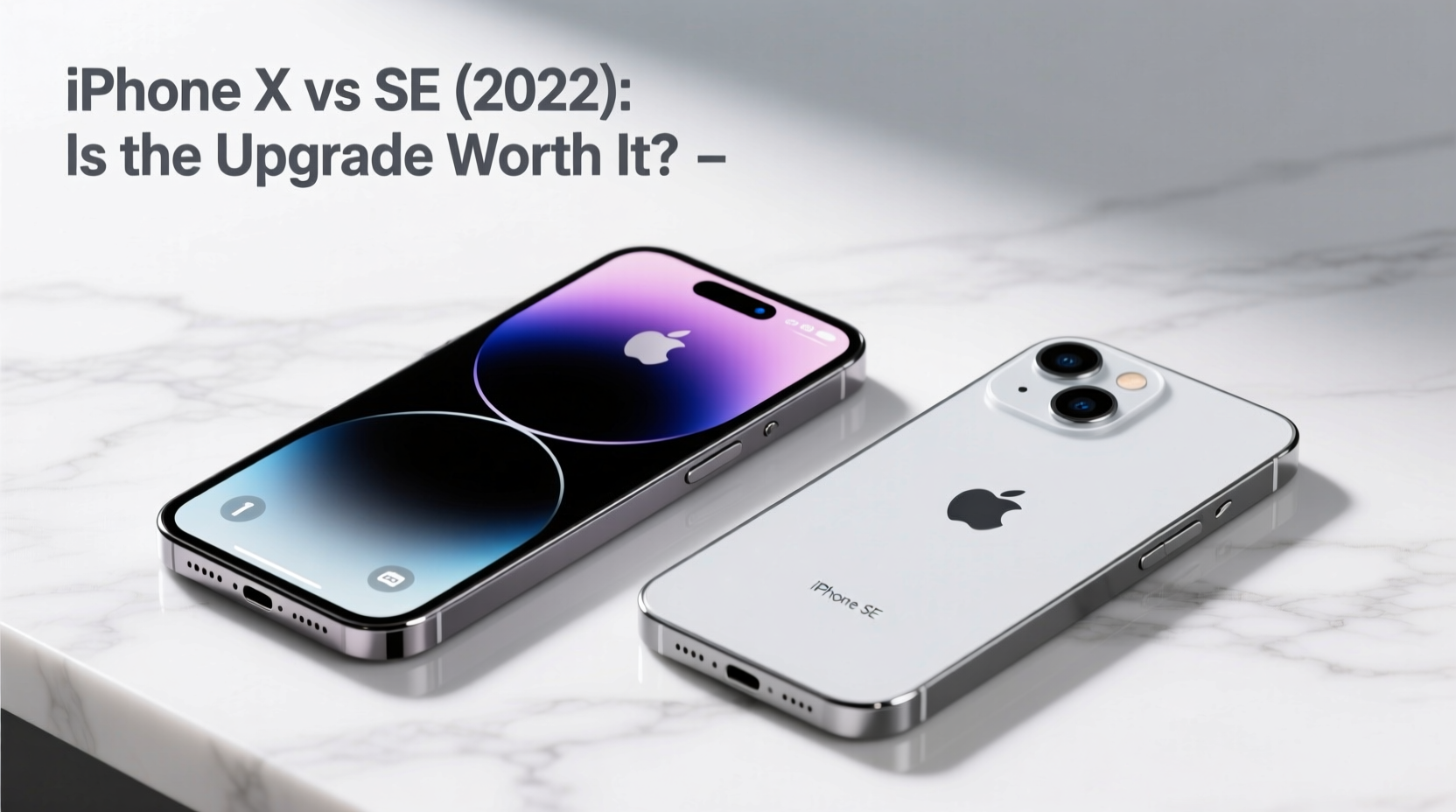
The iPhone X introduced a sleek, glass-and-stainless-steel design with a nearly bezel-less front. Its 5.8-inch Super Retina OLED display offered deep blacks and vibrant colors—a significant leap from previous iPhones. The notch became a signature feature, housing the TrueDepth camera system for Face ID.
In contrast, the 2022 iPhone SE sticks with the iPhone 8 form factor: a 4.7-inch LCD screen, thick top and bottom bezels, and a physical Home button with Touch ID. While this design feels dated compared to modern flagships, it has advantages. The smaller size makes it easier to handle one-handed, and many users still prefer the tactile feedback of a physical button over gesture navigation.
Durability is another factor. Both phones have glass backs and aluminum frames, making them susceptible to drops. However, the SE (2022) features IP67 water resistance—same as the X—so neither has a clear advantage there.
Performance: A Massive Leap Forward
Under the hood, the difference is staggering. The iPhone X launched with the A11 Bionic chip—an impressive processor in 2017. But by 2022 standards, it struggles with demanding apps, multitasking, and newer iOS updates.
The iPhone SE (2022), meanwhile, packs the A15 Bionic chip—the same found in the iPhone 13 series. This means significantly faster CPU and GPU performance, better machine learning capabilities, and improved efficiency. Real-world impact? Apps launch quicker, games run smoother, and the phone will likely remain responsive for years to come.
“The A15 Bionic gives the SE 2022 flagship-level performance in a budget body. It’s arguably the best value in smartphones today.” — Marques Brownlee, Tech Reviewer
If you’ve noticed your iPhone X slowing down—especially after iOS 15 or 16 updates—you’ll feel an immediate improvement with the SE. Background app refresh, camera processing, and even Safari tab switching are noticeably snappier.
Camera Comparison: Quality Over Quantity
The iPhone X featured a dual 12MP rear camera system (wide and telephoto) with Portrait Mode and optical image stabilization. The front-facing TrueDepth camera enabled Portrait Lighting and Animoji, which were cutting-edge at the time.
The SE (2022) only has a single 12MP rear camera and a 7MP front camera. On paper, that sounds like a downgrade. But thanks to the A15 chip’s advanced image signal processor and computational photography, the SE often matches or exceeds the X in photo quality—especially in daylight.
Night mode, Smart HDR 4, and深度融合 (Deep Fusion) bring detail and dynamic range that the X simply can’t match, even though it has two lenses. Portrait Mode is now software-based on the SE, using AI to simulate depth. It works well in ideal lighting but falters with complex edges or low light.
| Feature | iPhone X | iPhone SE (2022) |
|---|---|---|
| Chip | A11 Bionic | A15 Bionic |
| Display | 5.8\" OLED | 4.7\" LCD |
| Rear Camera | 12MP + 12MP (dual) | 12MP (single) |
| Front Camera | 7MP TrueDepth | 7MP |
| Battery Life (Video) | Up to 13 hours | Up to 15 hours |
| Biometrics | Face ID | Touch ID |
| Starting Storage | 64GB | 64GB |
| 5G Support | No | Yes (sub-6GHz) |
Software and Long-Term Value
Apple typically supports iPhones with iOS updates for 5–6 years. The iPhone X launched in 2017 and received updates through iOS 17—but performance degradation has been widely reported. Many users find iOS 16 or 17 sluggish on the A11 chip.
The SE (2022), with its A15 chip, is built to last. It launched with iOS 15 and is expected to receive updates until at least 2027. That means longer security patches, access to new features, and compatibility with future apps.
Additionally, the SE supports 5G (albeit sub-6GHz, not mmWave), giving it better future-proofing for network speeds. The X is limited to LTE, which may become a bottleneck as carriers expand 5G coverage.
Real-World Example: Sarah’s Upgrade Decision
Sarah had used her iPhone X since 2018. By 2022, she noticed frequent app crashes, slow camera processing, and battery life that barely lasted a day. She hesitated to upgrade, loving the X’s display and Face ID. But after borrowing a friend’s SE (2022), she was surprised by how fast it felt.
She made the switch. Though she missed the OLED screen, the speed improvements were transformative. Apps opened instantly, photos looked sharper, and iOS 16 ran smoothly. She also appreciated the lower price—$429 vs. the X’s original $999.
“I didn’t think a cheaper iPhone could feel so much faster,” she said. “It’s not flashy, but it does everything I need without slowing me down.”
Checklist: Should You Upgrade?
- ✅ Is your iPhone X running slowly on recent iOS versions?
- ✅ Do you want better battery life and camera performance?
- ✅ Are you looking to save money while staying in the Apple ecosystem?
- ✅ Can you live without Face ID and prefer Touch ID?
- ✅ Do you value raw performance over display quality?
If you answered yes to most of these, the SE (2022) is likely a worthwhile upgrade.
Frequently Asked Questions
Can the iPhone SE (2022) replace a flagship experience?
For most everyday tasks—messaging, browsing, social media, photography, and even gaming—the SE delivers a flagship-level experience thanks to the A15 chip. The main compromises are the smaller LCD screen and lack of advanced camera features like Night mode on the front camera or ultra-wide shooting.
Is the iPhone X still usable in 2024?
Yes, but with caveats. It runs iOS 17, but performance is inconsistent. Battery health degrades over time, and replacement batteries are harder to source. If you’re not experiencing slowdowns and don’t need 5G, it can still function as a daily driver—just don’t expect smooth performance with heavy multitasking or future iOS versions.
Why choose the SE over a newer model like the iPhone 14?
The SE offers 80% of the performance and core functionality of a high-end iPhone at less than half the price. If you don’t care about multiple cameras, OLED displays, or Face ID, the SE provides exceptional value. It’s ideal for budget-conscious users, parents buying first phones for teens, or anyone who wants a reliable, compact iPhone.
Final Verdict: Is the Upgrade Worth It?
For most iPhone X owners, the answer is yes—the 2022 iPhone SE is worth upgrading to, especially if performance, battery life, and long-term software support matter to you. While it lacks the premium design and display of the X, it compensates with a far superior processor, better camera processing, 5G connectivity, and stronger future-proofing.
The trade-offs are real: no Face ID, smaller screen, and outdated design. But if your priority is a fast, reliable iPhone that won’t break the bank, the SE (2022) delivers in ways the aging X simply can’t match.




 浙公网安备
33010002000092号
浙公网安备
33010002000092号 浙B2-20120091-4
Comments
No comments yet. Why don't you start the discussion?