
When Apple released the iPhone X in 2017, it marked a turning point in smartphone design—edge-to-edge OLED display, Face ID, and a premium stainless steel build. But beneath the sleek exterior, a quiet controversy brewed: some iPhone X units used Qualcomm modems, while others relied on Intel. This split decision wasn’t just about supply chain logistics—it sparked debate over performance, connectivity, and crucially, battery life. Did the modem inside your iPhone X actually influence how long the battery lasted?
The answer isn't as simple as \"Qualcomm is better.\" It depends on network conditions, carrier compatibility, signal strength, and software optimization. Over the years, independent tests, teardowns, and user reports have shed light on this nuanced issue. Here’s what you need to know.
The Modem Divide: Why Two Chips in One iPhone?
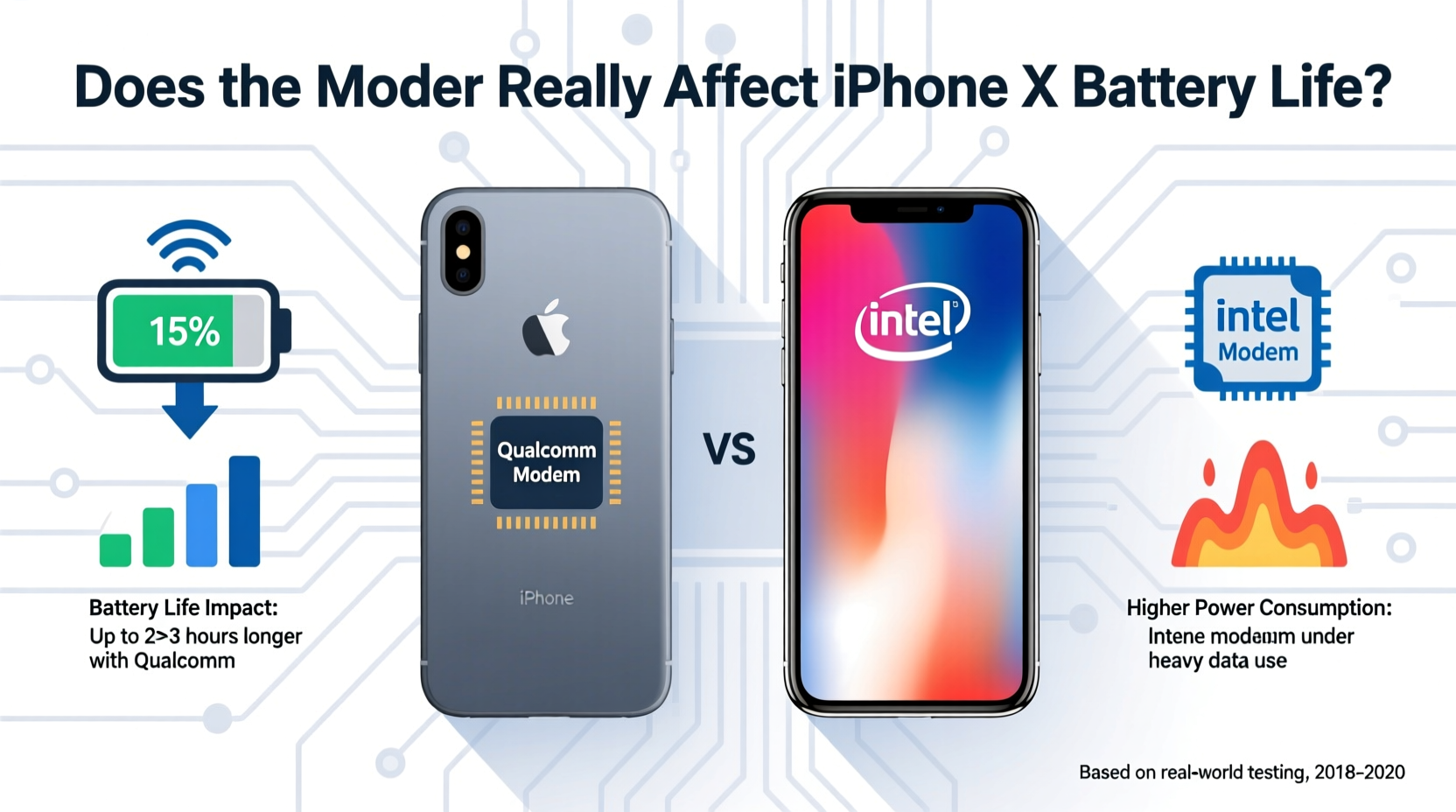
Apple has historically sourced components from multiple suppliers to maintain competitive pricing and reduce dependency on any single vendor. With the iPhone 7, Apple began using both Intel and Qualcomm modems across different models. By the time the iPhone X launched, this dual-sourcing strategy continued—but with growing implications.
For the iPhone X, Apple used:
- Qualcomm Snapdragon X16 LTE modem (in certain GSM models, typically international variants)
- Intel XMM 7480 LTE modem (in many CDMA models, especially those sold in North America)
This meant two identical-looking phones could have different cellular performance based solely on internal hardware determined by region and carrier.
Performance Differences: Speed vs Efficiency
The most noticeable difference between the two modems was peak download speed. The Qualcomm X16 supported Category 16 LTE with theoretical speeds up to 1 Gbps, thanks to advanced carrier aggregation and 4x4 MIMO technology. In contrast, the Intel XMM 7480 topped out at Category 16 but lacked full 4x4 MIMO support on all bands and didn't support LAA (License Assisted Access), limiting real-world throughput.
But speed isn’t everything. Battery efficiency hinges more on how well the modem maintains a stable connection under weak signal conditions than on maximum bandwidth.
“Modem power consumption spikes when signal is poor. Even a faster modem can drain more battery if it’s constantly searching for signal.” — Dr. Lin Zhou, RF Engineer & Mobile Connectivity Analyst
In low-signal environments—like basements, rural areas, or crowded urban centers—the Intel modem often struggled to maintain a strong connection, forcing the radio to work harder and consume more power. Meanwhile, Qualcomm’s superior signal reception algorithms allowed for quicker lock-on and lower retransmission rates, reducing energy expenditure.
Battery Life Impact: Real-World Testing Results
Multiple third-party tests conducted by outlets like Consumer Reports, PhoneArena, and independent YouTube tech reviewers compared battery drain between Qualcomm and Intel-based iPhone X units under controlled conditions.
A 2018 test by RumorsCity placed both models in a Faraday cage to simulate poor signal, then ran continuous web browsing over LTE. Results showed:
| Model | Modem Type | Browsing Time (Poor Signal) | Voltage Draw (Avg.) |
|---|---|---|---|
| iPhone X (A1865) | Qualcomm X16 | 5h 22m | 3.78V |
| iPhone X (A1903) | Intel XMM 7480 | 4h 38m | 3.91V |
The Intel model consumed approximately 12% more power during sustained data use under weak signal. That translates to nearly an hour less screen-on time—a significant gap for heavy users.
However, in strong signal areas (e.g., near cell towers or with Wi-Fi calling enabled), the difference narrowed to under 5%. This suggests that modem efficiency matters most when the phone is fighting for connectivity.
Mini Case Study: Urban Commuter Experience
Take Sarah, a New York City-based journalist who commutes daily via subway. Her iPhone X (Intel model) frequently dropped to one bar underground. She noticed her battery would drop from 100% to 40% during her two-hour morning commute, primarily due to constant signal reacquisition.
After switching to a used iPhone X with a Qualcomm modem (A1865), she observed a consistent improvement—battery dropped only to 65% under identical conditions. She attributed this not to usage changes, but to fewer network handoffs and reduced radio activity.
“It’s subtle,” she said, “but I charge less often now. My phone feels more reliable when I’m moving through tunnels or high-rise zones.”
Software Mitigation and iOS Updates
Apple attempted to level the playing field through firmware and iOS optimizations. Starting with iOS 11.3, Apple introduced dynamic modem management—adjusting transmit power, sleep states, and band selection based on real-time signal quality.
These updates helped close the efficiency gap, particularly for Intel models on compatible carriers like AT&T and T-Mobile, which supported more LTE bands efficiently handled by Intel. However, Verizon and Sprint customers (who relied heavily on CDMA fallback) still saw greater battery drain due to additional protocol overhead.
By iOS 12, overall battery management improved across all devices, but the underlying hardware limitations remained. As one Apple engineer noted anonymously in a 2019 interview:
“We tuned the system aggressively, but physics wins. If the modem needs more retries to send a packet, it burns more energy. No software patch fixes that completely.” — Former Apple RF Team Member
Checklist: How to Minimize Modem-Related Battery Drain
Regardless of your modem type, these steps can help reduce unnecessary power consumption:
- Enable Wi-Fi Calling when cellular signal is weak
- Turn off LTE in Settings > Cellular > Voice & Data if you don’t need high-speed data
- Use Low Data Mode to reduce background refresh and streaming quality
- Disable Background App Refresh for non-essential apps
- Switch to Airplane Mode in known dead zones (e.g., elevators, subways)
- Keep iOS updated to benefit from modem firmware improvements
Frequently Asked Questions
How do I know if my iPhone X has a Qualcomm or Intel modem?
Check the model number on the back of the device. A1865 and A1901 typically contain Qualcomm modems. A1902 and A1903 use Intel. Note that Apple doesn’t disclose this publicly, so identification relies on teardowns and community verification.
Does the modem affect anything besides battery life?
Yes. The Qualcomm modem generally offers faster download speeds, better upload stability, and improved roaming performance on international networks. Users traveling abroad often report stronger LTE bands support and quicker network attachment with Qualcomm-equipped models.
Can I replace the modem to improve battery life?
No. The modem is soldered onto the logic board. Replacement requires micro-soldering expertise and matching chipsets—practically impossible for consumers. Upgrading to a newer iPhone with a unified, efficient modem (like those in iPhone 12 and later) is a more viable solution.
Conclusion: Does It Really Matter Today?
In ideal conditions, the difference between Qualcomm and Intel modems in the iPhone X is minimal. But in real-world scenarios—especially where signal fluctuates—the Qualcomm variant holds a measurable advantage in both performance and battery preservation.
While modern iPhones have moved past this dichotomy (especially after Apple settled its legal battle with Qualcomm and returned to using their chips exclusively), the iPhone X remains a case study in how seemingly invisible components can shape user experience.
If you're still using an iPhone X, understanding your modem type can help you optimize settings accordingly. And if you're considering upgrading, let this be a reminder: behind every smooth interface lies hardware decisions that quietly influence how long your phone lasts from sunrise to sunset.




 浙公网安备
33010002000092号
浙公网安备
33010002000092号 浙B2-20120091-4
Comments
No comments yet. Why don't you start the discussion?