
The iPhone 6s was a landmark device when it launched in 2015. Known for its durability, solid build, and surprisingly long software support, it became one of Apple’s longest-lived iPhones. The iPhone X, released just two years later in 2017, marked a dramatic shift in design language and user experience with its edge-to-edge OLED display and Face ID. Today, many users still rely on the 6s as a secondary phone or even their daily driver. But how does it truly stack up against the iPhone X? And if you're still using a 6s, is upgrading to an X—or holding onto your current device—still a smart decision in 2024?
Design and Build: A Generational Leap
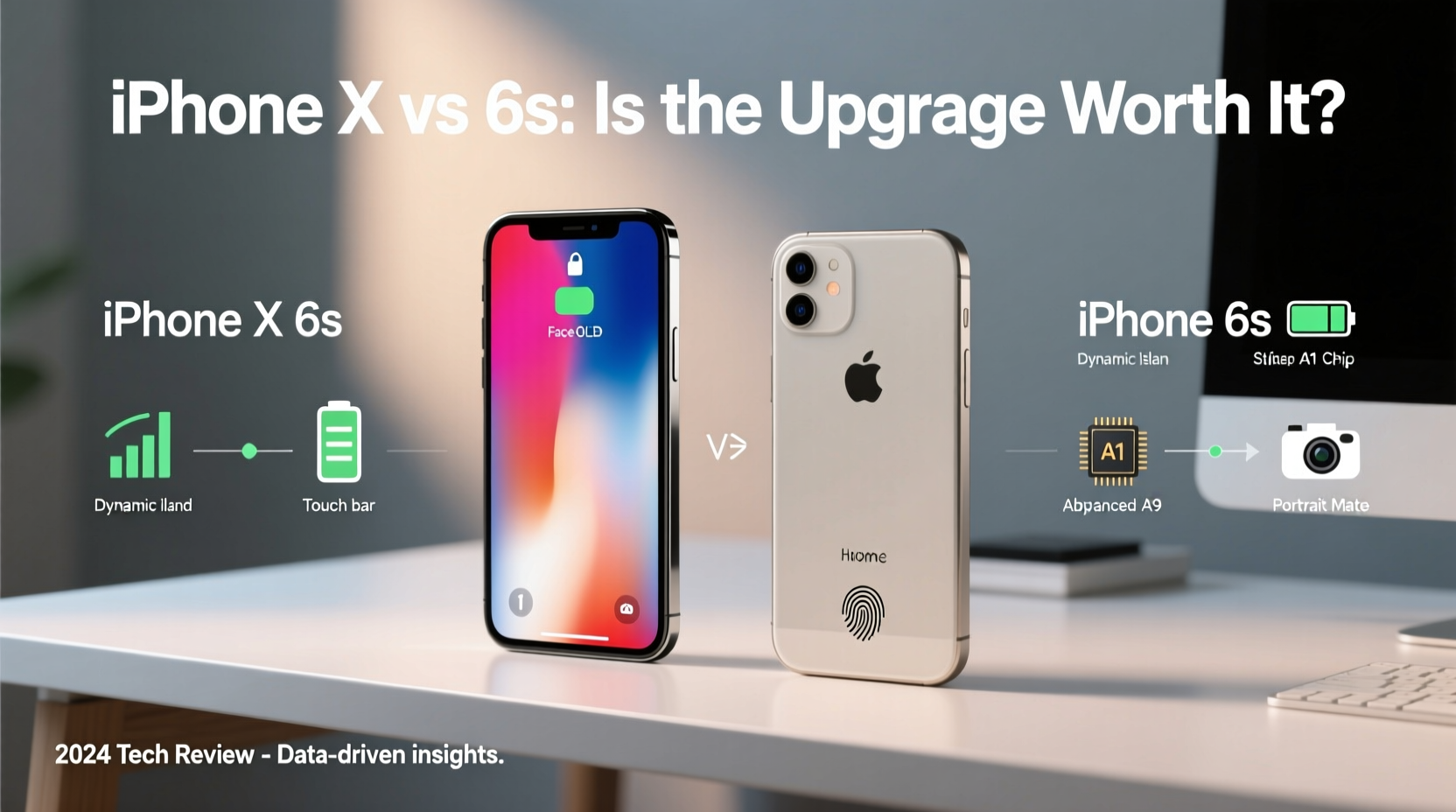
The physical differences between the iPhone X and 6s are stark. The 6s features a traditional 4.7-inch LCD screen with thick bezels, a home button with Touch ID, and an aluminum body that, while sturdy, shows wear over time. In contrast, the iPhone X introduced a 5.8-inch Super Retina OLED display, offering deeper blacks, higher contrast, and better color accuracy. Its stainless steel frame and glass back gave it a more premium feel and enabled wireless charging—a feature absent on the 6s.
The shift from the home button to gesture-based navigation on the X was controversial at first but has since become standard across Apple’s lineup. For users accustomed to Touch ID, the transition to Face ID takes adjustment, but in practice, it's fast and reliable in most lighting conditions.
Performance: Chipset and Real-World Speed
Under the hood, the difference is significant. The iPhone 6s runs on the A9 chip with 2GB of RAM, while the iPhone X uses the A11 Bionic chip with 3GB of RAM. While both devices were blazing fast in their time, the gap becomes apparent today.
In everyday tasks like opening apps, switching between them, and browsing the web, the 6s still performs adequately—but with noticeable delays in app launches and occasional stutters. The iPhone X, thanks to its more powerful processor and extra RAM, handles multitasking far more smoothly and remains capable of running modern iOS versions without major lag.
Apple continues to support both devices up to iOS 15, but neither will receive updates beyond that. However, third-party app developers are increasingly optimizing for newer hardware. Apps like Instagram, TikTok, and mobile games now demand more resources, and the 6s often struggles with longer load times or crashes.
“Even with iOS updates, older chips hit a wall when software demands exceed hardware capacity. The A11 in the X gives you breathing room the A9 simply doesn’t.” — David Lin, Mobile Hardware Analyst
Camera Comparison: Nighttime and Portrait Differences
The camera systems reflect the generational divide. The 6s has a 12MP rear camera with basic autofocus and stabilization. It captures decent daylight photos but falters in low light and lacks depth-sensing capabilities. The front-facing 5MP camera supports 720p video.
The iPhone X improves on every front: a 12MP rear sensor with optical image stabilization (OIS), dual-pixel autofocus, and significantly better low-light performance. More importantly, it introduced portrait mode using its dual-camera system (wide and telephoto lenses), allowing for background blur effects that the 6s cannot replicate.
The front camera on the X is also 7MP with Face ID sensors, enabling Animoji and better selfie quality. Video recording jumps from 1080p on the 6s to 4K at 60fps on the X.
| Feature | iPhone 6s | iPhone X |
|---|---|---|
| Rear Camera | 12MP, no OIS | 12MP + 12MP dual, OIS |
| Front Camera | 5MP, 720p video | 7MP, 1080p video, Animoji |
| Portrait Mode | No | Yes (rear and front) |
| Video Recording | 1080p@30fps | 4K@60fps |
Battery Life and Charging: Practical Daily Use
Battery degradation is a key factor after years of use. Both phones originally offered modest battery life, but real-world endurance differs. The iPhone X has a slightly larger battery (2716 mAh vs. 1715 mAh), but its OLED screen and faster processor consume more power. Still, in typical usage, the X lasts noticeably longer—about 1–2 hours more on average.
Another advantage: the iPhone X supports wireless charging and fast charging (with a compatible adapter). The 6s only charges via Lightning cable at standard speed. If you value convenience and flexibility, this is a meaningful upgrade.
Software Support and App Compatibility
As of 2024, both the iPhone 6s and iPhone X run up to iOS 15.4.1. They will not receive iOS 16 or later. This means no new features, security patches beyond mid-2023, and increasing friction with modern apps.
Some newer apps already require iOS 16 or higher. Banking apps, ride-sharing services, and productivity tools are gradually dropping support for older OS versions. While core functions like calls, messages, and email still work, the ecosystem around these phones is shrinking.
If you rely on specific apps for work or daily routines, check their current iOS requirements. Many users report that the 6s can no longer update certain apps from the App Store due to compatibility limits.
Mini Case Study: Sarah’s Decision to Upgrade
Sarah, a freelance writer in Portland, used her iPhone 6s for nearly seven years. She appreciated its compact size and reliability. But by early 2023, she noticed issues: her banking app stopped updating, WhatsApp became sluggish, and her camera couldn’t handle dimly lit coffee shops where she often worked.
She considered repairing the 6s but found that even with a new battery and screen, performance didn’t improve. After borrowing an iPhone X from a friend, she was struck by the smoother interface, better camera, and ability to use all her essential apps without delay. She upgraded and reported feeling “relieved” by the improved responsiveness—even if the larger screen took some getting used to.
Is Upgrading Worth It in 2024?
The answer depends on your needs. If you're using the 6s as a backup phone, for emergencies, or for a child who only needs calls and texts, it may still serve a purpose. But as a primary smartphone, its limitations are becoming critical.
The iPhone X offers tangible improvements: a better display, faster performance, superior cameras, and modern features like Face ID and wireless charging. Even though it’s no longer supported by Apple, its hardware is better equipped to handle current apps and workflows.
However, if budget is a concern, consider that both models are outdated by today’s standards. Instead of choosing between two discontinued iPhones, you might get more value from a newer entry-level model like the iPhone SE (3rd gen) or iPhone 11, which offer current iOS support, better performance, and longer viability.
Checklist: Should You Upgrade from iPhone 6s to iPhone X?
- ✅ Are you experiencing frequent app crashes or slow performance?
- ✅ Has your battery degraded below 80% health?
- ✅ Are key apps no longer available or updating on your device?
- ✅ Do you want better photo quality, especially in low light?
- ✅ Are you comfortable with gesture navigation and Face ID?
- ✅ Can you find a used iPhone X in good condition at a reasonable price?
Frequently Asked Questions
Can the iPhone 6s still be used in 2024?
Yes, but with caveats. It can handle basic tasks like calling, texting, and light browsing. However, app compatibility, performance, and lack of security updates make it risky as a primary device, especially for online banking or sensitive data.
Is the iPhone X better than the 6s for photography?
Significantly. The X has optical image stabilization, dual cameras for zoom and portrait mode, better low-light performance, and 4K video. The 6s lacks these features and produces softer, noisier images in anything but ideal lighting.
Should I repair my 6s or upgrade?
If repair costs exceed $50 and you rely on your phone daily, upgrading makes more sense. Spending money to extend the life of a device that won’t receive new software may not be cost-effective long-term.
Final Thoughts
The iPhone 6s was a remarkable device that outlasted expectations. But technology moves quickly, and by 2024, its age shows in every aspect—from app compatibility to camera quality. The iPhone X, while also discontinued, represents a major step forward in design, performance, and user experience.
If you’re still on a 6s, upgrading to an X will feel like a modernization, not just an incremental change. But don’t stop there. Explore newer models that offer active iOS support, better longevity, and features designed for how we use phones today.




 浙公网安备
33010002000092号
浙公网安备
33010002000092号 浙B2-20120091-4
Comments
No comments yet. Why don't you start the discussion?