
The iPhone 6 Plus was a landmark device when it launched in 2014—Apple’s first large-screen iPhone, setting a new standard for usability and media consumption. Fast forward to 2017, and the iPhone X redefined design with its edge-to-edge OLED display and Face ID. For users still clinging to the iPhone 6 Plus, the question isn’t just about newer features—it’s whether upgrading to the iPhone X delivers enough value, particularly in terms of screen size and overall experience.
While both phones offer a 5.5-inch form factor on paper, the reality of their displays couldn't be more different. Understanding these differences—and how they affect daily use—is key to determining if the upgrade is truly worth it.
Display Technology: A Night-and-Day Difference
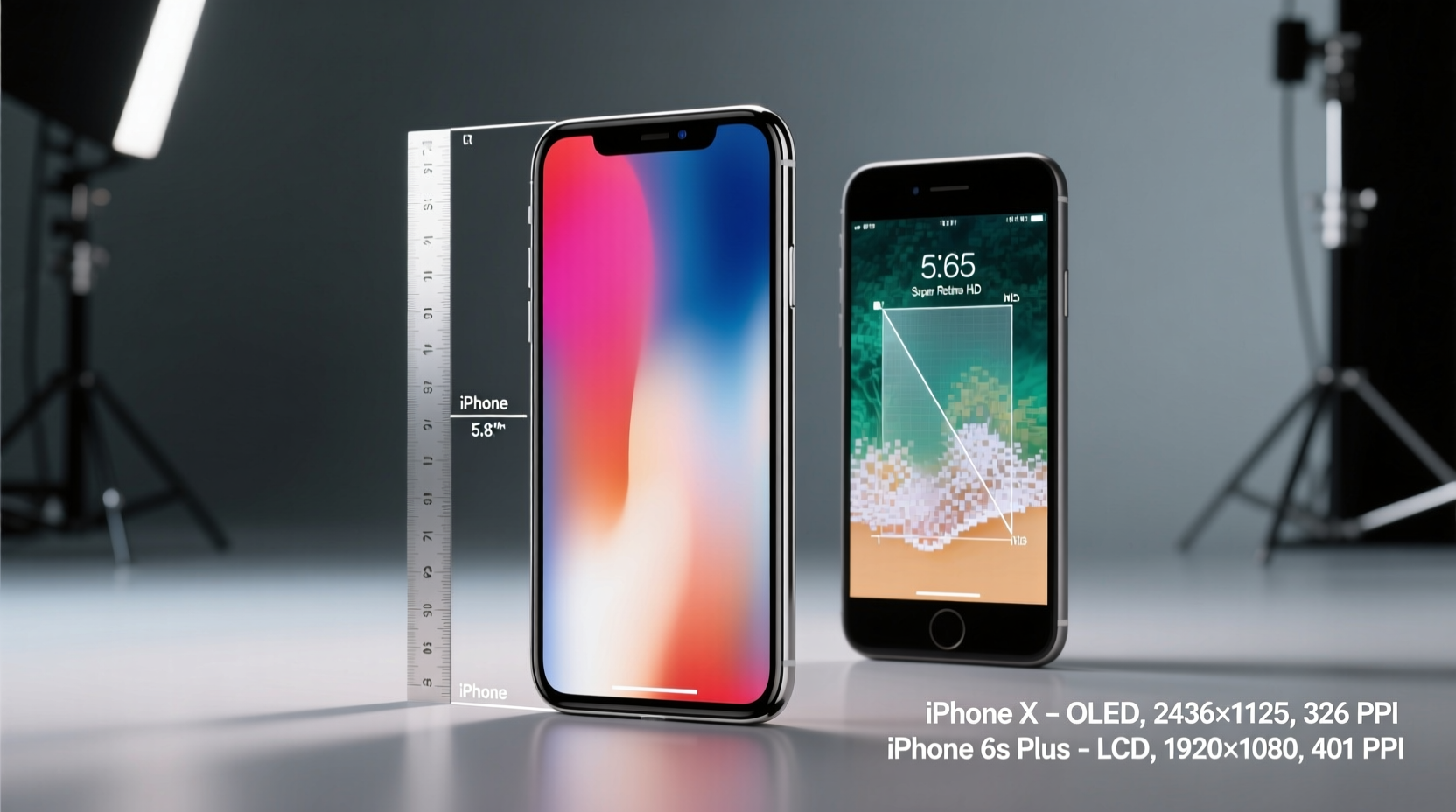
At first glance, both the iPhone 6 Plus and iPhone X appear to have similar screen sizes: 5.5 inches diagonally. However, this number tells only part of the story. The iPhone 6 Plus uses an LCD (IPS) panel, while the iPhone X introduced Apple’s first OLED display in an iPhone.
OLED technology offers deeper blacks, higher contrast ratios, and more vibrant colors. More importantly, because OLED pixels emit their own light, black pixels are truly off, resulting in infinite contrast—a feature especially noticeable in dark mode interfaces or video playback.
| Feature | iPhone 6 Plus | iPhone X |
|---|---|---|
| Screen Size | 5.5 inches | 5.8 inches |
| Display Type | IPS LCD | Super Retina OLED |
| Resolution | 1920 × 1080 | 2436 × 1125 |
| Pixels Per Inch (PPI) | 401 | 458 |
| Aspect Ratio | 16:9 | 19.5:9 |
| True Tone | No | Yes |
| HDR Support | No | Yes (HDR10 & Dolby Vision) |
The iPhone X’s taller 19.5:9 aspect ratio makes better use of vertical space, allowing more content to be visible at once—especially useful for web browsing, messaging, and social media. Despite being slightly taller, the iPhone X is actually shorter in height than the 6 Plus due to reduced bezels, making it more pocketable despite the larger usable screen area.
Design and Usability: From Bezel to Bezel-Less
The iPhone 6 Plus marked the beginning of Apple’s large-screen era but retained thick top and bottom bezels. In contrast, the iPhone X eliminated the home button and dramatically minimized bezels, pushing the display almost to the edges. This shift wasn’t just aesthetic—it changed how users interact with the device.
Without a physical home button, the iPhone X introduced gesture-based navigation: swipe up to return home, swipe up and hold for app switcher, and use Face ID for unlocking. While there's a learning curve, most users adapt within a few days. The result is a more immersive experience where the screen dominates the front face.
Additionally, the glass back on the iPhone X enables wireless charging—a feature absent on the 6 Plus. Though not directly related to screen size, it reflects a broader leap in functionality and modernity.
“Moving from the iPhone 6 Plus to the X feels like jumping from standard definition to HD TV—not just sharper, but fundamentally more engaging.” — Mark Tran, Mobile UX Designer
Performance and Longevity: Beyond the Display
Upgrading isn’t just about screen size—it’s about future-proofing. The iPhone 6 Plus runs on the A8 chip, which by today’s standards struggles with multitasking, augmented reality apps, and even some modern web experiences. The iPhone X, powered by the A11 Bionic chip with Neural Engine, handles demanding tasks effortlessly.
This performance gap affects real-world usability. Apps launch faster, photos process instantly, and iOS updates are supported much longer on the iPhone X. As of 2024, the iPhone X supports up to iOS 16, while the 6 Plus topped out at iOS 12—meaning critical security patches and feature improvements are no longer available.
- Faster app launches and smoother animations
- Better multitasking and background app retention
- Support for AR experiences and advanced camera features
- Longer software support and security updates
Camera Comparison: Evolution in Every Frame
The camera systems reflect the generational leap between these devices. The iPhone 6 Plus has a single 8MP rear camera with basic autofocus and no optical image stabilization for video. The iPhone X features a dual 12MP system (wide and telephoto), OIS, Portrait Mode, and Portrait Lighting—powered by machine learning.
In practical terms, this means the iPhone X captures sharper low-light photos, offers 2x optical zoom, and creates professional-looking depth effects. Front-facing, the 6 Plus has a 1.2MP FaceTime camera, while the X introduces the 7MP TrueDepth camera with Animoji, better low-light performance, and reliable Face ID.
For users who take frequent photos or use video calls, the upgrade is transformative—even if screen size were identical.
Real-World Example: Sarah’s Upgrade Journey
Sarah had been using her iPhone 6 Plus since 2015. She loved the screen size for reading news and watching YouTube, but over time, she noticed her phone slowing down, apps crashing, and battery life dropping below half a day. After upgrading to an iPhone X (refurbished), her experience changed overnight.
“I thought I was just getting a newer version of the same size,” she said. “But the screen felt bigger even though the phone wasn’t. Videos looked richer, text was crisper, and I could finally use Face ID instead of typing my password all the time. Plus, my photos actually look good now.”
She also appreciated the extra vertical space when scrolling through Instagram or emails—something she didn’t realize she was missing until she had it.
Is the Upgrade Worth It? A Practical Checklist
If you're still on the fence, ask yourself the following questions. Check each one that applies:
- Do you frequently experience app crashes or lag?
- Is your battery life less than 6 hours under normal use?
- Are you unable to update to the latest iOS version?
- Do you watch videos or read on your phone regularly?
- Do you want better photo quality, especially in low light?
- Have you considered switching to Face ID or wireless charging?
If three or more apply, the iPhone X (or a similar modern device) is likely a worthwhile upgrade—even if screen size seems comparable on paper.
Frequently Asked Questions
Does the iPhone X feel much larger in hand than the 6 Plus?
No—it actually feels more compact despite the larger screen. The reduced bezels and optimized design make it easier to hold and use one-handed, even with a slightly taller display.
Can I expect better battery life on the iPhone X?
Battery capacity is slightly smaller, but thanks to the efficient OLED display and A11 chip, real-world usage is comparable or slightly better. However, heavy users may still need to charge by evening.
Is the iPhone X still supported with iOS updates?
As of 2024, the iPhone X supports up to iOS 16. It does not receive iOS 17 or later, so while it’s secure for now, it’s nearing end-of-life. Consider newer models if long-term support is a priority.
Final Verdict: More Than Just Screen Size
The upgrade from iPhone 6 Plus to iPhone X isn’t just about screen size—it’s about screen quality, usability, performance, and longevity. While both devices sit around 5.5 inches, the iPhone X delivers a significantly more modern, immersive, and functional experience.
The OLED display offers richer visuals, the gesture interface maximizes screen real estate, and the hardware ensures smooth performance for years. Combined with superior cameras, Face ID, and wireless charging, the iPhone X represents a true generational leap.
If you’re holding onto a 6 Plus for the screen size, know this: the iPhone X gives you more screen utility in a sleeker package, along with countless upgrades that enhance every interaction.




 浙公网安备
33010002000092号
浙公网安备
33010002000092号 浙B2-20120091-4
Comments
No comments yet. Why don't you start the discussion?