
Choosing between upgrading from an iPhone XR to a Samsung Galaxy S10 Plus isn’t just about brand loyalty—it’s about what your phone can actually do when you raise it to capture a moment. The camera is often the deciding factor for users switching ecosystems. While Apple has long championed natural color science and consistent processing, Samsung introduced a multi-lens powerhouse with the S10 Plus. But does that translate into a meaningful upgrade for everyday photographers?
This analysis dives deep into real-world performance, comparing not just specs but how both devices handle lighting, detail retention, dynamic range, and video. Whether you're considering a switch or simply evaluating your next device, this breakdown delivers clarity on whether the S10 Plus truly outshines the XR.
Camera Specifications at a Glance
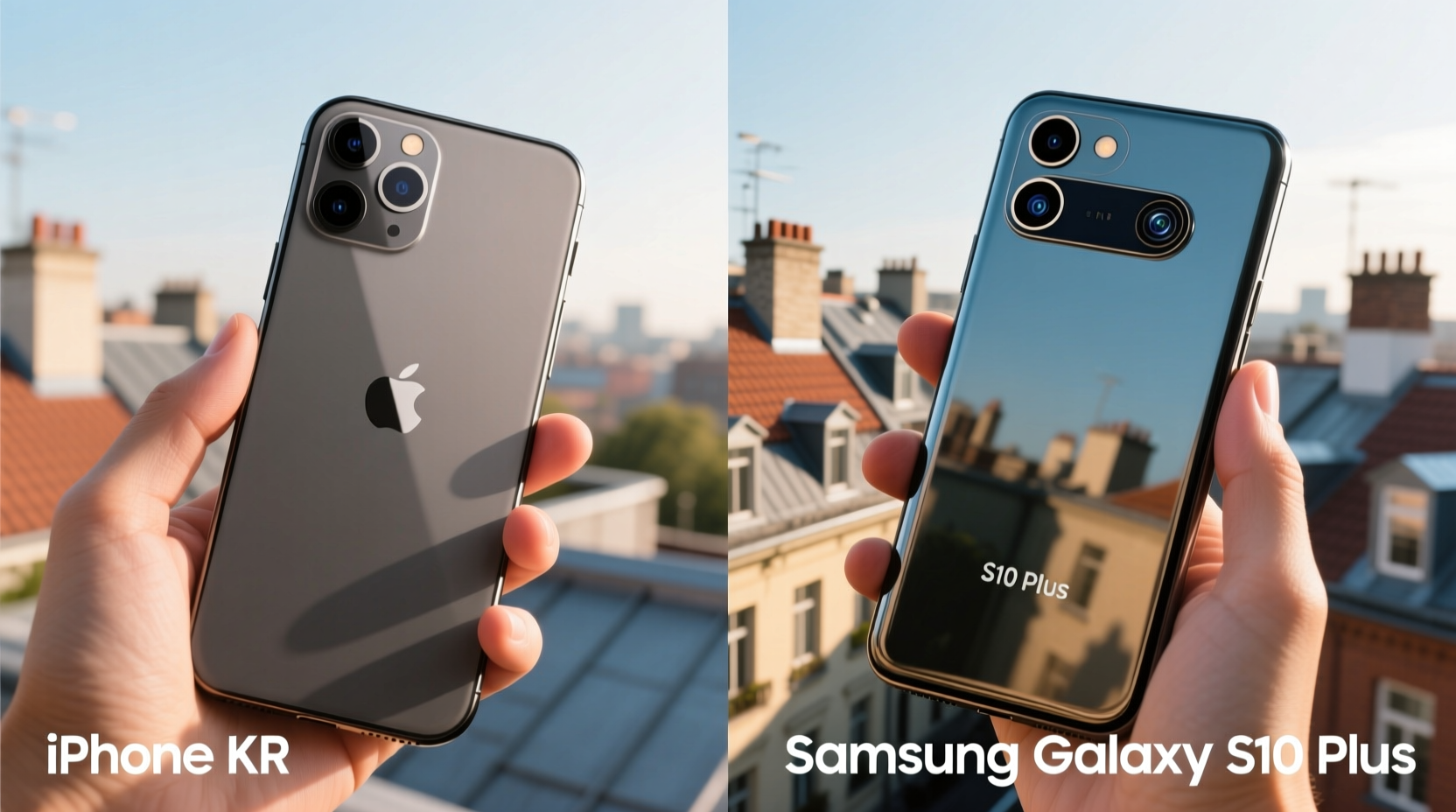
The hardware differences between these two phones are significant and set the stage for divergent photography experiences.
| Feature | iPhone XR | Samsung Galaxy S10 Plus |
|---|---|---|
| Rear Cameras | Single 12MP f/1.8 wide | Trio: 12MP f/1.5–f/2.4 wide, 12MP f/2.4 telephoto, 16MP f/2.2 ultrawide |
| Front Camera | 7MP f/2.2 | Dual: 10MP f/1.9 + 8MP RGB depth |
| Optical Zoom | No | 2x telephoto zoom |
| Ultrawide Lens | No | Yes (123° FoV) |
| Portrait Mode | Software-based (single lens) | Supported on front and rear (multiple lenses) |
| Video Recording | 4K @ 60fps, extended dynamic range | 4K @ 60fps, HDR10+ support |
The S10 Plus clearly wins on paper. Three rear cameras offer flexibility the XR can't match—especially the ultrawide and optical zoom. However, hardware alone doesn’t guarantee better photos. Software tuning, image processing, and consistency matter just as much.
Photo Quality in Real-World Conditions
In daylight, both phones produce compelling results, but their philosophies differ. The iPhone XR favors true-to-life colors, balanced contrast, and minimal post-processing artifacts. Skin tones remain accurate, skies retain natural blues, and highlights roll off smoothly without harsh clipping.
The S10 Plus, by contrast, leans into vibrancy. Greens pop, reds intensify, and contrast is boosted—giving images a “ready-to-post” look. This may appeal to social media users, but professionals or purists might find it oversaturated. Samsung's AI scene optimizer often kicks in automatically, enhancing greenery or sky details, which can lead to inconsistent results across similar shots.
In mixed lighting—such as shaded areas with bright backgrounds—the XR handles dynamic range more gracefully. Its single sensor uses Smart HDR effectively, preserving highlight detail in clouds while lifting shadows without introducing noise. The S10 Plus sometimes over-processes, creating haloing around edges or flattening textures in an attempt to balance exposure.
Low-Light Performance: Where Hardware Meets Processing
Night photography has become a benchmark for smartphone cameras. The S10 Plus benefits from larger sensors and variable aperture (f/1.5–f/2.4), allowing more light intake in dark settings. In practice, its night mode—though not labeled as such at launch—uses multi-frame stacking to brighten scenes significantly.
However, aggressive noise reduction can smear fine details. Hair texture, fabric patterns, or architectural lines often appear blurred. The iPhone XR lacks Night Mode (introduced later on iPhone 11), so low-light shots rely on computational stabilization and longer exposures. While brighter scenes fare well, dim environments result in noisier, darker images with less visibility in shadows.
“Multi-frame processing gives Android an edge in brightness, but Apple still leads in preserving natural textures and avoiding artificial smoothing.” — David Kim, Mobile Imaging Analyst at DXOMARK
If your priority is visibility in near-dark conditions, the S10 Plus delivers brighter results. But if you value realism and detail fidelity, the XR’s approach remains preferable despite lower luminance.
Zoom and Ultrawide: Flexibility vs. Necessity
The absence of optical zoom on the iPhone XR means all zoomed shots are digital—cropped and upscaled. At 2x, results are acceptable; beyond that, quality degrades quickly. The S10 Plus offers true 2x optical zoom via its telephoto lens, delivering sharper portraits and distant subjects.
Its 16MP ultrawide lens opens creative possibilities—ideal for architecture, landscapes, or group selfies in tight spaces. Distortion is well-controlled at the edges, and automatic stitching between main and ultrawide shots works seamlessly in gallery previews.
Still, many users rarely use ultrawide or zoom. For casual shooters focused on standard compositions, the XR’s single high-quality lens may be sufficient. The S10 Plus adds versatility, but only matters if you actively use those features.
Video Capabilities: Stability and Detail
Both phones record 4K video at 60fps with excellent stabilization. The XR excels in smooth motion handling, thanks to Apple’s industry-leading gyro-based correction. Footage maintains clarity even while walking or filming from moving vehicles.
The S10 Plus matches resolution and frame rate but shows slightly more wobble in aggressive motion. Audio recording is clearer on the iPhone, with better wind noise suppression. Additionally, the XR supports extended dynamic range for video, offering superior highlight retention in backlit scenes.
For vloggers and mobile creators, the S10 Plus offers one advantage: dual front cameras allow simultaneous selfie and depth-effect recording. You can overlay bokeh effects or adjust background blur after filming—a niche but fun feature.
Mini Case Study: Travel Photography in Barcelona
Consider Sarah, a travel blogger using her iPhone XR during a trip to Barcelona. She captures Gaudí’s mosaics at Park Güell, narrow alleys in the Gothic Quarter, and sunset views from Bunkers del Carmel.
She struggles to fit wide panoramas into a single frame, resorting to panorama mode. At dusk, her photos lack brightness compared to fellow travelers using Samsung devices. When photographing distant details on Sagrada Família, digital zoom fails to deliver crispness.
After switching to the S10 Plus, she gains immediate advantages: ultrawide captures full facades effortlessly, dual pixel autofocus keeps fast-moving street performers sharp, and nighttime cityscapes appear dramatically brighter. However, she notices skin tones in her vlogs sometimes appear too warm, requiring manual white balance adjustments.
The upgrade enhanced her creative range—but required learning new tools and managing over-processing tendencies.
Checklist: Is the Upgrade Worth It for You?
Before making the jump, evaluate your needs with this practical checklist:
- ✅ Do you frequently shoot landscapes or architecture? → S10 Plus ultrawide helps
- ✅ Do you take portraits with zoomed framing? → S10 Plus offers optical zoom
- ✅ Do you prioritize vibrant, social-ready photos? → S10 Plus enhances saturation
- ✅ Do you value natural colors and consistency? → XR remains strong
- ✅ Are you active in low-light environments (concerts, dinners)? → S10 Plus performs brighter
- ✅ Do you dislike editing or tweaking photos? → XR requires less correction
If four or more apply to the left column, the S10 Plus likely offers tangible benefits. If you lean toward the right, sticking with iOS—or upgrading within the ecosystem—might serve you better.
Frequently Asked Questions
Can the iPhone XR do portrait mode without a second lens?
Yes. Using machine learning and depth mapping from focus pixels, the XR creates convincing bokeh effects on people. It works best with clear subject separation and good lighting.
Does the S10 Plus have better front camera quality?
Objectively, yes. The dual front setup allows true depth sensing and autofocus. Selfies show more detail, and portrait selfies have more accurate edge detection than the XR’s software-only version.
Is the camera difference enough to switch from iOS to Android?
It depends. If camera versatility is your top priority, yes. But consider ecosystem integration—iCloud, iMessage, FaceTime, and app continuity—before abandoning iOS for hardware advantages.
Final Verdict: Is the Upgrade Worth It?
The Samsung Galaxy S10 Plus offers measurable improvements in camera flexibility: optical zoom, ultrawide framing, and stronger low-light output. These are real advantages for users who push their phones creatively or professionally.
Yet the iPhone XR holds its ground with reliable color accuracy, excellent video, and consistent processing. It proves that a single, well-tuned camera can compete with multi-sensor arrays in many scenarios.
The upgrade is worth it if you value photographic options and shoot in varied conditions. But if you prefer simplicity, natural results, and seamless ecosystem integration, staying with the XR—or moving to a newer iPhone—may be the smarter path.




 浙公网安备
33010002000092号
浙公网安备
33010002000092号 浙B2-20120091-4
Comments
No comments yet. Why don't you start the discussion?