
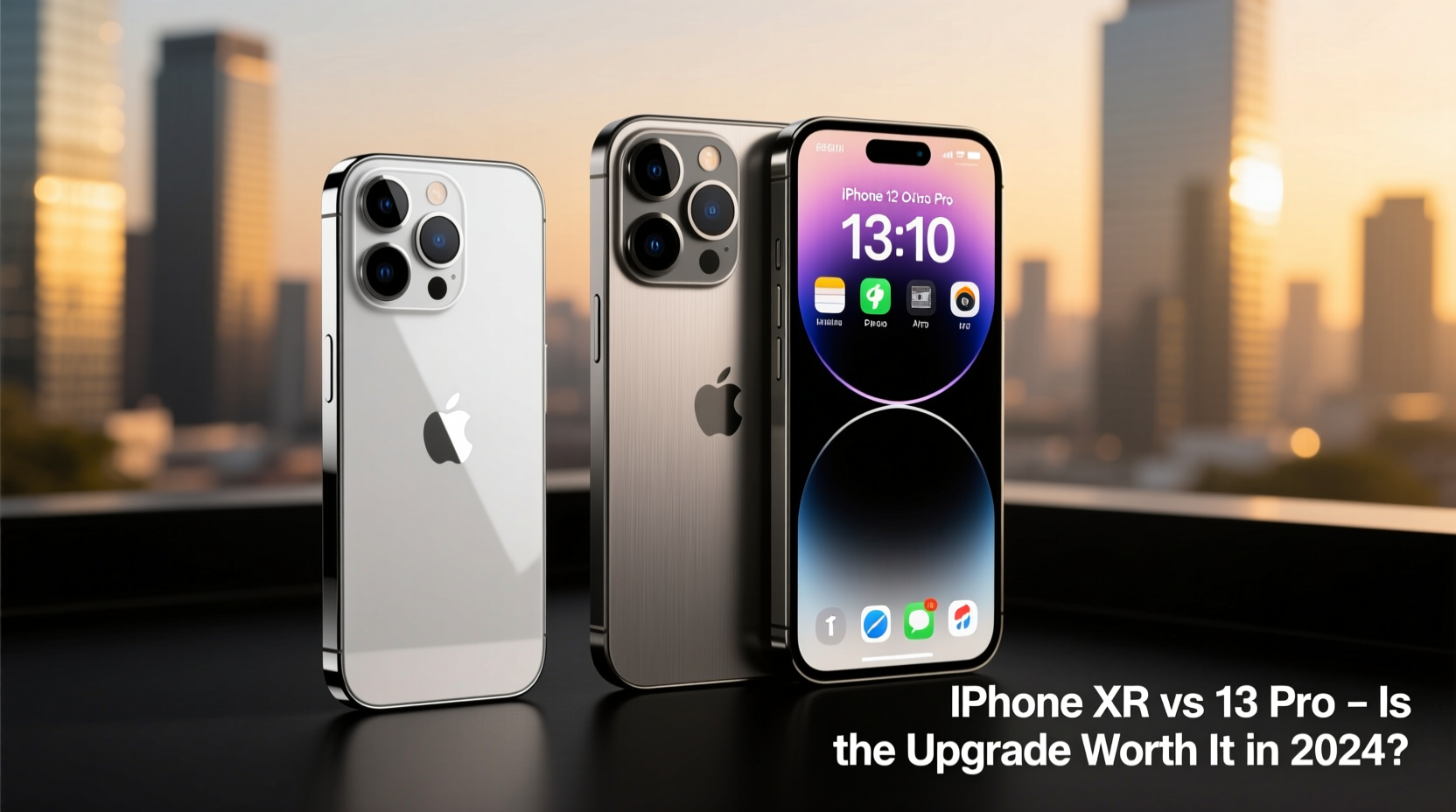
If you're still using an iPhone XR and have been eyeing the iPhone 13 Pro, you're not alone. Released five years apart—2018 versus 2021—the two devices represent vastly different generations of Apple’s smartphone evolution. But does that gap translate into real-world value in 2024? With iOS updates still supporting both models and repair costs rising, many users are asking: is upgrading from the XR to the 13 Pro truly worth it?
The answer isn’t a simple yes or no. It depends on your usage patterns, photography needs, budget, and how long you plan to keep your next phone. Let’s take a deep dive into the key differences and real-life implications of making the jump.
Performance: A Quantum Leap in Speed and Efficiency
The iPhone XR runs on Apple’s A12 Bionic chip—an impressive processor for its time. In 2024, however, it shows its age when multitasking, launching demanding apps, or handling newer games. The iPhone 13 Pro, powered by the A15 Bionic chip with a 5-core GPU, delivers significantly better performance across the board.
Benchmarks tell part of the story: the A15 outperforms the A12 by over 50% in CPU tasks and nearly double in graphics processing. But more importantly, this translates to smoother animations, faster app launches, quicker photo rendering, and better longevity. iOS 17 already feels slightly sluggish on the XR during heavy use, while the 13 Pro handles it effortlessly.
Camera Capabilities: Night Mode, Telephoto, and Computational Photography
This is where the iPhone 13 Pro pulls far ahead. The XR features a single 12MP wide camera with decent dynamic range but lacks Night mode, portrait lighting adjustments, and any optical zoom. The 13 Pro, meanwhile, packs a triple-camera system: wide, ultra-wide, and telephoto lenses, all with sensor-shift stabilization and advanced computational photography.
Night mode now works across all lenses, and the introduction of Cinematic Mode and ProRes video recording opens doors for content creators. Portrait mode is more accurate thanks to LiDAR scanning, and Smart HDR 4 captures richer tones in challenging light.
“Upgrading from an XR to a 13 Pro is like switching from point-and-shoot to a mirrorless camera—you gain creative control.” — Jordan Lee, Mobile Photographer & Tech Reviewer
For casual users who mostly share snapshots on social media, the XR’s camera may still suffice. But if you value low-light performance, zoom capability, or professional-looking portraits, the 13 Pro offers tangible improvements.
Battery Life and Charging: Real-World Endurance Compared
Apple claims up to 16 hours of video playback on the XR and up to 22 hours on the 13 Pro—a significant increase. In practice, most XR users find themselves charging by late afternoon with moderate use, especially as battery health degrades over time. The 13 Pro consistently lasts a full day, even with heavy photography, navigation, and streaming.
Another major advantage: the 13 Pro supports fast charging (up to 50% in 30 minutes with a 20W adapter) and MagSafe wireless charging. The XR only supports basic Qi wireless charging and maxes out at 15W with fast charging—if you have the right cable and adapter (neither included).
Charging Comparison
| Feature | iPhone XR | iPhone 13 Pro |
|---|---|---|
| Fast Charging | Yes (with 18W+ adapter) | Yes (up to 20W) |
| Wireless Charging | Qi only | Qi + MagSafe alignment |
| Max Battery Life (Video) | 16 hours | 22 hours |
| Charger Included? | No (since 2020) | No |
Display and Design: From LCD to Super Retina XDR
The iPhone XR uses a 6.1-inch Liquid Retina LCD display with a resolution of 1792x828. While bright and color-accurate for an LCD, it can't match the depth and contrast of the 13 Pro’s 6.1-inch Super Retina XDR OLED panel (2532x1170). Blacks appear deeper, HDR content pops, and overall clarity is noticeably sharper.
One often-overlooked upgrade is the 13 Pro’s ProMotion technology—supporting a 120Hz adaptive refresh rate. Scrolling, gaming, and animation feel dramatically smoother compared to the XR’s fixed 60Hz. This isn’t just a spec bump; it changes how the phone feels in daily use.
Design-wise, both are IP67 water-resistant and feature aerospace-grade aluminum frames. However, the 13 Pro adds a ceramic shield front cover and textured matte glass back, improving durability and grip.
Software Support and Longevity Outlook for 2024 and Beyond
As of 2024, both devices run iOS 17 smoothly, but future-proofing matters. The iPhone XR launched with iOS 12 and has received five major updates. Historically, iPhones get around six to seven years of OS support. That means the XR could be phased out after iOS 18 or 19.
In contrast, the iPhone 13 series is expected to receive updates through at least 2027. Given that security patches and app compatibility increasingly depend on recent iOS versions, upgrading now ensures longer usability.
Mini Case Study: Sarah’s Upgrade Decision
Sarah, a freelance graphic designer, used her iPhone XR since 2019. By early 2023, she noticed slow app switches in Adobe Creative Cloud, poor low-light shots for client mood boards, and a battery that died by noon. She considered a mid-tier Android but ultimately chose the 13 Pro.
Within weeks, she was editing RAW images directly on her phone, shooting client videos in ProRes, and relying less on her laptop during travel. “It felt like I upgraded my entire workflow,” she said. “The camera alone paid for itself in saved editing time.”
Her experience highlights a crucial point: the value of an upgrade isn’t always about specs—it’s about how the device integrates into your life.
Is the Upgrade Worth It? A Practical Checklist
Before spending $700–$900 on a used or refurbished 13 Pro, ask yourself the following:
- Do you regularly struggle with slow app performance or lag?
- Are you frustrated by poor night-time photos or lack of zoom?
- Does your current battery fail to last a full workday?
- Do you create content, edit media, or rely on your phone professionally?
- Are you planning to keep your next phone for 3+ years?
If three or more apply, the upgrade makes strong financial and functional sense.
Frequently Asked Questions
Can the iPhone XR still handle everyday tasks in 2024?
Yes, for basic use—calls, messaging, web browsing, and light social media. However, heavier apps (like Instagram Reels editing or Maps with live transit) may lag, and future iOS updates could further impact speed.
How much does it cost to upgrade from XR to 13 Pro?
New 13 Pro models are discontinued, but you can find high-condition refurbished units for $550–$700. Trade-in values for working XR models range from $100–$180 depending on storage and condition, reducing net cost.
Is the camera worth the price jump?
If you value photography, yes. The addition of Night mode on all lenses, 3x optical zoom, macro photography, and ProRes video provides creative tools the XR simply cannot match.
Conclusion: Making the Right Move for Your Needs
Upgrading from the iPhone XR to the 13 Pro in 2024 isn’t essential for everyone—but for many, it’s transformative. You’re not just gaining a faster processor or better screen; you’re stepping into a more capable ecosystem of photography, productivity, and long-term reliability.
The 13 Pro offers meaningful advancements in display quality, camera versatility, battery endurance, and software lifespan. For users whose phones are central to their personal or professional lives, the investment pays off in daily convenience and future readiness.




 浙公网安备
33010002000092号
浙公网安备
33010002000092号 浙B2-20120091-4
Comments
No comments yet. Why don't you start the discussion?