
For many iPhone 7 Plus owners, the question isn’t whether their phone still works—it’s whether it still makes sense to keep using it in 2024. The iPhone XR, released just a year after the 7 Plus, brought notable changes in design, performance, and software support. But does upgrading from the 7 Plus to the XR offer meaningful improvements, or is it just a minor refresh? Let’s break down exactly what you gain—and what you might not need.
Performance: A Significant Leap Forward
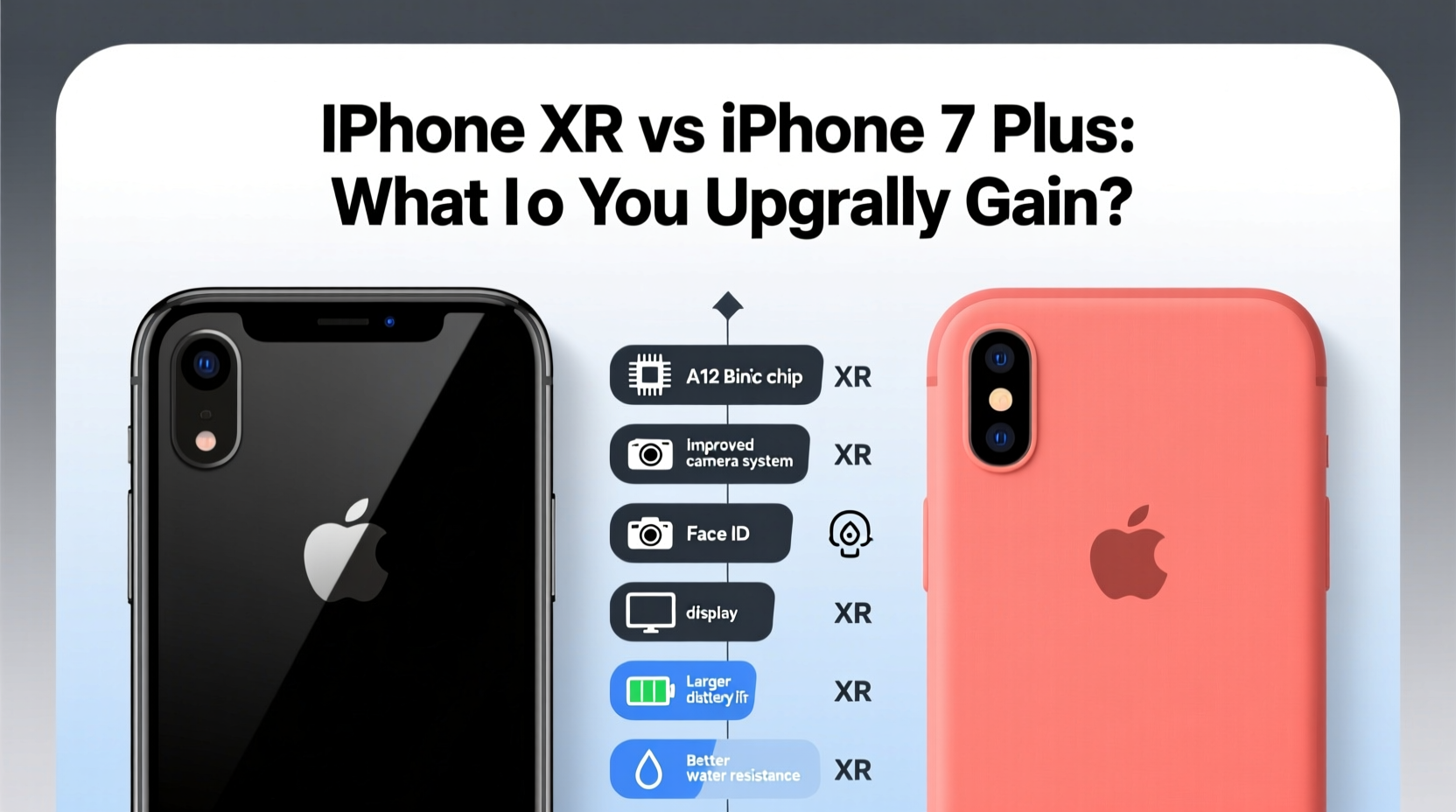
The most immediate difference between the iPhone 7 Plus and the XR lies under the hood. The 7 Plus runs on the A10 Fusion chip, which was powerful in 2016 but now struggles with newer iOS versions and demanding apps. In contrast, the iPhone XR features the A12 Bionic chip—Apple’s first 7nm processor at the time—delivering up to 15% faster CPU performance and a 50% improvement in GPU speed.
This means smoother multitasking, faster app launches, and better performance in graphics-heavy games and AR applications. More importantly, the A12 supports longer-term iOS updates. While the 7 Plus stopped receiving updates after iOS 16, the XR continues to run iOS 17 and is expected to support iOS 18, giving it at least two more years of security patches and feature upgrades.
Display Technology: One Step Forward, One Design Trade-off
The iPhone 7 Plus features a 5.5-inch LCD display with 1080p resolution. It’s sharp and color-accurate for its time, but it lacks modern enhancements like True Tone or wide color support (P3). The iPhone XR ups the ante with a 6.1-inch Liquid Retina HD display—an LCD panel that Apple optimized for edge-to-edge visuals, though it uses a single-lens front camera notch instead of bezels.
Despite being an LCD, the XR’s screen offers better brightness (up to 625 nits), True Tone (which adjusts white balance based on ambient light), and support for Haptic Touch (a precursor to 3D Touch). However, some users miss the physical home button and Touch ID of the 7 Plus, replaced by Face ID on the XR.
“Moving from a home-button iPhone to Face ID takes adjustment, but once set up correctly, it’s faster and more secure.” — Mark Chen, Mobile UX Analyst
Camera Comparison: Better Single Lens vs. Dual-Lens Versatility
The iPhone 7 Plus was one of the first iPhones to feature a dual-camera system: a 12MP wide lens and a 12MP telephoto lens enabling 2x optical zoom and Portrait Mode. The XR, despite having only a single 12MP wide lens, leverages the A12’s Neural Engine to simulate depth effects in Portrait Mode with impressive accuracy.
In daylight, both phones produce excellent photos with natural colors and good dynamic range. But in low light, the XR pulls ahead thanks to Smart HDR and improved sensor processing. It captures brighter shadows, retains more highlight detail, and handles mixed lighting better.
Where the 7 Plus still holds an advantage is optical zoom. The XR relies entirely on digital zoom, which degrades image quality beyond 2x. If you frequently take distant shots—like concerts or wildlife—the lack of a telephoto lens may be a drawback.
| Feature | iPhone 7 Plus | iPhone XR |
|---|---|---|
| Rear Cameras | Dual 12MP (Wide + Telephoto) | Single 12MP (Wide) |
| Portrait Mode | Hardware-based depth sensing | Software-powered depth mapping |
| Low-Light Performance | Good for its era | Significantly improved with Smart HDR |
| Zoom | 2x optical, up to 10x digital | Digital only (up to 5x) |
| Front Camera | 7MP | 7MP with Portrait Mode & Animoji |
Battery Life and Build: Modern Efficiency Meets Durability
Battery life is another area where the XR shines. Despite having a smaller physical battery (2942 mAh vs. 2900 mAh), the XR lasts longer due to power-efficient components and iOS optimizations. Apple rated it for up to 16 hours of video playback; real-world usage often sees 1.5 days on moderate use. The 7 Plus, while solid in its day, typically requires daily charging, especially under iOS 16.
In terms of build, both phones are IP67-rated for dust and water resistance—meaning they can survive submersion in up to 1 meter of water for 30 minutes. However, the XR’s glass back enables wireless charging, a feature absent on the 7 Plus. This adds convenience if you own a Qi-compatible charger or use services like airport charging pads.
Real-World Example: Sarah’s Upgrade Journey
Sarah had been using her iPhone 7 Plus since 2017. By 2023, she noticed apps took longer to load, her camera struggled in dim lighting, and iOS updates left her phone sluggish. After researching, she upgraded to a refurbished iPhone XR for $220.
Her experience was transformative. “I didn’t realize how much I was missing until I used the XR,” she said. “Face ID is faster than Touch ID once it learns my face, the screen is bigger without making the phone unwieldy, and the battery lasts through my workday even with heavy email and navigation use.”
The biggest surprise? The single camera. “I thought losing the zoom would hurt, but 90% of my photos are close-ups or landscapes. The XR’s HDR makes everything look richer.”
What You Actually Gain: A Practical Checklist
Before deciding to upgrade, consider this checklist to assess whether the benefits align with your needs:
- Faster performance – Apps open quicker, multitasking is smoother
- Longer software support – At least one more year of iOS updates
- Better battery life – Up to 1.5x longer usage per charge
- Modern display – Larger, edge-to-edge screen with True Tone
- Wireless charging – Convenient if you have compatible accessories
- Improved front camera – Portrait Mode and Animoji support
- Better low-light photos – Thanks to Smart HDR and noise reduction
If most of these matter to you, the upgrade is justified. If you prioritize optical zoom, prefer Touch ID, or rarely use resource-heavy apps, sticking with the 7 Plus may still suffice.
Frequently Asked Questions
Can the iPhone XR run the latest apps smoothly?
Yes. The A12 Bionic chip handles current iOS apps—including social media, streaming, and mobile games—with ease. Even augmented reality apps perform well, unlike on the older A10 chip.
Is Face ID reliable compared to Touch ID on the 7 Plus?
Face ID is generally faster and more secure, but it doesn’t work when the phone is lying flat or if you’re wearing masks. Touch ID is more consistent in those scenarios. However, once trained properly, Face ID unlocks the XR nearly instantly in most situations.
Should I upgrade if my iPhone 7 Plus still works fine?
If you’re satisfied with performance and don’t mind slower updates, staying put is reasonable. But if you want better camera quality, longer battery life, and future-proof software support, the XR is a cost-effective step forward—especially when bought refurbished.
Conclusion: Is the Upgrade Worth It?
Upgrading from the iPhone 7 Plus to the XR isn’t about chasing the latest trend—it’s about gaining tangible improvements in speed, efficiency, and usability. You get a more modern interface, longer support, better cameras in low light, and a battery that keeps up with today’s demands.
The trade-offs—losing the home button, optical zoom, and Touch ID—are real but manageable for most users. Given that the XR can often be found for under $250 in refurbished condition, it represents one of the most balanced upgrade paths for long-time 7 Plus owners.




 浙公网安备
33010002000092号
浙公网安备
33010002000092号 浙B2-20120091-4
Comments
No comments yet. Why don't you start the discussion?