
For iPhone users still clinging to the iPhone 8 Plus, the question isn’t just about whether they *can* upgrade—it’s whether they *should*. The iPhone XR emerged as Apple’s more affordable flagship option in 2018, positioned between the entry-level models and the premium XS series. With both devices now available at discounted prices or through trade-in programs, many are weighing whether moving from the 8 Plus to the XR delivers meaningful improvements. The answer depends on what you value most: familiarity, performance, camera quality, or future software support.
Design and Display: A Shift in Philosophy
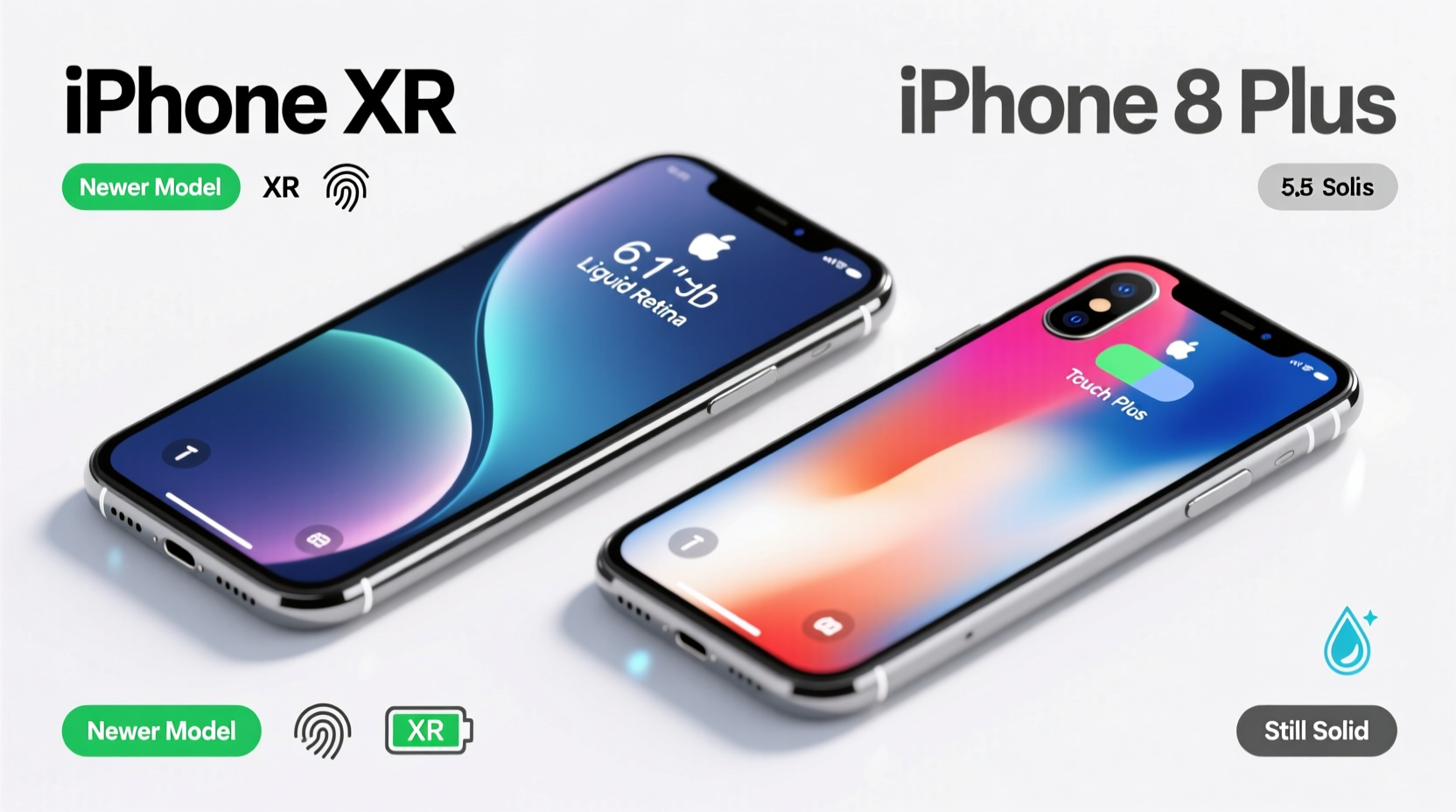
The most immediate difference between the iPhone XR and 8 Plus lies in their design language. The 8 Plus represents the last of Apple’s traditional home-button iPhones with thick bezels and a 5.5-inch LCD screen at 1080p resolution. In contrast, the XR embraces the modern iPhone aesthetic—slimmer bezels, Face ID, and a 6.1-inch Liquid Retina display. While both use LCD technology, the XR’s panel benefits from improved color accuracy, True Tone, and better brightness levels.
Despite its larger screen, the XR is actually smaller in physical footprint than the 8 Plus due to reduced bezel size. This makes it easier to handle with one hand, though some users accustomed to the 8 Plus’s wider form may find the XR slightly less stable when held horizontally.
Performance and Software Longevity
Under the hood, both phones launched with Apple’s A12 Bionic chip—the first 7nm processor in a smartphone at the time. However, real-world performance differs subtly due to software optimization. The XR runs iOS more fluidly thanks to its lower-resolution display (326 ppi vs. 401 ppi on the 8 Plus), meaning the GPU doesn’t have to work as hard rendering pixels.
More importantly, software support is a decisive factor. As of 2024, the iPhone 8 Plus no longer receives major iOS updates, stopping at iOS 16. The iPhone XR, however, was supported through iOS 17 and may receive security patches into 2025. This extended lifecycle means better app compatibility, access to new features, and improved security over time.
“Devices receiving current OS updates tend to retain functionality and resale value significantly longer.” — David Lin, Mobile Technology Analyst at TechPulse Insights
Camera Comparison: Portrait Mode and Beyond
The camera setup highlights a key trade-off. The iPhone 8 Plus features a dual-camera system: 12MP wide and 12MP telephoto lenses, enabling true optical zoom and depth-sensing for portrait mode. The XR, despite having only a single 12MP wide lens, uses advanced software algorithms to simulate depth and deliver comparable portrait results in most lighting conditions.
In daylight, both cameras produce excellent photos with natural color reproduction and dynamic range. But in low light, the 8 Plus’s optical zoom gives it an edge for tighter shots without digital cropping. On the flip side, the XR introduces Smart HDR, which enhances detail in shadows and highlights—a feature absent on the 8 Plus.
Video recording is identical on paper (4K at 60fps), but the XR benefits from improved stabilization and audio processing. For casual photographers, the XR’s computational photography often feels more consistent across scenarios.
Detailed Feature Comparison
| Feature | iPhone 8 Plus | iPhone XR |
|---|---|---|
| Release Year | 2017 | 2018 |
| Display Size & Type | 5.5\" LCD (Retina HD) | 6.1\" LCD (Liquid Retina) |
| Resolution | 1920×1080 | 1792×828 |
| Biometric Security | Touch ID | Face ID |
| Rear Cameras | Dual 12MP (Wide + Telephoto) | Single 12MP (Wide) |
| Portrait Mode | Yes (Dual-lens depth sensing) | Yes (Software-based depth mapping) |
| Battery Life | Up to 13 hours video playback | Up to 16 hours video playback |
| iOS Support (Latest) | iOS 16 | iOS 17 |
| Water Resistance | IP67 (1m for 30 mins) | IP67 (1m for 30 mins) |
| Starting Storage | 64GB | 64GB |
Battery and Daily Usability
Battery life is where the XR pulls ahead decisively. Apple rated the XR for up to 16 hours of video playback compared to 13 hours on the 8 Plus. Real-world usage confirms this gap—many users report gaining an extra 1.5 to 2 hours of screen-on time with the XR, even after years of battery degradation.
This improvement stems not only from a larger battery but also from power-efficient components like the A12’s neural engine and optimized iOS integration. Additionally, the XR supports fast charging (with a compatible adapter) and wireless charging out of the box—features already present on the 8 Plus, so no loss there.
Mini Case Study: Sarah’s Upgrade Dilemma
Sarah had used her iPhone 8 Plus since 2018. By 2023, she noticed apps taking longer to load, the camera struggling in dim restaurants, and iOS updates becoming infrequent. She hesitated to upgrade, fearing she’d lose the physical home button she relied on during workouts. After testing the XR at a store, she realized Face ID worked reliably—even with sweat—and appreciated the brighter screen and longer battery. Six months later, she reported smoother multitasking, better photo consistency, and relief that her phone still received updates. “It wasn’t flashy,” she said, “but everything just works better now.”
Is Upgrading Really Worth It? A Step-by-Step Decision Guide
If you're still unsure, follow this practical timeline to evaluate your needs:
- Assess your current device health: Check battery health in Settings > Battery. If maximum capacity is below 80%, replacement or upgrade becomes more urgent.
- List your pain points: Are you frustrated by slow performance, poor low-light photos, or outdated software?
- Test the XR in person: Visit an Apple Store or carrier outlet. Try Face ID, hold the device, view photos side-by-side.
- Evaluate cost vs. benefit: Consider trade-in values. Often, upgrading costs $100–$200 out-of-pocket, which may be justified by 2+ extra years of support.
- Decide based on longevity: If you plan to keep a phone for 3+ years, the XR’s extended software support offers greater long-term value.
Frequently Asked Questions
Can the iPhone XR take zoomed portraits like the 8 Plus?
No, the XR lacks a telephoto lens, so it cannot optically zoom. However, it uses digital zoom and software to simulate 2x portrait effects, which work well in good lighting but lack the clarity of optical zoom in challenging conditions.
Is Face ID on the XR reliable?
Yes. While early versions of Face ID were criticized for inconsistency, firmware updates have made it highly accurate. It works in most lighting conditions and adapts to changes in appearance like glasses or facial hair.
Does the XR feel cheaper because of the lower-resolution screen?
Not noticeably. The pixel density is lower, but the larger size, vibrant colors, and True Tone adjustment make the display feel modern and immersive for everyday tasks like browsing, streaming, and reading.
Actionable Checklist Before You Upgrade
- ✅ Back up your iPhone 8 Plus via iCloud or iTunes
- ✅ Check battery health and replace if under 80%
- ✅ Compare trade-in values from Apple, carriers, and third parties
- ✅ Test Face ID usability in your daily routine (e.g., wearing hats, sunglasses)
- ✅ Ensure your favorite apps support newer iOS versions
- ✅ Decide if the larger screen improves or hinders one-handed use
Final Verdict: Should You Make the Switch?
Upgrading from the iPhone 8 Plus to the XR isn’t about dramatic leaps—it’s about incremental gains that add up over time. You gain a more modern design, better battery life, improved display, and crucially, longer software support. While the 8 Plus holds up remarkably well, its aging platform limits future usability.
The XR may not dazzle with cutting-edge specs, but it delivers a more sustainable user experience. For anyone planning to keep their phone beyond two years, the upgrade makes sense—not because the XR is vastly superior, but because it remains relevant longer.




 浙公网安备
33010002000092号
浙公网安备
33010002000092号 浙B2-20120091-4
Comments
No comments yet. Why don't you start the discussion?