
When Apple released the iPhone XR and iPhone XS Max in 2018, they represented two very different approaches to flagship smartphones. The XR offered a more affordable entry into the modern iPhone era with a single-lens camera and LCD screen, while the XS Max stood as the ultimate expression of Apple’s engineering—larger, pricier, and packed with premium features. For many users deciding between them—or considering an upgrade from the XR to the XS Max—the question remains: was stepping up to the Max truly worth the extra cost?
This isn’t just about specs on paper. It’s about how those differences translate into daily use, long-term satisfaction, and whether the higher price tag delivers proportional value.
Design and Build: Glass, Size, and Feel
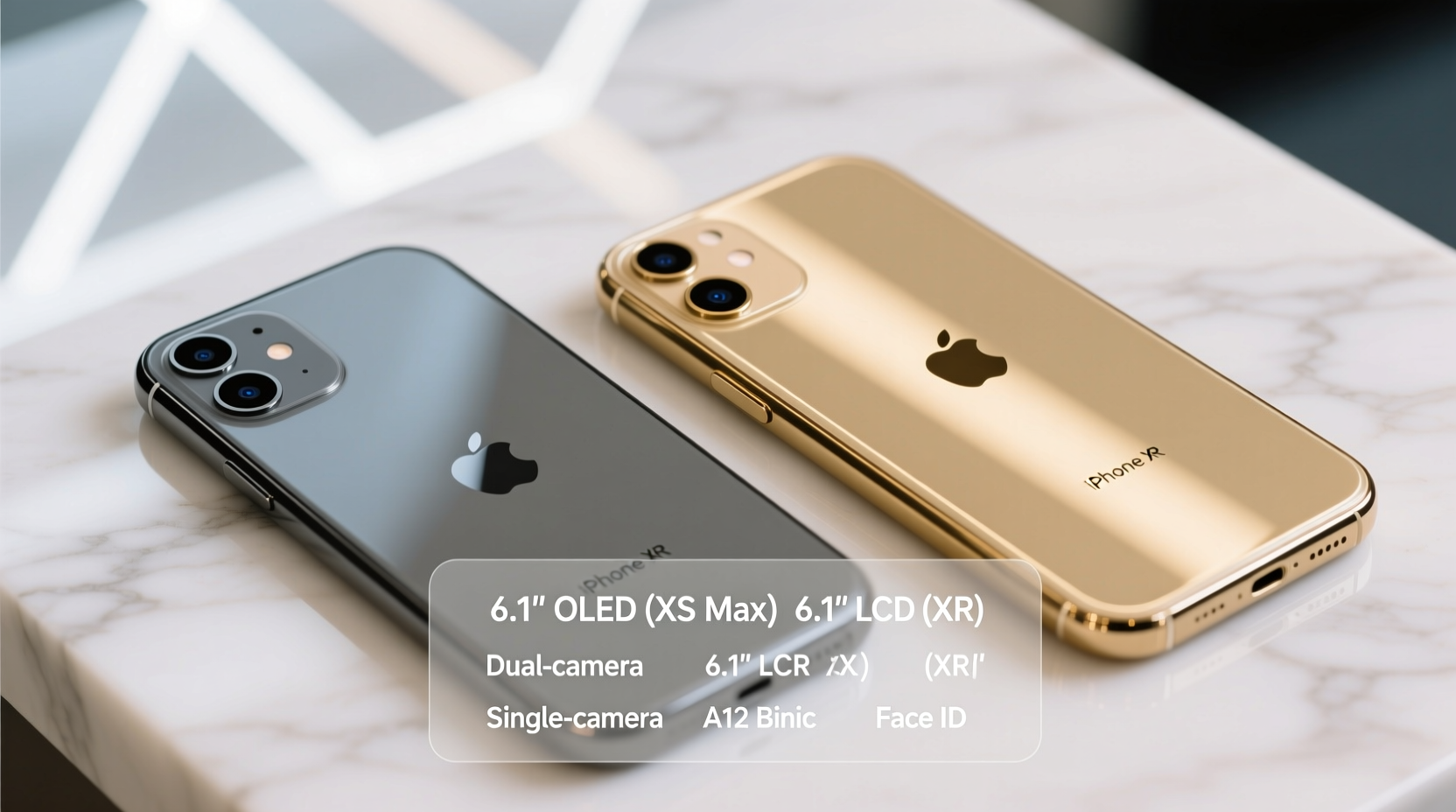
The iPhone XR and XS Max shared the same overall design language introduced with the iPhone X: stainless steel frame, glass back, Face ID, and minimal bezels. However, subtle but meaningful differences shaped the user experience.
The XS Max featured a sleek stainless steel frame, giving it a noticeably heavier, more premium feel. In contrast, the XR used aluminum, which made it lighter—some might say too light—and slightly less luxurious in hand. Both phones supported wireless charging and had IP67 water resistance, though the XS Max's build quality felt sturdier and more refined.
Size also played a role. The XS Max measured 6.2 inches diagonally, making it one of the largest iPhones at the time. The XR, while still large at 6.1 inches, was marginally easier to handle due to its flat edges and slightly better weight distribution.
Display Quality: OLED vs LCD – A Clear Divide
One of the most significant differences between the two models lies in their displays. The XS Max used a 6.2-inch Super Retina OLED panel with a resolution of 2688 x 1242 pixels (458 ppi), delivering deep blacks, vibrant colors, and excellent contrast. The XR, meanwhile, had a 6.1-inch Liquid Retina LCD screen with a lower resolution of 1792 x 828 pixels (326 ppi).
OLED technology allows individual pixels to turn off completely, resulting in true black levels and superior HDR performance—especially noticeable when watching movies or using dark mode interfaces. The LCD on the XR couldn’t match that depth, often appearing washed out in comparison, particularly under direct sunlight.
| Feature | iPhone XR | iPhone XS Max |
|---|---|---|
| Display Type | Liquid Retina LCD | Super Retina OLED |
| Resolution | 1792 x 828 | 2688 x 1242 |
| Pixels Per Inch | 326 ppi | 458 ppi |
| Contrast Ratio | 1400:1 | 1,000,000:1 |
| HDR Support | No | Yes (Dolby Vision, HDR10) |
For media enthusiasts, photographers, or anyone who values visual fidelity, the XS Max’s display was a clear step up. But for casual users focused on social media, web browsing, and messaging, the XR’s screen was still perfectly serviceable.
Camera Performance: Single Lens vs Dual System
The camera setup is where the divide becomes most apparent. The iPhone XR featured a single 12MP wide-angle rear camera with an f/1.8 aperture. While it supported Portrait Mode through software-based depth mapping, it lacked the telephoto lens found on the XS Max.
The XS Max, on the other hand, came with a dual-camera system: a 12MP wide (f/1.8) and a 12MP telephoto (f/2.4) lens. This enabled 2x optical zoom and significantly better low-light portraits. Optical zoom meant no loss in quality when getting closer to subjects—a feature the XR could only simulate digitally, leading to softer results.
“While computational photography has closed the gap, having a second lens gives you creative flexibility that software alone can't replicate.” — David Lin, Mobile Photography Specialist
In daylight, both phones produced excellent photos with accurate color reproduction and smart HDR. But in challenging lighting or when zooming, the XS Max consistently outperformed the XR. Additionally, the XS Max captured 4K video at 60fps across all lenses, whereas the XR was limited to 30fps on the front and ultra-wide shots.
Battery Life and Real-World Usage
Apple claimed the XS Max had the best battery life of any iPhone at launch—up to 13 hours of video playback. The XR wasn’t far behind, rated for up to 16 hours of video streaming (a rare case where Apple used different metrics). In real-world mixed usage, both lasted a full day, but the XR often edged ahead by 1–2 hours.
This counterintuitive result stemmed from the XR’s lower-resolution LCD screen and efficient A12 Bionic chip managing fewer background processes. Despite sharing the same processor, the XS Max consumed more power due to its higher-resolution OLED display and additional camera hardware.
For heavy travelers or users who hate charging midday, the XR’s stamina gave it a functional advantage—even if the XS Max offered more premium features.
Performance and Longevity: Same Chip, Similar Lifespan
Both phones were powered by Apple’s A12 Bionic chip—the first 7nm processor in a smartphone at the time. This meant identical processing power, GPU performance, and AI capabilities. Apps launched just as quickly on both devices, and multitasking was smooth even years after release.
Because they ran the same silicon, both phones received iOS updates simultaneously and maintained strong performance through iOS 16 and beyond. Users upgrading from older iPhones would have noticed a dramatic leap on either model.
However, the XS Max’s extra RAM (4GB vs 3GB on the XR) provided slight advantages in graphics-intensive tasks and prolonged app retention in memory. Gamers and pro users benefited subtly, though most wouldn’t notice the difference in everyday use.
Mini Case Study: Sarah’s Upgrade Dilemma
Sarah owned an iPhone 8 and wanted a bigger screen and better camera. She narrowed her choices to the XR and XS Max. After testing both in-store, she opted for the XS Max, drawn by the richer display and dual cameras.
A year later, she admitted the upgrade was “overkill.” While she loved the video quality and zoom capability, she rarely used the telephoto lens and found the phone too large for her small hands. She ended up using a case and screen protector that added bulk, defeating the elegance she initially admired.
Had she chosen the XR, she would have saved $250, gained longer battery life, and still enjoyed a massive leap from her iPhone 8. Her experience highlights a common truth: premium specs don’t always align with actual usage patterns.
Cost-Benefit Analysis: Was the Upgrade Worth It?
The iPhone XS Max started at $1,099, while the XR launched at $749—a $350 difference. That gap buys you:
- A sharper, higher-contrast OLED display
- Dual-camera system with optical zoom
- Stainless steel frame and slightly more premium feel
- Better HDR video recording
- Slightly improved stereo speakers
But you sacrifice:
- Battery efficiency (slightly shorter endurance)
- Portability (heavier, larger device)
- Value for money (diminishing returns above $900)
Frequently Asked Questions
Can the iPhone XR take good portrait photos?
Yes. Using machine learning and the A12 chip, the XR simulates depth sensing effectively. While not as precise as dual-camera systems, portraits are generally sharp and well-separated, especially in good lighting.
Is the size difference between XR and XS Max noticeable?
Visually, the screens appear similar, but the XS Max feels significantly heavier and harder to operate with one hand. If you prefer compact handling, the XR is more manageable despite nearly identical dimensions.
Do both phones support the latest iOS versions?
As of 2024, both models support up to iOS 16. Neither is compatible with iOS 17, so neither should be considered future-proof. However, they remain secure and functional for everyday use.
Conclusion: Making the Right Choice for You
Was upgrading to the XS Max worth it? For professionals, creatives, and tech enthusiasts who valued every incremental improvement, yes—it was the pinnacle of what Apple offered in 2018. But for the average user, the iPhone XR delivered 90% of the experience at a much better price point.
The real answer depends not on specs, but on how you use your phone. If you shoot a lot of portraits, zoom frequently, or care deeply about display quality, the XS Max justified its cost. But if you mostly browse, message, stream, and take occasional photos, the XR was smarter choice—one that balanced performance, battery, and affordability without compromise.




 浙公网安备
33010002000092号
浙公网安备
33010002000092号 浙B2-20120091-4
Comments
No comments yet. Why don't you start the discussion?