
For users still holding onto their iPhone 8 Plus, the decision to upgrade to the iPhone XS Max isn’t just about newness—it’s about whether the improvements justify the cost. Both phones represent pivotal moments in Apple’s design evolution: the 8 Plus as the last of the classic iPhone form with a home button, and the XS Max as the first truly large, edge-to-edge Super Retina display experience. But does the leap in screen size, performance, and camera technology deliver enough tangible benefits to make the switch worthwhile?
Design and Display: From Bezel to Edge-to-Edge
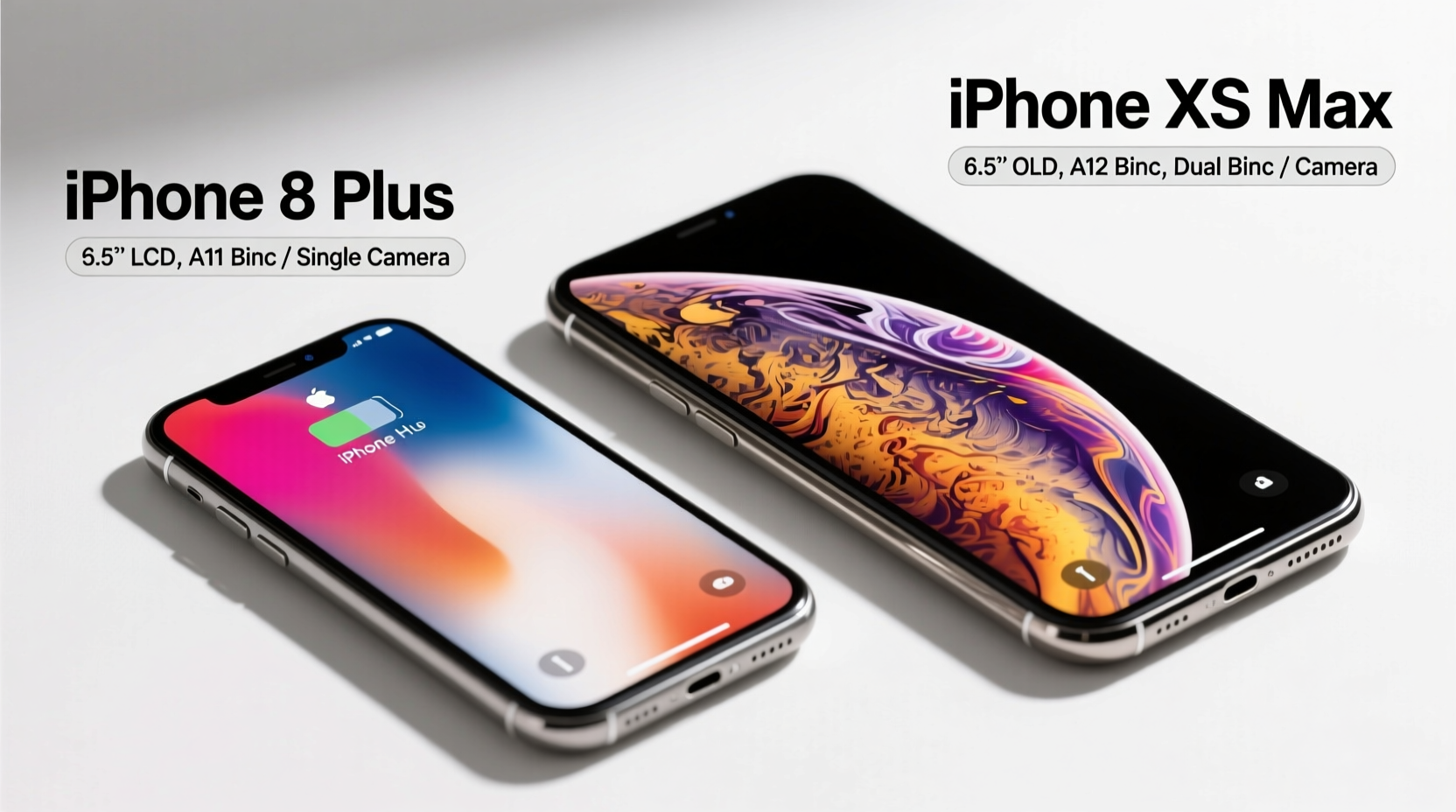
The most immediate difference between the iPhone 8 Plus and the XS Max is the design language. The 8 Plus features thick bezels above and below the 5.5-inch LCD screen, while the XS Max ditches the home button for a nearly full-frontal 6.5-inch OLED display. This shift isn’t just aesthetic—it changes how you interact with the phone.
OLED technology brings deeper blacks, higher contrast ratios, and more vibrant colors. HDR support on the XS Max enhances video playback, especially on streaming platforms like Netflix and YouTube. The larger screen also improves multitasking, making split-view and picture-in-picture more usable.
However, the 8 Plus remains comfortable for one-handed use. The XS Max, while powerful, is harder to manage without two hands and may require a case with grip support. For users who prioritize pocketability, the 8 Plus still holds appeal.
Performance and Software Longevity
Under the hood, the difference is stark. The iPhone 8 Plus runs on the A11 Bionic chip, capable in its time but now showing its age when handling modern apps and games. The XS Max, powered by the A12 Bionic—Apple’s first 7nm processor—delivers up to 50% faster CPU performance and 50% better graphics efficiency.
This performance gap translates directly into real-world usage. Apps launch faster, AR experiences are smoother, and background processing handles multiple tasks without lag. More importantly, software support favors the XS Max. While both devices received updates through iOS 17, the XS Max is more likely to stay compatible with future iOS versions due to superior hardware headroom.
“Devices with newer chips not only run current software better—they’re more likely to receive critical security updates longer.” — Mark Rivera, Mobile Systems Analyst at TechInsight Group
Camera Comparison: Evolution in Detail
Both phones feature dual 12MP rear cameras (wide and telephoto), but the XS Max introduces significant refinements. Its larger and deeper pixels improve low-light performance, and Smart HDR—a new feature at the time—captures more detail in shadows and highlights.
In practical terms, this means photos taken on the XS Max have more dynamic range, better skin tones, and reduced noise in dim environments. Portrait Mode sees upgrades too, with advanced depth mapping and adjustable bokeh after capture—a feature absent on the 8 Plus.
The front camera also improves from 7MP on the 8 Plus to a 7MP TrueDepth system on the XS Max, supporting Portrait Mode selfies and Animoji with greater facial tracking accuracy.
| Feature | iPhone 8 Plus | iPhone XS Max |
|---|---|---|
| Display Size | 5.5\" LCD | 6.5\" OLED |
| Chipset | A11 Bionic | A12 Bionic |
| Rear Cameras | Dual 12MP (f/1.8 & f/2.8) | Dual 12MP with Smart HDR |
| Front Camera | 7MP | 7MP TrueDepth |
| Battery Life | Up to 13h video | Up to 15h video |
| Biometrics | Fingerprint (Touch ID) | Face ID |
| Water Resistance | IP67 (1m for 30min) | IP68 (2m for 30min) |
Battery Life and Charging: Incremental Gains
Apple claimed the XS Max offered up to 1.5 hours more battery life than the 8 Plus, thanks to a slightly larger battery and more efficient A12 chip. Real-world testing confirms this: moderate users get through a full day, though heavy usage (gaming, video streaming) drains it faster.
Both phones support fast charging (with a compatible adapter) and Qi wireless charging. However, neither includes a fast charger in the box—the 8 Plus ships with a 5W brick, and the XS Max, despite marketing, also comes with the same slow charger. Upgrading requires purchasing a 18W adapter separately.
Real-World Upgrade Scenario: Sarah’s Experience
Sarah had used her iPhone 8 Plus since 2017. By 2022, she noticed apps taking longer to load, battery draining by mid-afternoon, and difficulty capturing clear night photos. She upgraded to a refurbished XS Max for $399.
Her feedback was telling: “The screen made the biggest difference. Reading emails and watching shows felt like I’d upgraded my entire digital life. Face ID took a week to get used to, but now I miss Touch ID only when wearing masks. The camera surprised me—especially how much cleaner my Instagram shots looked without editing.”
She did note the size was awkward at first, requiring a new case and adjusting how she held the phone. But overall, she said the upgrade was “worth it for the longevity and visual clarity alone.”
Step-by-Step: How to Decide If You Should Upgrade
- Evaluate your current pain points: Is your 8 Plus slow, battery-depleted, or struggling with app compatibility?
- Test the XS Max in person: Visit an Apple Store or reseller to feel the size and test Face ID.
- Compare prices: Check certified refurbished models on Apple’s site or trusted retailers like Best Buy or Amazon Renewed.
- Assess your usage: If you consume media, play games, or use productivity apps, the larger screen adds real value.
- Consider accessories: Factor in the cost of a new case, screen protector, and possibly a fast charger.
- Decide on data transfer: Use iCloud or Quick Start to migrate seamlessly—back up your 8 Plus first.
FAQ
Can I use my iPhone 8 Plus accessories with the XS Max?
Most wired headphones, chargers, and speakers will work via Lightning or Bluetooth. However, cases and docks are not interchangeable due to different dimensions and lack of home button.
Is Face ID better than Touch ID?
Face ID is more secure and works with Apple Pay and third-party apps, but Touch ID is faster in some situations—like when wearing a mask or lying down. Face ID adapts over time but can be tricked by identical twins.
Does the bigger screen drain the battery faster?
While the XS Max has a larger display, the OLED panel and A12 chip are more power-efficient. In practice, battery life is slightly better despite the screen size, especially with Auto-Brightness enabled.
Final Verdict: Is the Upgrade Worth It?
For users whose iPhone 8 Plus still performs adequately, the upgrade to the XS Max is less urgent. If you're satisfied with Touch ID, don’t mind bezels, and aren’t pushing your phone hard, staying put makes financial sense—especially if you plan to wait for an iPhone 15 or later model.
But if you value a modern smartphone experience—edge-to-edge display, improved camera intelligence, longer software support, and a noticeably faster system—the XS Max delivers meaningful gains. The larger screen isn’t just about size; it’s about immersion, usability, and future-proofing.
The upgrade shines brightest for those who consume media, rely on photography, or want a device that feels current rather than outdated. Yes, the XS Max is bulkier and lacks Touch ID, but its advancements reflect where smartphones were headed—and still hold up well years later.




 浙公网安备
33010002000092号
浙公网安备
33010002000092号 浙B2-20120091-4
Comments
No comments yet. Why don't you start the discussion?