
As Apple continues to release new models each year, many users still rely on older iPhones like the iPhone 8 Plus. Meanwhile, the iPhone XS Max, once a flagship device, now sits in the mid-tier range of secondhand options. For owners of the 8 Plus wondering whether to upgrade, the decision isn’t as simple as checking specs. Real-world usability, software support, camera quality, and long-term value all come into play. In today’s market—where iOS updates still support both devices—the question remains: Is moving from the iPhone 8 Plus to the XS Max truly worthwhile?
Design and Display: A Clear Step Forward
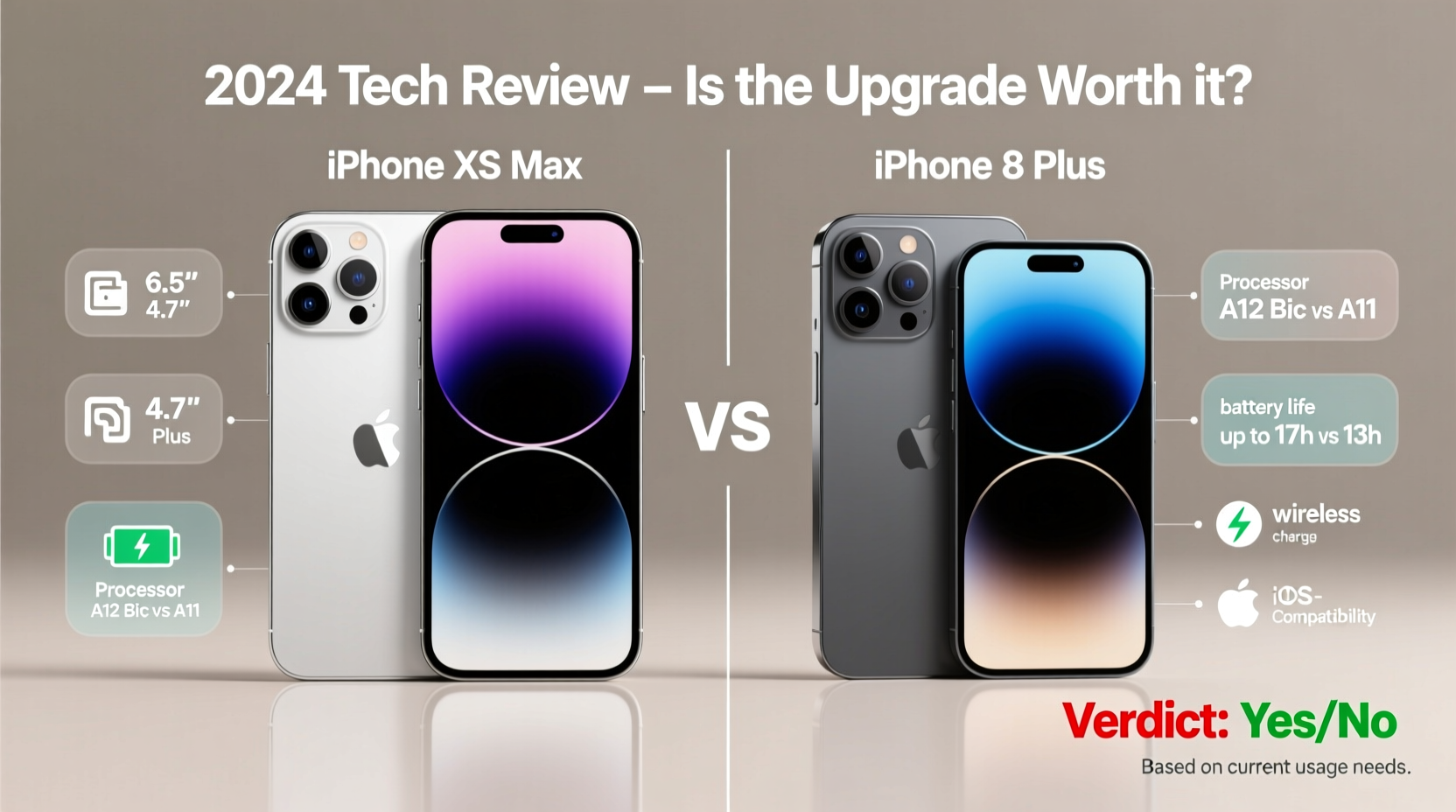
The most immediate difference between the two phones lies in their design and display. The iPhone 8 Plus features a traditional LCD screen with thick bezels and a home button. It has a 5.5-inch Retina HD display with a resolution of 1920x1080 pixels. While perfectly functional, it feels dated compared to modern smartphones.
In contrast, the iPhone XS Max introduced Apple’s edge-to-edge OLED Super Retina display. At 6.5 inches with a resolution of 2688x1242, it offers deeper blacks, richer colors, and higher contrast. The lack of a home button allows for more screen real estate, and Face ID replaces Touch ID as the biometric authentication method.
For users who prioritize visual experience—whether watching videos, browsing photos, or playing games—the jump from the 8 Plus to the XS Max is substantial. However, some may miss the tactile feedback of the home button or find the larger size less comfortable for one-handed use.
Performance and Software Longevity
Under the hood, the differences become even more pronounced. The iPhone 8 Plus runs on the A11 Bionic chip, which was groundbreaking in 2017 but now struggles with heavier multitasking and newer apps optimized for faster processors. The XS Max, powered by the A12 Bionic chip, delivers noticeably smoother performance across the board.
Benchmarks show the A12 is approximately 15–20% faster in CPU tasks and up to 50% faster in GPU performance. This translates to quicker app launches, better gaming performance, and improved responsiveness when switching between apps.
“Even in 2024, the A12 Bionic holds up remarkably well in daily tasks. It's not just about speed—it's about how long the device will remain supported.” — Mark Lin, Mobile Technology Analyst
iOS update support is a critical factor. As of 2024, both devices are compatible with iOS 17, but the XS Max is more likely to receive iOS 18, given its newer architecture. Apple typically supports iPhones for five to six years post-release. The 8 Plus (2017) is nearing the end of that window, while the XS Max (2018) may still have one final update left.
Camera Comparison: More Than Just Megapixels
Both phones feature dual 12MP rear cameras, but the improvements in the XS Max are significant. The 8 Plus has wide and telephoto lenses, capable of 2x optical zoom and Portrait Mode. However, the XS Max enhances this with better sensors, larger pixels, and advanced image signal processing.
- Low-light performance: The XS Max captures brighter, clearer photos in dim environments.
- Smart HDR: Introduced with the XS series, it balances highlights and shadows more naturally.
- Depth control: Available in Portrait Mode, allowing adjustment of bokeh after taking the photo.
- Faster autofocus: Thanks to the A12’s neural engine, subject tracking is more reliable.
The front-facing camera also sees an upgrade—from 7MP on the 8 Plus to 7MP TrueDepth with Portrait Mode and better low-light handling on the XS Max. For social media users or those who frequently take selfies, this is a meaningful improvement.
Real-World Example: Travel Photography
Sarah, a frequent traveler using her 8 Plus since 2018, upgraded to a used XS Max in 2023. On a trip to Iceland, she noticed a dramatic difference in her landscape shots. “The dynamic range made a huge difference in snowy scenes,” she said. “I didn’t lose details in the bright glaciers or the dark volcanic rock. My old phone would blow out the whites.”
This kind of real-world advantage matters—not just in specs, but in preserving memories with greater fidelity.
Battery Life and Charging: Practical Differences
Battery capacity increased from 2691 mAh in the 8 Plus to 3174 mAh in the XS Max. Apple claims up to 1.5 hours more video playback time. In practice, most users report the XS Max lasts a full day under moderate use, similar to the 8 Plus, though efficiency gains from the A12 help extend longevity during intensive tasks.
Where the XS Max pulls ahead is in charging flexibility. It supports fast charging (up to 50% in 30 minutes with an 18W adapter) and Qi wireless charging—neither of which the 8 Plus offers natively. While the 8 Plus can be updated to support wireless charging via iOS, it lacks the internal hardware for fast charging without third-party accessories.
Detailed Comparison Table
| Feature | iPhone 8 Plus | iPhone XS Max |
|---|---|---|
| Release Year | 2017 | 2018 |
| Display | 5.5\" LCD (1920x1080) | 6.5\" OLED (2688x1242) |
| Processor | A11 Bionic | A12 Bionic |
| Rear Cameras | Dual 12MP (wide + telephoto) | Dual 12MP with Smart HDR |
| Front Camera | 7MP | 7MP TrueDepth (Portrait Mode) |
| Battery | 2691 mAh | 3174 mAh |
| Charging | Standard USB-C to Lightning | Fast & Wireless Charging |
| Biometrics | Touch ID | Face ID |
| iOS Support (2024) | iOS 17 (likely final) | iOS 17, potential iOS 18 |
| Water Resistance | IP67 (1m for 30 min) | IP68 (2m for 30 min) |
Is the Upgrade Worth It in 2024?
The answer depends on your usage, budget, and expectations. Consider the following checklist before making a move:
Upgrade Checklist: Ask Yourself
- Am I experiencing slow app performance or crashes with newer apps?
- Do I want better photo quality, especially in low light?
- Would I benefit from a larger, more modern display?
- Is fast or wireless charging important to my daily routine?
- Do I plan to keep this phone for another 1–2 years?
If you answered “yes” to three or more, the upgrade makes sense. The XS Max offers tangible improvements in display, camera, performance, and future-proofing. However, if you're satisfied with your 8 Plus and don’t mind slower speeds or outdated design, holding on might be the smarter financial move—especially if you're planning to switch to a newer iPhone model soon.
Frequently Asked Questions
Can the iPhone 8 Plus still run the latest apps smoothly?
Most lightweight apps work fine, but demanding applications—like high-end games, video editors, or AR tools—may lag or fail to launch. Over time, compatibility will continue to decline.
Is Face ID on the XS Max more secure than Touch ID?
Both are secure, but Face ID has a lower false acceptance rate (1 in 1,000,000 vs. 1 in 50,000 for Touch ID). However, Face ID can struggle with masks, hats, or extreme angles, whereas Touch ID works reliably with fingers.
Should I buy a used XS Max or save for a newer model?
If your budget is tight and you need a capable iPhone now, a well-maintained XS Max is a solid choice. But if you can wait, investing in an iPhone 13 or later ensures longer software support and better resale value.
Final Verdict: Upgrade with Purpose
The iPhone XS Max represents a meaningful evolution from the 8 Plus—one that’s still relevant in 2024 for users seeking a reliable, high-performing iPhone without paying premium prices. While neither phone is cutting-edge, the XS Max delivers a noticeably better user experience in nearly every category: display, camera, processor, and longevity.
However, upgrading should be driven by need, not novelty. If your 8 Plus still meets your needs, there’s no urgent reason to replace it. But if you’re facing performance bottlenecks, disappointed with photo quality, or eager for a more immersive screen, the XS Max remains a compelling upgrade path—even years after its release.




 浙公网安备
33010002000092号
浙公网安备
33010002000092号 浙B2-20120091-4
Comments
No comments yet. Why don't you start the discussion?