
The iPhone XS and iPhone 11 Pro are two flagship models separated by just one generation, yet they represent a subtle shift in Apple’s smartphone design philosophy. While both feature premium build quality, powerful internals, and excellent cameras, one of the most commonly debated differences is their screen size. The iPhone 11 Pro has a slightly larger display than the iPhone XS—but does that half-inch difference translate into a meaningful change in user experience? For users considering an upgrade or choosing between used models, understanding whether this increase is perceptible in everyday use is essential.
Display Specifications at a Glance
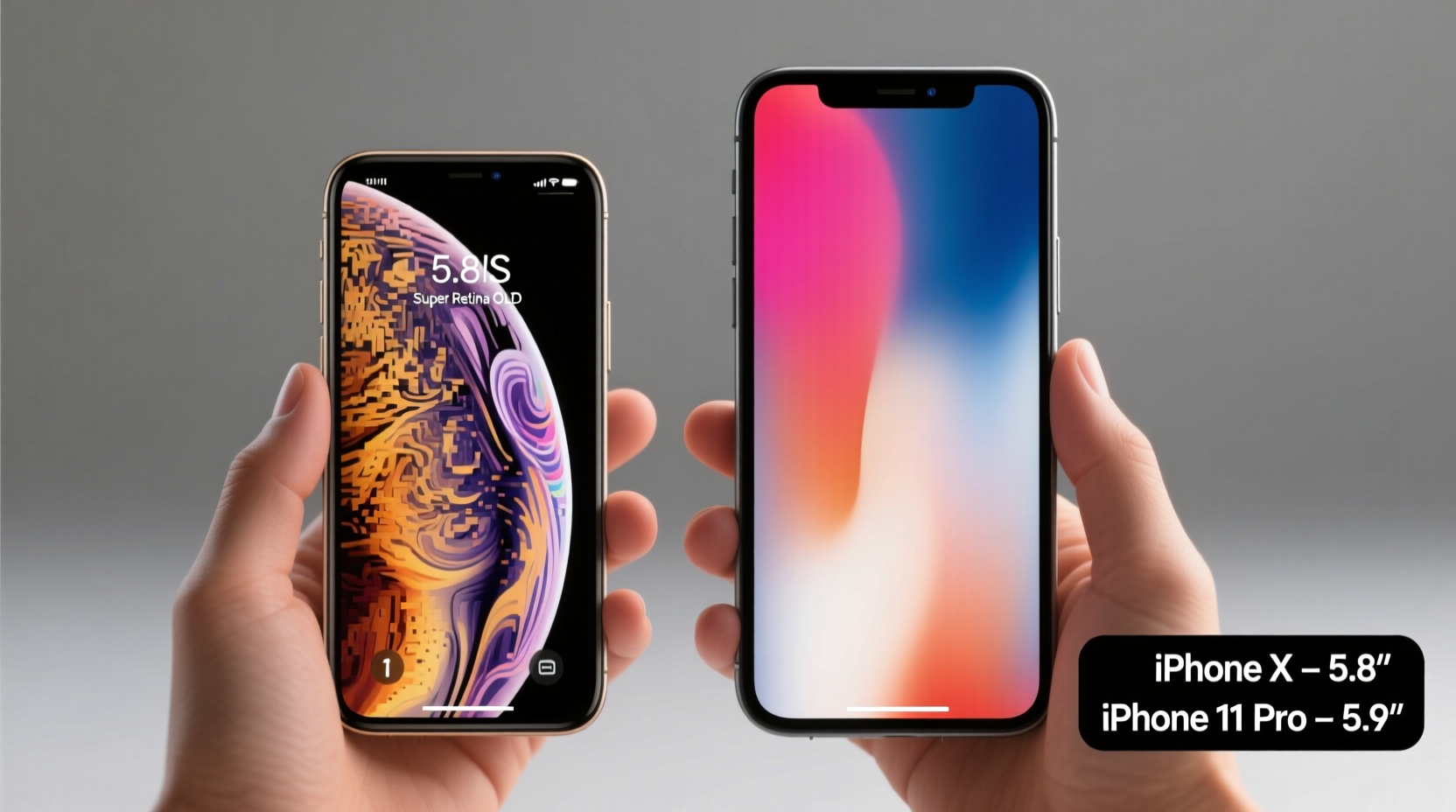
The iPhone XS, released in 2018, features a 5.8-inch Super Retina OLED display with a resolution of 2436 x 1125 pixels. The iPhone 11 Pro, launched in 2019, also uses a Super Retina XDR OLED panel but increases the diagonal measurement to 5.8 inches—wait, what?
Hold on—both phones list a 5.8-inch display. That’s technically correct. However, the key difference lies not in the diagonal measurement, but in how much of the front surface is occupied by the screen. The iPhone 11 Pro has slightly thinner bezels and a more optimized layout, resulting in a marginally larger active display area and improved brightness (up to 800 nits typical, 1200 peak vs. 625 nits on the XS).
Despite the identical listed size, the 11 Pro offers better contrast, HDR support, and a more future-proof display technology. But for users upgrading from the XS, the visual change isn’t dramatic—it’s evolutionary, not revolutionary.
“Apple refined the OLED experience with the 11 Pro series, focusing on durability, efficiency, and dynamic range rather than sheer size.” — David Liu, Mobile Display Analyst at TechInsight Group
Real-World Screen Usability: Does It Feel Bigger?
If you’re holding both devices side by side, the physical footprint of the iPhone 11 Pro is nearly identical to the XS. The width remains 70.9 mm, making both comfortable for single-handed use. The weight differs slightly—the 11 Pro is 10 grams heavier (188g vs. 177g)—but this doesn’t affect screen perception directly.
So why do some users report that the 11 Pro “feels” like it has a bigger screen? The answer lies in three factors:
- Brightness and contrast: The 11 Pro’s XDR display delivers deeper blacks and brighter whites, enhancing immersion, especially when watching video.
- Content scaling: Apps and videos appear sharper and slightly more expansive due to improved color accuracy and reduced glare.
- User expectations: Knowing it’s a newer model can create a psychological bias toward perceiving improvements.
In direct comparison, scrolling through Safari, viewing photos, or watching YouTube, the screen real estate is effectively the same. You won’t notice extra lines of text or significantly wider app interfaces. The notch dimensions are nearly identical, so UI elements remain consistent across both devices.
Detailed Comparison Table: iPhone XS vs iPhone 11 Pro Display & Design
| Feature | iPhone XS | iPhone 11 Pro |
|---|---|---|
| Display Size (Diagonal) | 5.8 inches | 5.8 inches |
| Panel Type | Super Retina OLED | Super Retina XDR OLED |
| Resolution | 2436 x 1125 pixels | 2436 x 1125 pixels |
| Pixels Per Inch (PPI) | 458 | 458 |
| Max Brightness (Peak) | 625 nits | 1200 nits (HDR) |
| HDR Support | Limited (HDR10 playback) | Full HDR10 and Dolby Vision |
| Bezel Width | Slightly thicker | Narrower, more screen coverage |
| Weight | 177g | 188g |
| Water Resistance | IP67 (30 min at 2m) | IP68 (30 min at 4m) |
Mini Case Study: Upgrading After Two Years
Jamie had used an iPhone XS since its launch in 2018. By late 2020, battery life was declining, and she considered upgrading. She tested both the iPhone 11 Pro and the larger 11 Pro Max at an Apple Store. Holding the 11 Pro next to her XS, she expected the screen to feel dramatically different.
“I kept looking for something obvious—more screen space, bigger icons, wider web pages,” she said. “But honestly, it looked almost the same. What stood out was how much crisper the video looked and how much easier it was to see outdoors.”
She ultimately chose the 11 Pro not for screen size, but for improved battery life, camera performance, and the confidence of owning a device with better water resistance and longer software support.
This reflects a broader trend: for most users, the practical benefits of newer components outweigh marginal changes in display dimensions.
When Screen Differences Matter: Specific Use Cases
While the screen size difference isn’t noticeable for general use, certain scenarios highlight where the 11 Pro pulls ahead:
- Outdoor Visibility: On a sunny beach or under harsh office lighting, the 11 Pro’s higher brightness makes a tangible difference.
- Media Consumption: Watching HDR movies on Apple TV+ or Netflix reveals richer detail and contrast on the 11 Pro.
- Photo and Video Editing: Color grading on the more accurate XDR display allows professionals to make better decisions.
- Long-Term Durability: The 11 Pro’s screen is rated for better scratch resistance and includes an improved oleophobic coating.
However, if your primary concerns are pocketability, one-handed operation, or budget, the iPhone XS remains a capable device. The lack of a visible screen size jump means you’re not sacrificing usability by sticking with the older model.
Checklist: Should You Upgrade for the Screen?
Use this checklist to determine if the display improvements justify an upgrade from iPhone XS to 11 Pro:
- ☐ Do you frequently watch HDR content? → Yes favors 11 Pro
- ☐ Do you struggle to see your screen in bright sunlight? → Yes favors 11 Pro
- ☐ Is battery life a bigger concern than screen size? → 11 Pro lasts up to 4 hours longer
- ☐ Do you edit photos or videos on your phone? → 11 Pro offers better color accuracy
- ☐ Are you sensitive to added weight? → XS is lighter by 11g
- ☐ Is budget a constraint? → Xs typically costs less secondhand
Frequently Asked Questions
Is the iPhone 11 Pro screen actually bigger than the iPhone XS?
No, both have a 5.8-inch diagonal measurement. The 11 Pro has slightly thinner bezels and a more advanced OLED panel (XDR), which improves image quality but not usable screen area.
Can I tell the difference just by looking?
Not easily. Side-by-side, the screens look nearly identical in size. The 11 Pro appears sharper and brighter, especially in HDR mode, but the interface and app layouts are the same.
Does the screen difference affect gaming or multitasking?
No. Since resolution and aspect ratio are identical, games and split-view apps behave the same on both devices. Any performance gains come from the faster A13 chip, not screen size.
Final Verdict: Not About Size—It’s About Quality
The idea that the iPhone 11 Pro has a “noticeably larger” screen than the iPhone XS is a common misconception. In reality, Apple maintained the same compact form factor while improving the underlying display technology. The real advancements are in brightness, contrast, color fidelity, and HDR performance—not physical dimensions.
If you're deciding between these two models today—especially in the refurbished or secondhand market—the choice shouldn’t hinge on screen size. Instead, consider battery life, camera upgrades (the 11 Pro adds a telephoto lens and Night Mode), processor speed, and long-term iOS support. The display improvements enhance the experience, but they don’t redefine it.
For users who value a compact flagship experience without sacrificing modern features, the iPhone XS still holds up well. But if you want the best possible screen quality in a similarly sized package, the 11 Pro delivers—just not in the way most expect.




 浙公网安备
33010002000092号
浙公网安备
33010002000092号 浙B2-20120091-4
Comments
No comments yet. Why don't you start the discussion?