
When Apple released the iPhone 11 Pro in 2019, it marked a pivotal shift in mobile photography. For owners of the iPhone XS—still a capable device—the question became immediate: Is upgrading for the improved camera actually worth it? The answer isn’t just about megapixels or marketing claims. It hinges on how you use your phone, what kind of photos matter to you, and whether the gains justify the cost and effort of switching.
The iPhone XS, launched in 2018, set a high bar with its dual-camera system, Smart HDR, and strong color accuracy. But the iPhone 11 Pro didn’t just improve—it redefined expectations with a third ultra-wide lens, Night mode, and significantly enhanced computational photography. To determine if the upgrade pays off, we need to look beyond specs and into real-world performance, user habits, and long-term value.
Camera Hardware: What Changed?
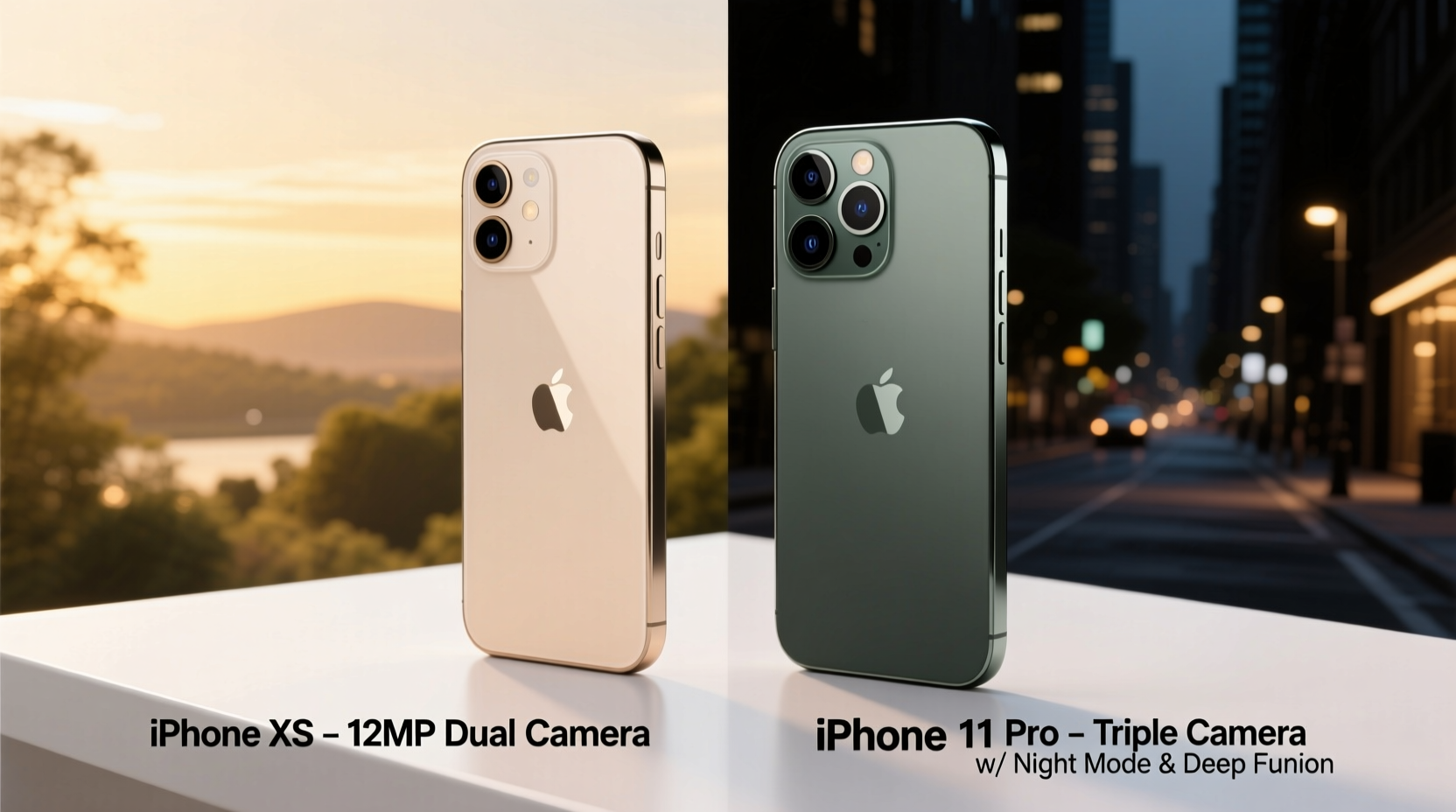
The most obvious difference between the iPhone XS and iPhone 11 Pro lies in their camera hardware. While both devices feature dual optical zoom and portrait mode capabilities, the 11 Pro introduces a third lens that fundamentally expands creative possibilities.
| Feature | iPhone XS | iPhone 11 Pro |
|---|---|---|
| Rear Cameras | Dual 12MP (Wide + Telephoto) | Triple 12MP (Ultra-Wide + Wide + Telephoto) |
| Aperture (Wide) | f/1.8 | f/1.8 |
| Ultra-Wide Lens | No | Yes (f/2.4, 120° field of view) |
| Night Mode | No | Yes (on all rear cameras) |
| Sensor Size | Smaller sensor area | Larger sensors with improved light capture |
| Smart HDR | Introduced | Enhanced with deeper processing |
The addition of the ultra-wide lens on the 11 Pro allows photographers to capture expansive landscapes, tight interior shots, or dynamic group photos without stepping back. This single change opens up compositional options that simply aren’t possible on the XS. More importantly, the larger sensors and improved pixel binning mean better dynamic range and cleaner images in mixed lighting.
Low-Light Performance: Where the 11 Pro Shines
If there’s one area where the iPhone 11 Pro pulls far ahead, it’s low-light photography. The introduction of Night mode was a game-changer. Unlike third-party apps that attempted similar results, Night mode is deeply integrated into the camera system, using machine learning to stabilize shots, adjust exposure, and reduce noise—all automatically.
On the iPhone XS, low-light photos often suffer from grain, motion blur, and poor shadow detail. Without computational night shooting, users are forced to rely on flash or external lighting, which rarely produces natural results. In contrast, the 11 Pro can capture usable, well-exposed images in near-darkness—up to 30 seconds of exposure time, stabilized by the phone’s gyro and software.
“Night mode on the 11 Pro wasn’t just an improvement—it was a new capability. Suddenly, people could take meaningful photos in environments where they previously wouldn’t even try.” — David Kim, Mobile Photography Instructor at SF Media Academy
This doesn’t mean every dimly lit photo becomes perfect. Handheld stability still matters, and moving subjects remain challenging. But for static scenes—a candlelit dinner, cityscapes at dusk, or indoor family moments—the 11 Pro delivers consistently superior results.
Real-World Example: A Travel Photographer’s Dilemma
Consider Sarah, a travel blogger who upgraded from an iPhone XS to an 11 Pro before a trip through Southeast Asia. On her previous journey, she’d struggled to capture temple interiors without a tripod. Indoors, her XS photos were dark, noisy, and lacked depth. She often relied on post-processing to salvage them.
With the 11 Pro, she found she could shoot freely inside ancient structures during golden hour. Night mode activated automatically, producing clean, detailed images with accurate color balance. The ultra-wide lens allowed her to capture entire murals without distortion. Even casual street shots at twilight showed richer textures and balanced highlights.
For Sarah, the upgrade wasn’t just about convenience—it expanded her creative toolkit. She published more original content, received higher engagement, and reduced editing time by nearly 40%. For professionals or passionate hobbyists, this kind of efficiency gain translates directly into value.
When the Upgrade Makes Sense: A Practical Checklist
Not every iPhone XS owner needs to upgrade. If your current camera meets your needs, staying put may be the smarter choice. But if any of the following apply, the 11 Pro’s camera could be worth the investment:
- You frequently take photos in low-light settings (restaurants, concerts, evening walks)
- You want greater creative control with multiple focal lengths
- You share photos professionally or on social media where image quality impacts perception
- You dislike using external apps or accessories to compensate for hardware limits
- You value future-proofing and plan to keep your phone for two or more years
Conversely, if you mostly take daytime photos, rarely edit images, or use your phone primarily for video calls and messaging, the XS remains entirely functional. The performance gap narrows significantly under ideal conditions.
Image Processing and Software Advantages
Beyond hardware, the 11 Pro benefits from the A13 Bionic chip, which powers faster image signal processing and more advanced machine learning models. This means quicker shot-to-shot times, better subject detection in portraits, and more natural bokeh effects.
Smart HDR on the 11 Pro analyzes faces, skies, and shadows independently, preserving highlight detail while lifting shadows intelligently. The result is a more lifelike photo straight out of the camera—less need for manual correction.
Additionally, the 11 Pro supports extended dynamic range for video recording up to 60fps, making it a better tool for vloggers or creators who shoot on the go. While the XS handles 4K at 60fps, it lacks the refined tone mapping and stabilization refinements introduced with the newer model.
Frequently Asked Questions
Does the iPhone 11 Pro camera make a noticeable difference in daylight?
In good lighting, both phones produce excellent results. However, the 11 Pro generally captures slightly more detail in shadows and highlights due to improved Smart HDR. Colors are also more consistent across different scenes. The ultra-wide lens adds versatility, but if you don’t use it, the difference may seem minor.
Can I get Night mode-like results on the iPhone XS with third-party apps?
Yes, apps like NightCap or ProCamera offer long-exposure modes that mimic Night mode. However, they require manual setup, a steady hand or tripod, and often produce noisier results. They lack the seamless integration and automatic optimization of Apple’s native solution.
Is the front camera better on the 11 Pro?
Yes. The 11 Pro features a 12MP TrueDepth camera with 4K video recording and slofies (slow-motion selfies). It also supports Night mode for low-light selfies—a feature absent on the XS. Portrait mode is more accurate thanks to improved depth mapping.
Final Verdict: Is It Worth It?
Upgrading from the iPhone XS to the 11 Pro solely for the camera is a decision best made based on usage patterns, not benchmarks. For casual users who take occasional snapshots, the improvement may feel incremental. The XS still takes beautiful photos in daylight and performs adequately indoors.
But for those who rely on their phone as a primary camera—travelers, content creators, parents documenting milestones, or anyone who values photographic flexibility—the 11 Pro offers tangible, everyday advantages. The ultra-wide lens, Night mode, and superior processing deliver more than technical upgrades; they provide confidence in diverse shooting conditions.
Moreover, the 11 Pro brought iOS features and hardware longevity that extended its relevance well into the 2020s. Even today, many 11 Pro units run the latest iOS versions smoothly, supporting modern camera algorithms and editing tools that the XS cannot fully utilize.




 浙公网安备
33010002000092号
浙公网安备
33010002000092号 浙B2-20120091-4
Comments
No comments yet. Why don't you start the discussion?