
When it comes to interior design, rugs are more than just floor coverings—they’re anchors for style, comfort, and spatial definition. For decades, the rectangular rug has dominated living rooms, bedrooms, and dining areas. But in recent years, irregular-shaped rugs—those with organic curves, asymmetrical edges, or freeform silhouettes—have surged in popularity. Are they just a fleeting trend, or do they offer tangible benefits over their traditional counterparts?
This article dives deep into the practical, aesthetic, and psychological differences between irregular and rectangular rugs. From layout functionality to emotional impact, we’ll examine whether the “weird shape” truly performs better in real homes.
Design Philosophy: Structure vs. Spontaneity
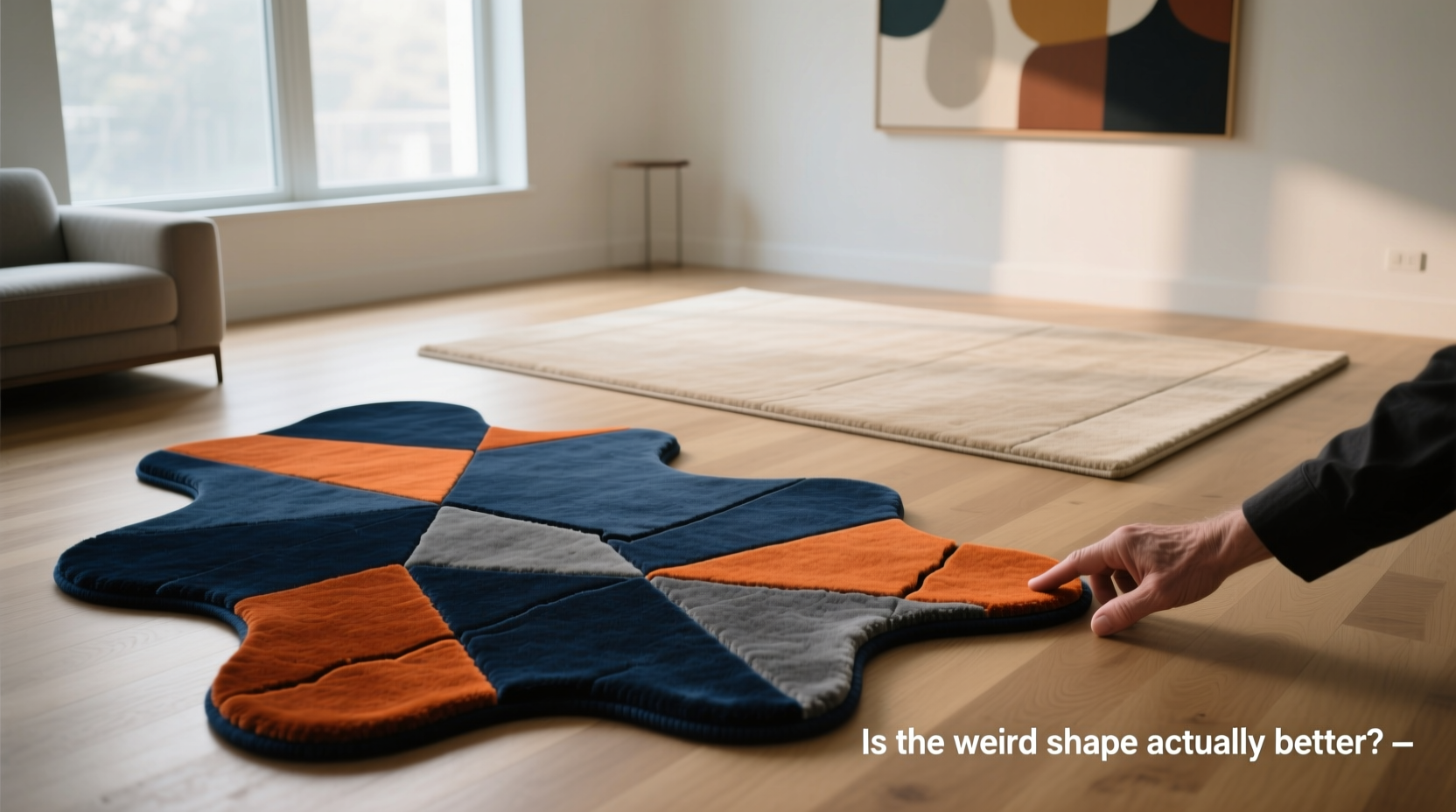
Rectangular rugs embody order. Their straight lines and right angles complement furniture arrangements, architectural symmetry, and minimalist aesthetics. They’re predictable, which makes them easy to shop for and place. Most sofas, coffee tables, and beds fit neatly within their borders, creating a balanced visual rhythm.
Irregular rugs, by contrast, reject rigidity. Inspired by nature, abstract art, or artisan craftsmanship, these rugs introduce movement and unpredictability. A wavy edge might echo the flow of water; a scalloped border can soften a sharp corner. Designers use them to break monotony and inject personality.
“An irregular rug doesn’t follow the room—it redefines it.” — Lena Torres, Interior Architect & Textile Curator
The choice between structure and spontaneity often reflects broader design intent. Rectangular rugs support function-first spaces. Irregular rugs thrive where self-expression matters more than conformity.
Functional Comparison: Where Each Rug Excels
Functionality isn’t just about durability—it’s about how well a rug integrates into daily life. Below is a detailed comparison:
| Criteria | Rectangular Rug | Irregular Rug |
|---|---|---|
| Furniture Alignment | Excellent – fits standard layouts | Poor to moderate – hard to align symmetrically |
| Space Definition | Strong – clearly zones areas | Moderate – defines loosely, artistically |
| Versatility | High – works in most rooms | Low to medium – best in creative or open spaces |
| Under Furniture Fit | Easy – all legs typically sit on rug | Challenging – may leave legs exposed unevenly |
| Visual Impact | Subtle, grounding | High – becomes a focal point |
| Maintenance | Straightforward – standard cleaning | Slightly harder – edges collect dust |
While rectangular rugs win in predictability and ease of use, irregular rugs score higher in artistic expression and emotional resonance. The “better” option depends on whether you prioritize harmony or individuality.
Real-World Application: A Case Study
In a 2023 renovation of a Brooklyn brownstone, designer Marcus Lin faced a challenge: a sunroom with mismatched windows, slanted walls, and no clear focal point. Traditional rectangular rugs only emphasized the room’s awkwardness.
Lin introduced a large, organically shaped wool rug with undulating edges in earthy tones. Instead of centering it under furniture, he placed it off-axis near a window seat, allowing its curves to mirror the tree branches visible outside.
“The moment that rug went down, the room stopped fighting itself,” Lin said. “It didn’t hide the imperfections—it celebrated them.”
Residents reported feeling more relaxed in the space. Visitors consistently commented on the rug first. Functionally, some furniture legs remained off the rug, but the emotional payoff outweighed the minor imbalance.
This case illustrates a key truth: irregular rugs don’t fix flawed layouts—they transform how we perceive them.
Choosing the Right Rug: A Step-by-Step Guide
Selecting between irregular and rectangular isn’t arbitrary. Follow this process to make an informed decision:
- Assess Room Function: Is the space for entertaining, relaxation, or work? High-traffic areas favor durable, structured rugs.
- Map Furniture Layout: Sketch your arrangement. If pieces align neatly, a rectangular rug will enhance cohesion.
- Evaluate Architectural Lines: Straight walls and right angles suit rectangles. Curved walls or angled ceilings pair well with irregular forms.
- Determine Focal Point: Do you want the rug to blend or stand out? Irregular rugs demand attention.
- Test Proportion: In small rooms, oversized irregular rugs can overwhelm. Stick to modest dimensions unless making a bold statement.
- Consider Maintenance: Pet owners and families may prefer simpler-to-clean rectangular options.
- Trust Your Instinct: Stand in the empty room. Does it feel static or dynamic? Choose the rug that complements its energy.
Common Misconceptions Debunked
- “Irregular rugs are just for bohemian styles.” False. Modernist and Scandinavian designers increasingly use asymmetrical rugs to add warmth without clutter.
- “Rectangular rugs are boring.” Not necessarily. Texture, pile height, and color layering can make a rectangle visually rich.
- “You can’t mix rug shapes.” You can—but sparingly. Layering a small irregular rug over a larger neutral rectangle adds depth when done intentionally.
FAQ
Can I use an irregular rug in a formal living room?
Yes, if done thoughtfully. Choose an irregular rug in a refined material like hand-knotted silk or tightly woven wool, and keep surrounding decor restrained. The contrast between formal setting and organic shape can create sophisticated tension.
Do irregular rugs cost more than rectangular ones?
Generally, yes. Many are handmade or limited-edition designs. Custom sizing also increases cost. However, machine-made versions are becoming available at mid-range price points.
How do I clean the edges of an irregular rug?
Use a narrow vacuum attachment or soft brush to reach curved borders. Rotate the rug quarterly to ensure even wear and prevent edge fraying from foot traffic.
Final Checklist Before Buying
✅ Measure your space and key furniture ✅ Decide whether you want the rug to unify or disrupt the room ✅ Test virtual samples using augmented reality apps ✅ Check return policy—especially for online purchases ✅ Feel the texture in person if possible ✅ Confirm non-slip pad compatibility
Conclusion
The question isn’t whether irregular rugs are objectively better than rectangular ones—it’s whether they serve your space more authentically. Rectangular rugs offer reliability, clarity, and timeless utility. Irregular rugs invite emotion, surprise, and personal narrative into a room.
For many, the future of home design lies not in choosing one over the other, but in knowing when to deploy each. A well-balanced home might feature a structured rectangle under the dining table and a freeform piece beneath a hanging chair in the corner. The “weird shape” isn’t superior—it’s strategic.
If you’ve been hesitant to try an irregular rug, consider starting small: a kidney-shaped accent rug in a hallway or a cloud-like runner in a bedroom. Let form follow feeling. The result might not be conventional—but it could be unforgettable.




 浙公网安备
33010002000092号
浙公网安备
33010002000092号 浙B2-20120091-4
Comments
No comments yet. Why don't you start the discussion?