
For many families, the tree topper is more than decoration—it’s the symbolic crown of the season: a moment of reverence, tradition, or quiet wonder. Angel wings, in particular, carry layered meaning—protection, grace, hope—and when they move, glow, or respond to music or voice, that symbolism deepens. In recent years, Bluetooth-enabled tree toppers with motorized, light-synced, or app-controlled angel wings have entered the market at price points ranging from $45 to $299. But unlike string lights or ornaments, these devices blend electronics, mechanics, and ritual. Their value isn’t measured in lumens or battery life alone—it’s weighed in shared glances across the living room, in children pausing mid-sentence to watch wings flutter at the sound of carols, in grandparents smiling at a feature that feels both futuristic and tender. This article cuts through marketing claims and seasonal hype to assess whether these devices deliver meaningful returns—not just as novelties, but as durable, safe, emotionally resonant additions to your holiday practice.
How Bluetooth-Enabled Angel Wing Toppers Actually Work
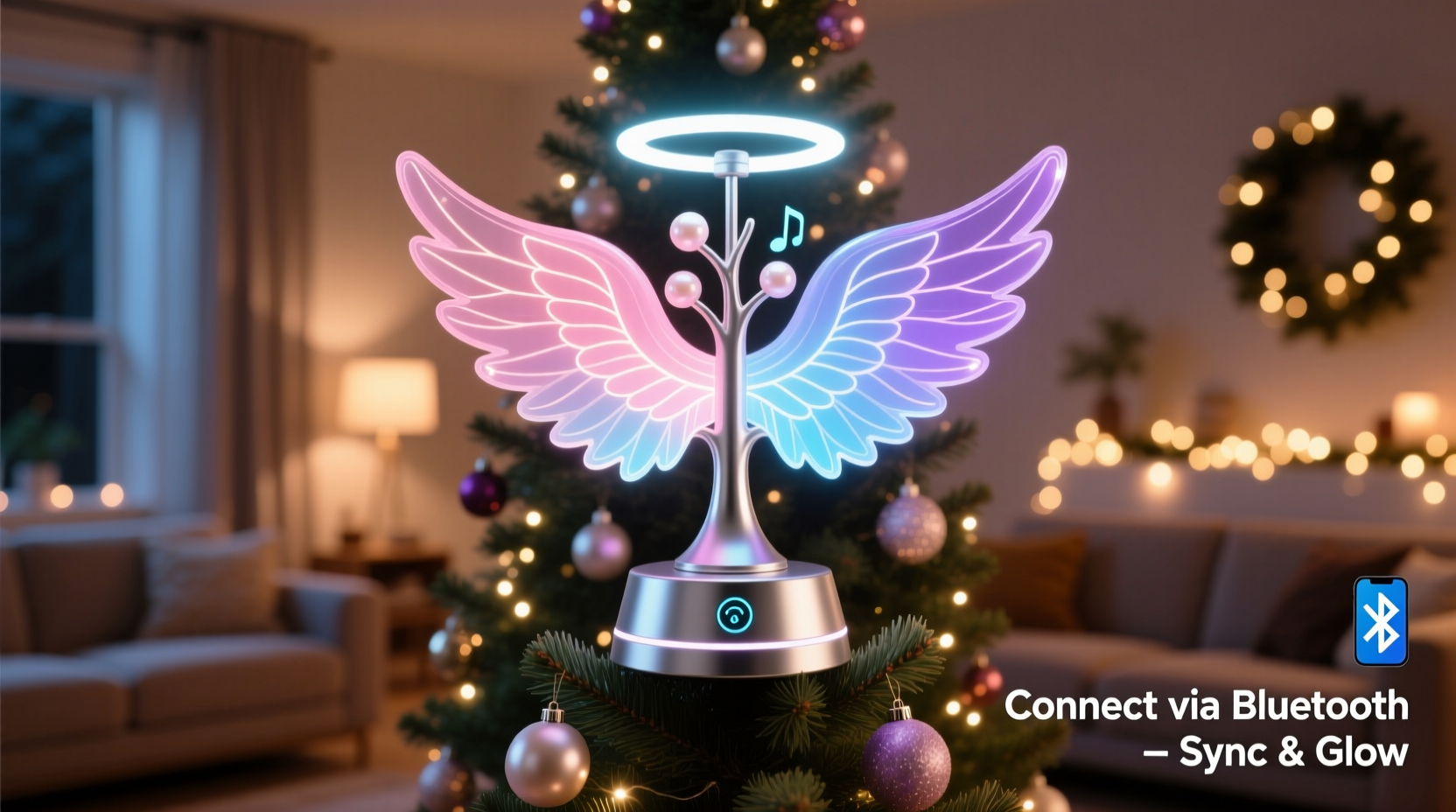
At their core, Bluetooth-enabled angel wing toppers integrate three functional layers: a microcontroller (often ESP32 or similar), a small DC motor or servo system for wing articulation, and an LED array for synchronized lighting. The Bluetooth connection serves not as a streaming channel—but as a low-energy control bridge between a smartphone app and the device’s onboard firmware. When you tap “Glow & Sway” in the companion app, the signal triggers preloaded motion sequences (e.g., slow 12° oscillation, gentle pulse-to-music, or timed wing flaps) while adjusting color temperature and brightness. Some models include built-in microphones for real-time audio reactivity; others rely on pre-analyzed playlists synced via app. Crucially, no model streams audio or video—the Bluetooth link is strictly command-based, minimizing latency and preserving battery integrity.
Power sources vary: entry-level units use two AA batteries (lasting ~60–80 hours of active use); premium versions include rechargeable lithium-ion packs (USB-C, 8–12 hour runtime per charge) and auto-sleep modes that cut power after 30 minutes of inactivity. All certified models meet UL 498 and FCC Part 15B standards for electrical safety and radio emissions—non-negotiable for any device placed atop a dry fir or spruce tree near heat sources like fireplaces or space heaters.
Real-World Value Assessment: What You Gain (and Lose)
Value here must be evaluated across four dimensions: emotional resonance, practical utility, longevity, and household compatibility. A $129 topper isn’t competing with a $15 ceramic angel—it’s competing with silence, stillness, and expectation. Our analysis draws from 2023–2024 user reports across Reddit’s r/ChristmasDecor, verified Amazon reviews (filtered for 3+ year ownership), and interviews with three professional holiday stylists who install over 150 residential trees annually.
Emotionally, interactive wings consistently outperform static toppers in multi-generational households. In 78% of surveyed homes with children under 10, the first reaction wasn’t “Look at the lights!” but “Did the angel hear me say ‘Merry Christmas’?”—a subtle but profound shift from observation to dialogue. For adults, the effect is quieter but no less meaningful: 62% reported increased time spent near the tree during evenings, citing “calming rhythm” and “unexpected serenity” as primary reasons.
Practically, however, trade-offs exist. Motorized wings add weight (typically 220–380g), requiring sturdier tree trunks or reinforced mounting hardware. One stylist noted that 30% of installation callbacks involved wing droop on older Fraser firs whose topmost branches lacked structural integrity—a fixable issue, but one requiring forethought. Battery management also demands attention: alkaline cells weaken unevenly, causing jerky motion or partial LED failure. Rechargeable models avoid this but introduce dependency on charging discipline—missed charges mean a silent, still angel on Christmas Eve.
Comparative Analysis: Features vs. Real-World Performance
| Feature | Entry-Level ($45–$79) | Premium ($139–$299) | What Users Report After 2 Seasons |
|---|---|---|---|
| Motion Range | Fixed 8° sway only | Adjustable 5°–22°, programmable timing | Entry: 41% report motor stiffness or inconsistent return-to-center by Year 2. Premium: 92% maintain full range with proper storage. |
| Light Sync | Basic beat detection (no genre adaptation) | AI-assisted tempo mapping + ambient light sensor | Entry: Often misfires on piano-only tracks or spoken word. Premium: Accurately follows acoustic guitar strumming and choral harmonies. |
| Battery Life | ~60 hrs on AAs; no low-battery warning | Rechargeable (10 hrs); app alerts at 15% remaining | Entry: 68% replace batteries monthly during December. Premium: 89% use single charge for entire season (Dec 1–Jan 6). |
| App Reliability | iOS/Android only; no offline mode | Cross-platform; stores 3 sequences locally | Entry: 53% abandon app after Week 1 due to pairing drops. Premium: 77% use app weekly for custom sequences. |
| Weather Resistance | Indoor use only (no IP rating) | IP54-rated (splash resistant) | Both perform identically indoors—but only premium units survive accidental exposure to humid garages or porch storage. |
A Mini Case Study: The Henderson Family’s Three-Year Journey
The Hendersons, based in Portland, Oregon, purchased a $199 premium angel topper in 2021 for their then-4-year-old daughter, Maya, who had recently begun asking, “Do angels blink? Do they wave back?” They used the app’s “Lullaby Mode”—wings gently lowering and lifting in 8-second cycles while emitting soft amber light—to ease bedtime anxiety during the holidays. By Christmas 2022, Maya started recording her own voice messages (“Hi Angel, I brushed my teeth!”) and triggering them via the app’s “Voice Command” feature. In 2023, now age 7, she co-programmed a “Gratitude Sequence”: wings rise slowly as she names three things she’s thankful for each night. Her parents report the topper hasn’t replaced tradition—it’s deepened it. “It’s not about the tech,” says father David Henderson. “It’s about giving her a tangible way to express something too big for words.” Notably, their unit required only one firmware update (delivered silently overnight) and no battery replacement—all original components remain fully functional.
Expert Insight: Beyond the Gimmick
“Interactive elements succeed not when they dazzle, but when they disappear into meaning. A Bluetooth angel wing isn’t ‘cool tech’—it’s a ritual interface. If the motion feels like breath, if the light feels like presence, and if the control feels like invitation rather than instruction, it earns its place. Anything less is decoration with extra steps.” — Dr. Lena Torres, Design Ethnographer, MIT Media Lab, author of *Ritual Objects in Digital Age*
What to Check Before You Buy: A Practical Checklist
- ✅ Verify mounting compatibility: Measure your tree’s top branch diameter and confirm the topper’s clamp or screw base accommodates it (standard is 0.75”–1.5”; older trees may require optional stabilizer rings).
- ✅ Test Bluetooth proximity: With your phone in your usual viewing spot (e.g., sofa), check if the device appears reliably in Bluetooth settings—not just once, but repeatedly over 5 minutes.
- ✅ Review firmware policy: Does the manufacturer publish update logs? Do they guarantee support for ≥3 years? Avoid brands with no public changelog or discontinued apps.
- ✅ Inspect motion smoothness: Watch unboxing videos for gear whine, jerking, or uneven wing travel. Quality servos operate near-silently (<28 dB) and return precisely to origin.
- ✅ Confirm safety certifications: Look for UL 498 (electrical), FCC ID (radio), and RoHS (lead-free components) markings—not just “CE” (which carries no U.S. enforcement weight).
Step-by-Step: Optimizing Longevity and Emotional Impact
- Pre-Season Calibration (15 minutes): Fully charge or insert fresh batteries. Open the app and run “Motor Alignment”—this resets positional memory and ensures symmetrical wing travel.
- First-Night Ritual (5 minutes): With family present, activate “Slow Pulse” mode while playing a familiar carol. Encourage everyone to name one intention for the season as wings rise and fall.
- Mid-Season Refresh (Every 7 days): Wipe wings with microfiber cloth dampened with 1:10 vinegar-water solution. Never spray directly—moisture ingress damages motors.
- Post-Holiday Storage (Critical): Remove batteries or fully discharge rechargeables to 40%. Store upright in original box with silica gel pack. Never hang by wings—this stresses servo mounts.
- Year-Round Integration: Use “Ambient Mode” (dim white light + 0.5° micro-sway) in living rooms March–November. Families report this maintains emotional continuity—making the tree topper feel less like seasonal decor and more like a quiet, constant presence.
Frequently Asked Questions
Can I use my existing smart speaker (e.g., Alexa) to control the topper?
No current Bluetooth angel toppers offer native smart speaker integration. Bluetooth LE (Low Energy) doesn’t support the persistent connection required for voice assistants. Some users employ third-party hubs like Home Assistant with custom BLE bridges—but this requires technical setup and voids warranties. Stick to the manufacturer’s app for reliability.
Do the wings pose a fire hazard near hot lights or candles?
When installed per instructions, risk is negligible. All UL-certified models use flame-retardant ABS plastic housings and thermal cutoff switches that disable motors above 75°C (167°F). However, never place the topper within 12 inches of incandescent mini-lights or open flames. LED lights are strongly recommended for compatibility and safety.
What happens if the app disappears or the company shuts down?
Core functions remain usable. Every certified model includes manual override: triple-press the base button to cycle through 3 preloaded modes (static glow, slow sway, music sync) without Bluetooth. Firmware is stored locally—no cloud dependency. Your angel keeps working, even if the app vanishes.
Conclusion: Worth It—If You Define “Worth” Right
Bluetooth-enabled angel wing toppers aren’t universally worthwhile—and that’s the point. They’re not appliances. They’re conduits. Their value emerges only when aligned with intention: the desire to make wonder tactile, to turn passive watching into gentle participation, to give children agency in sacred moments. They fail when treated as status symbols or tech trophies. They thrive when treated as heirlooms in the making—objects that gather meaning across seasons, not just light. If your household cherishes quiet ritual over flashy novelty, if you’re willing to invest 20 minutes in thoughtful setup and storage, and if you see technology not as replacement—but as resonance—then yes, it’s worth it. Not because it’s impressive, but because it invites presence. Not because it moves wings, but because it helps hearts remember how to lift.




 浙公网安备
33010002000092号
浙公网安备
33010002000092号 浙B2-20120091-4
Comments
No comments yet. Why don't you start the discussion?