
A capsule wardrobe—a curated collection of essential, versatile clothing items designed to be mixed and matched—has gained widespread popularity as a symbol of minimalist living, intentional consumption, and sustainable fashion. Proponents praise its ability to reduce decision fatigue, streamline mornings, and promote mindful dressing. But what about those whose personal style isn’t confined to a single aesthetic? For individuals who enjoy expressing themselves through eclectic, evolving, or contrasting looks—from edgy streetwear to polished tailoring, bohemian flow to sleek minimalism—the idea of limiting their wardrobe to 30 interchangeable pieces can feel restrictive, even alienating.
The core question remains: Can a capsule wardrobe coexist with diverse style preferences? The answer isn’t a simple yes or no. Instead, it depends on how we redefine the concept—not as a rigid formula, but as a flexible framework that prioritizes intentionality without erasing individuality.
Redefining the Capsule Wardrobe for Style Diversity
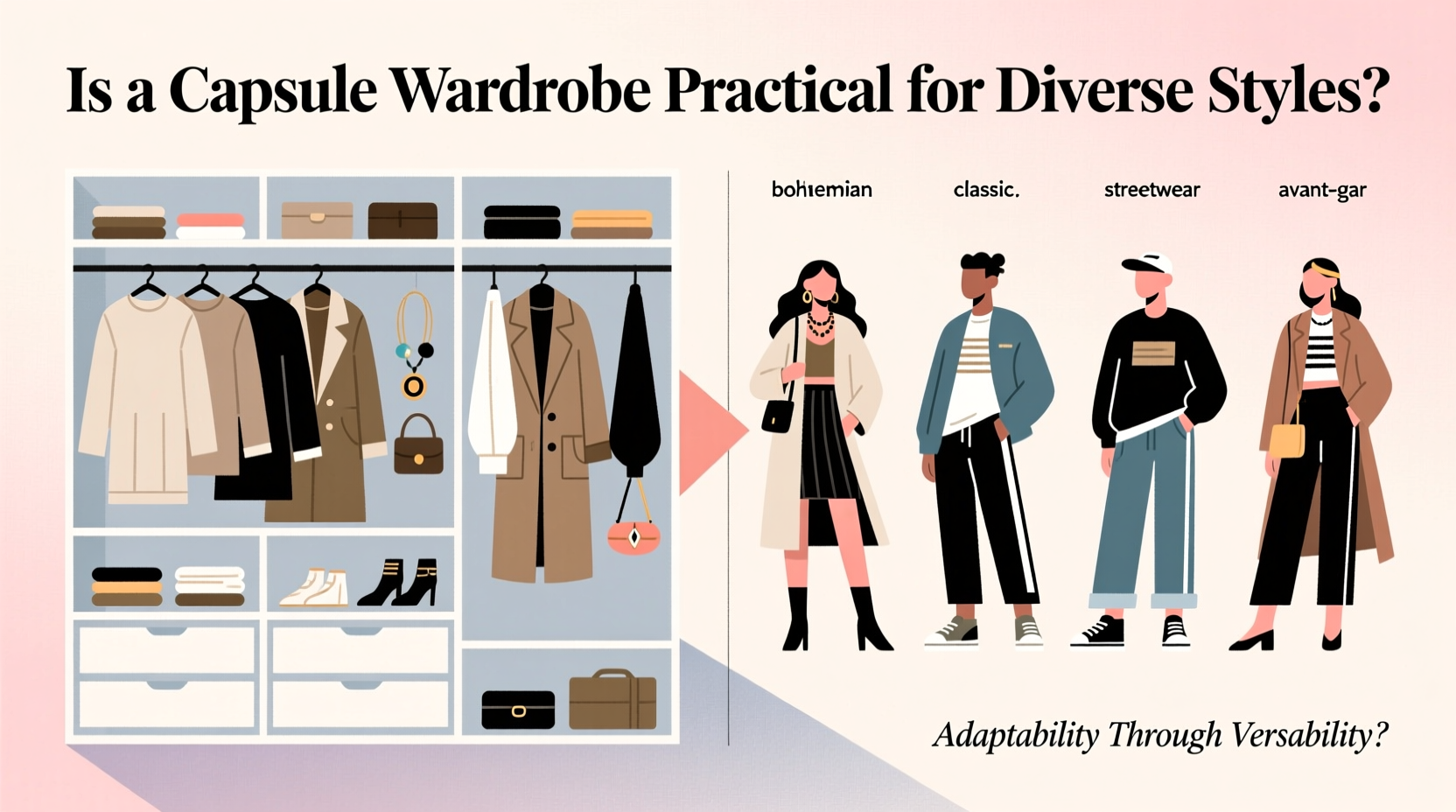
Traditionally, a capsule wardrobe follows strict parameters: a limited number of garments (often 30–40), a cohesive color palette, and seasonal rotation. While effective for those drawn to neutral tones and minimalist silhouettes, this model often overlooks the emotional and expressive role clothing plays in identity formation. For someone who dresses differently based on mood, occasion, or creative impulse, such rigidity may backfire, leading to frustration or abandonment of the concept altogether.
However, the underlying principles of a capsule—versatility, quality over quantity, and thoughtful curation—can still apply. The key lies in expanding the definition. A modern, inclusive capsule doesn’t demand uniformity; instead, it encourages strategic selection of foundational pieces that support multiple aesthetics. Think of it not as a one-style-fits-all solution, but as a modular system where core items anchor a range of expressive combinations.
“Capsule wardrobes aren’t about restriction—they’re about liberation from clutter so you can dress more authentically.” — Dana Thomas, author of *Fashionopolis*
Building a Multi-Style Capsule: Core Principles
To build a capsule that honors diverse tastes, shift focus from aesthetic consistency to functional synergy. This means selecting pieces that serve as bridges between styles rather than enforcing homogeneity. Consider these guiding principles:
- Invest in high-quality neutrals with character: Instead of plain black trousers, choose tailored wide-leg pants in charcoal with subtle texture. These can pair equally well with a silk blouse for evening wear or an oversized band tee for casual outings.
- Prioritize adaptability over minimalism: A leather jacket isn’t “minimal,” but it’s endlessly adaptable—equally at home with a slip dress or ripped jeans. Include statement basics that transcend singular categories.
- Design around lifestyle needs, not trends: If your week includes creative meetings, weekend hikes, and gallery openings, your capsule must reflect that range. Identify non-negotiable scenarios and build outward.
- Allow room for personality pieces: Allocate 20% of your capsule to “identity items”—a bold print coat, vintage boots, or artisan jewelry—that define your unique voice.
Case Study: Maya’s Modular Capsule
Maya, a graphic designer and part-time DJ, struggled with traditional capsule advice. Her ideal wardrobe needed to accommodate studio work, client presentations, club performances, and weekend markets. Early attempts at minimalism left her feeling underdressed or out of place.
She restructured her approach by identifying five core roles her wardrobe served:
- Professional Creative (client meetings)
- Studio Casual (long hours at the desk)
- Nightlife Edge (performances)
- Weekend Bohemian (markets, brunch)
- Transitional Basics (commuting, errands)
From there, she selected 15 foundational pieces—like black tailored shorts, a draped white shirt, dark wash jeans, and a structured blazer—that could transition across roles. She then added 10 specialized items: platform boots, a sequined vest, a crochet top, and a utility jumpsuit. Finally, she incorporated seven accessories—three bags, two belts, and two necklaces—that dramatically altered the tone of any outfit.
The result? A 32-piece capsule that felt expansive, not limiting. By anchoring her wardrobe in versatility while allowing space for expression, Maya reduced her closet size by 60% without sacrificing variety.
Do’s and Don’ts: Balancing Flexibility and Function
| Do | Don’t |
|---|---|
| Choose fabrics that drape well and resist wrinkling (e.g., Tencel, wool blends) | Limit yourself to only neutral colors—deep burgundy or forest green can be just as versatile |
| Include at least one wildcard piece per season (e.g., a printed coat or metallic skirt) | Assume all capsule items must be “basic”—personality has a place in curation |
| Use layering to shift formality (e.g., turtleneck under dress, blazer over hoodie) | Ignore fit—ill-fitting clothes undermine even the most stylish combinations |
| Rotate seasonal accents (scarves, shoes) to refresh the look without overhauling | Overload on trend-driven items that don’t align with long-term preferences |
Step-by-Step Guide to Creating a Diverse-Friendly Capsule
Follow this six-phase process to design a capsule that supports multiple aesthetics while minimizing clutter:
- Inventory & Audit: Pull every clothing item from your closet. Categorize them by style role (e.g., “night out,” “work meeting,” “creative day”). Note which pieces you reach for most and why.
- Define Your Style Archetypes: Identify 3–5 recurring themes in your preferred looks (e.g., “urban grunge,” “soft glam,” “modern classic”). Be honest about what makes you feel confident.
- Select Foundation Pieces: Choose 10–15 high-wear, mixable items that appear across archetypes. Examples: dark jeans, white button-down, black ankle boots, trench coat.
- Add Style Anchors: Select 5–7 pieces that embody each archetype but can be combined with foundations. Example: a velvet blazer (for glam), a denim jacket (for casual), a pleated midi skirt (for romantic).
- Curate Accessories Strategically: Pick 3–5 accessories that can pivot an outfit’s tone. A chunky chain necklace adds edge; a silk scarf softens a look.
- Test & Iterate: Wear the capsule for two weeks. Track which combinations worked, which felt awkward, and where gaps exist. Adjust before finalizing.
Common Misconceptions About Capsule Wardrobes
Several myths prevent people with varied tastes from embracing the capsule concept:
- Misconception: Capsules require a minimalist aesthetic. Reality: Minimalism is one interpretation, not a requirement. A capsule can include bold prints, textures, and statement pieces—as long as they serve a purpose.
- Misconception: You can’t wear trends in a capsule. Reality: Trends can be incorporated selectively. A micro-trend like cut-out shoulders can be included if it complements existing pieces and aligns with your style DNA.
- Misconception: Capsules are static. Reality: They’re meant to evolve. Most capsule advocates recommend refreshing 20–30% of the collection each season.
- Misconception: Capsules are only for women. Reality: Gender-neutral and masculine-leaning capsules are increasingly common, focusing on layered basics, footwear variety, and outerwear diversity.
Frequently Asked Questions
Can I have different capsules for different lifestyles?
Absolutely. Many professionals maintain separate work and weekend capsules. Frequent travelers often keep a compact travel capsule. The goal is alignment with context, not consolidation at all costs.
What if my style changes frequently?
That’s normal. A capsule isn’t a lifelong contract—it’s a seasonal tool. Build flexibility into your foundation pieces (e.g., choose classic cuts in adaptable fabrics) so they remain useful even as your tastes shift.
How do I handle special occasions?
Incorporate one or two elevated pieces into your capsule (e.g., a little black dress, tailored suit), or maintain a small “occasion reserve” outside the main collection. Renting formalwear is also a sustainable option.
Expert Insight: The Psychology of Choice and Wardrobe Satisfaction
Dr. Laura Sgro, behavioral psychologist specializing in consumer habits, explains: “The benefit of a capsule isn’t just logistical—it’s psychological. When people reduce excessive choice, they report higher satisfaction with their selections because each item feels intentional. The trick is ensuring that intention includes self-expression, not just efficiency.”
This insight underscores a critical point: a successful capsule doesn’t eliminate variety; it channels it. By removing the noise of excess, you create space to engage more deeply with the clothes you own, fostering a stronger connection between identity and appearance.
Checklist: Building a Practical, Expressive Capsule
- ☐ Audit current wardrobe by usage and emotional resonance
- ☐ Define 3–5 personal style archetypes
- ☐ Select 10–15 versatile foundation garments
- ☐ Add 5–7 style-specific anchor pieces
- ☐ Choose 3–5 transformative accessories
- ☐ Test the capsule for 10–14 days
- ☐ Document successful combinations
- ☐ Revise based on real-world feedback
- ☐ Schedule seasonal reviews (every 3 months)
- ☐ Allow 1–2 wildcard additions per season
Conclusion: Practicality Meets Personalization
A capsule wardrobe can indeed be practical for people with diverse style preferences—but only if we move beyond outdated definitions. The goal isn’t to conform to a narrow ideal of simplicity, but to create a system that reduces clutter while amplifying authenticity. When built with intention, a capsule becomes less about limitation and more about liberation: freedom from indecision, from fast fashion churn, and from the guilt of owning clothes you never wear.
The most practical wardrobe is not the smallest one, but the one that works hardest for you—across moods, moments, and meanings. Whether you lean into punk, preppy, poetic, or a mix of all three, a thoughtfully constructed capsule can support your evolution without demanding conformity. Start not by subtracting, but by clarifying: What do you truly want your clothes to say? Build from there, and you’ll find that practicality and personality don’t compete—they complement.




 浙公网安备
33010002000092号
浙公网安备
33010002000092号 浙B2-20120091-4
Comments
No comments yet. Why don't you start the discussion?