
For many families, the holiday season means twinkling lights, warm gatherings—and increasingly, smart decorations. Among the newest trends is the Wi-Fi-enabled Christmas tree topper camera: a decorative star or angel that doubles as a 1080p security cam, streaming live video to your phone while “watching over” your tree. It sounds festive and functional—until you consider where it’s pointed. These devices are mounted at eye level in the center of your living room, often facing sofas, dining tables, hallways, and even bedrooms down the hall. Unlike a dedicated security camera you place intentionally, a topper camera blends in, making its surveillance role easy to overlook—until it’s compromised. The short answer is yes: a hacked Christmas tree topper camera is a genuine, underappreciated privacy risk. But the deeper truth is more nuanced: the risk isn’t theoretical, it’s documented, preventable, and disproportionately high for devices marketed as “plug-and-play” without meaningful security safeguards.
How Tree Topper Cameras Work—and Where the Weak Spots Lie
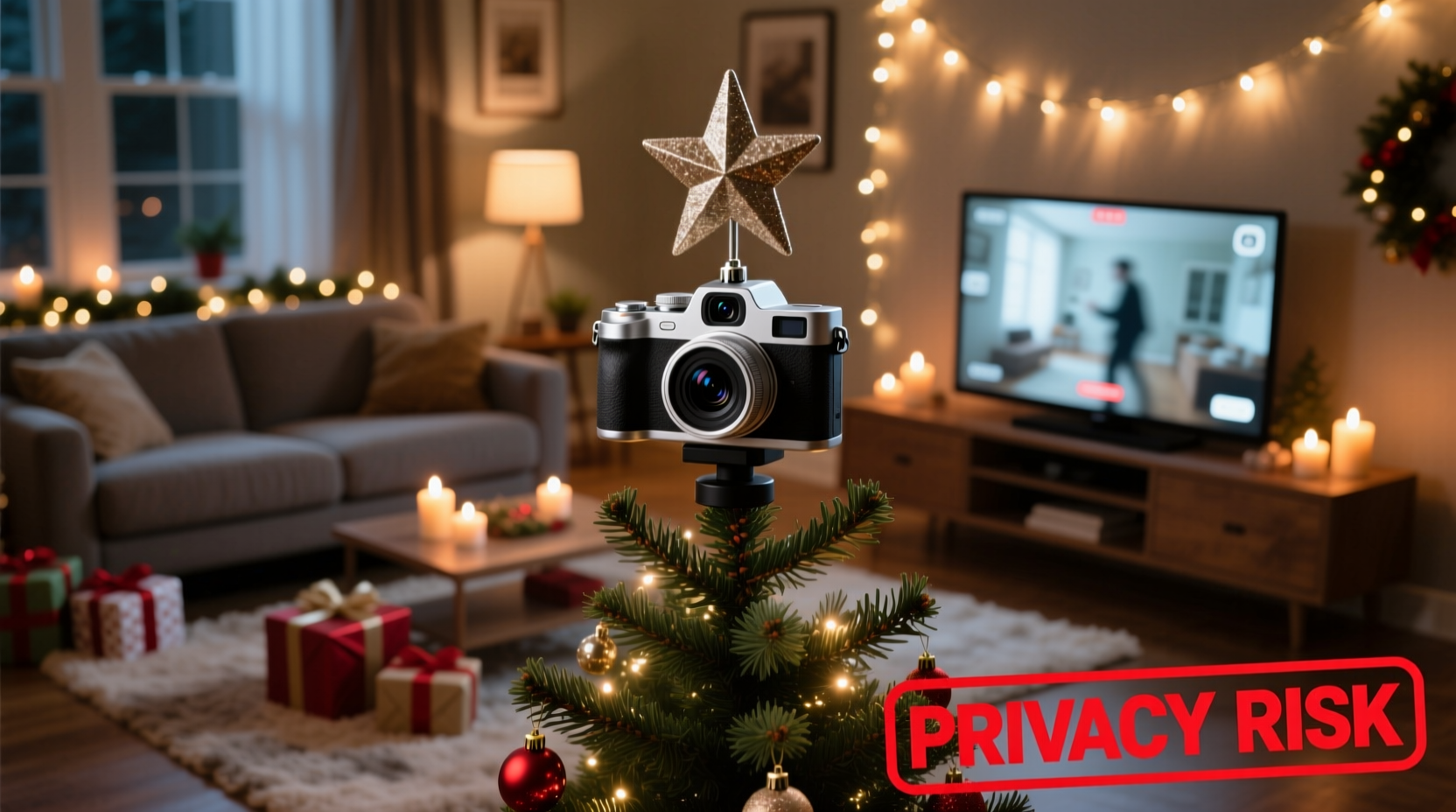
Most tree topper cameras operate on the same architecture as budget indoor security cams: a CMOS image sensor, built-in microphone and speaker, Wi-Fi radio (typically 2.4 GHz only), and cloud-connected firmware. Setup usually involves scanning a QR code with a companion app, syncing to your home network, and enabling remote viewing. That simplicity is the first red flag. Many models skip essential security practices—like enforcing strong passwords during onboarding, implementing automatic firmware updates, or using end-to-end encryption for video streams. Instead, they rely on manufacturer-controlled cloud servers where footage is stored, often with minimal transparency about data retention policies or third-party access.
Security researchers have repeatedly found vulnerabilities in this category of device. In 2023, the IoT Security Foundation issued an advisory after discovering that three popular topper brands used hardcoded default credentials embedded in firmware—meaning every unit shipped with the same username (“admin”) and password (“123456”). Even after user setup, some devices retained backdoor access via undocumented API endpoints. Others failed to validate SSL certificates, allowing man-in-the-middle attacks on local networks. And because these devices are rarely updated after purchase—some manufacturers discontinue support within 12 months—their firmware becomes a static target for known exploits.
What a Hacker Can Actually See and Do
A successful compromise goes far beyond passive video snooping. Attackers who gain control of a tree topper camera typically achieve full device root access—enabling them to:
- View live video and audio feeds in real time, including conversations, arguments, or children playing
- Access stored cloud clips—even those labeled “private” or “encrypted,” if the vendor’s encryption implementation is flawed
- Activate the microphone remotely, even when the camera appears idle or “off”
- Disable motion alerts or overwrite local SD card recordings (if supported)
- Use the device as a pivot point to scan your home network for other vulnerable devices (smart speakers, baby monitors, NAS drives)
- Deploy ransomware-like tactics—such as locking the device and demanding payment to restore functionality
Crucially, because the camera sits high and central, its field of view often captures multiple rooms. A single topper may see your front door entry, kitchen counter, living room couch, and staircase landing—areas most people don’t expect to be monitored constantly. Unlike a doorbell cam, which faces outward by design, this device faces inward, turning your most private domestic moments into potential data points.
Real-World Incident: The “Starlight Breach” of December 2022
In late December 2022, a family in Portland, Oregon, discovered their tree topper camera had been accessed remotely after receiving an unusual notification: “New login from Ukraine.” They hadn’t traveled abroad—or granted access to anyone overseas. Investigation revealed that the device’s companion app had no two-factor authentication, and its password reset function accepted any email address—even one not registered to the account. An attacker had brute-forced the weak password (the user had kept the default “christmas2022”), then used the app’s “email change” loophole to hijack the account.
Over 38 hours, the intruder viewed 17 hours of footage—including nighttime recordings of the couple sleeping in their adjacent bedroom (visible through an open doorway) and a toddler’s nursery (within partial frame). The attacker also activated the microphone during a private phone call about medical records. When the family contacted the vendor, support admitted the vulnerability had been reported to them six months earlier—but no patch or communication had been issued. The device was discontinued shortly after public disclosure. This wasn’t a targeted hack; it was opportunistic, automated, and entirely preventable.
Do’s and Don’ts: Securing Your Holiday Surveillance
Not all tree topper cameras are equally risky—and responsible use *can* mitigate exposure. The key is treating the device not as seasonal decor, but as a networked endpoint with real security implications. Below is a practical, evidence-based comparison of behaviors that reduce or amplify risk.
| Action | Do | Don’t |
|---|---|---|
| Setup & Configuration | Create a unique, strong password (12+ characters, mix of cases, numbers, symbols); disable UPnP on your router; assign the device to a guest Wi-Fi network isolated from main devices | Use default credentials; enable remote access unless absolutely necessary; connect directly to your primary network with smart TVs, laptops, or banking devices |
| Firmware & Updates | Manually check for firmware updates monthly; sign up for vendor security bulletins; replace devices older than 2 years | Assume “auto-update” is enabled and working; ignore update notifications; continue using devices after vendor announces end-of-life support |
| Physical Placement | Angle downward to limit field of view to tree only; avoid pointing toward bedrooms, bathrooms, or desks with sensitive documents | Mount flush to ceiling for maximum coverage; position where lens sees doorways to private rooms; leave unobstructed overnight |
| Data Handling | Disable cloud storage if local microSD recording is available; review and delete stored clips weekly; opt out of analytics sharing in app settings | Enable “lifetime cloud storage” plans without reading the privacy policy; allow voice assistant integration (e.g., “Hey Google, show me the tree cam”); grant location permissions to the app |
Expert Insight: Why “Festive Tech” Gets Security Wrong
The underlying issue isn’t malice—it’s misaligned incentives. Holiday tech vendors prioritize speed-to-market, low cost, and ease of use over robust security engineering. As Dr. Lena Torres, Director of the Embedded Systems Security Lab at Carnegie Mellon University, explains:
“Consumer IoT devices sold for seasonal use face a perfect storm: compressed development cycles, minimal regulatory oversight, and zero consumer expectation of long-term support. A $49 tree topper camera undergoes less security scrutiny than a $5 office webcam. Yet it sits in the most intimate space of the home—often for weeks at a time—with continuous power and network access. That makes it one of the highest-leverage targets in a typical smart home.”
This insight underscores a critical reality: privacy risk scales with access, not price tag. A $30 topper with poor encryption is objectively riskier than a $200 professional security system with verified encryption standards (like TLS 1.3) and SOC 2-compliant infrastructure.
Step-by-Step: Hardening Your Tree Topper Camera in Under 15 Minutes
You don’t need technical expertise to significantly improve security. Follow this sequence precisely—each step builds on the last:
- Unplug the device and locate its physical reset button (usually recessed, requiring a paperclip).
- Factory reset while holding the button for 12 seconds—this clears any prior configuration and default credentials.
- Launch your router’s admin interface (typically 192.168.1.1 or similar) and create a new guest Wi-Fi network named “Tree-Cam-Guest” with WPA3 encryption. Set a 16-character passphrase using random words (e.g., “maple-tin-whale-jolt-42!”).
- Reconnect the topper exclusively to the guest network—not your main SSID. Disable “Allow LAN Access” in the guest network settings.
- Open the companion app, create a new account using a dedicated email (not your personal Gmail), and set a unique password generated by a reputable password manager.
- Within the app, disable cloud recording, turn off microphone when not actively monitoring, and disable “remote access” unless you specifically need to view footage outside your home.
- Physically adjust the mount so the lens points slightly downward and covers only the tree trunk and lower branches—not the floor, furniture, or doorways.
Repeat steps 1–7 for any other smart holiday devices (light controllers, animated figures, musical ornaments). Consistency across your holiday tech stack multiplies protection.
FAQ
Can I cover the lens when not in use?
Yes—but with caveats. A removable opaque sticker or sliding lens cap works well. Avoid permanent tape or glue, which can damage housing or leave residue. Note that covering the lens does *not* disable the microphone; if audio privacy matters, power down the device completely or unplug it.
Are wired (non-Wi-Fi) tree topper cameras safer?
Generally, yes—if they transmit only locally via HDMI or analog signal to a nearby display and lack any network interface. However, verify specifications carefully: some “wired” models still include hidden Wi-Fi chips for “setup assistance” or firmware updates. Look for explicit statements like “no wireless connectivity” and “no internet dependency” in the product manual—not just marketing copy.
What should I do if my topper camera vendor shuts down support?
Immediately disconnect it from your network. If the device requires cloud services to function (many do), it will likely stop working anyway—but residual vulnerabilities may persist in local firmware. At minimum, factory reset and isolate it on a physically separate network (e.g., a travel router with no internet uplink) if you insist on keeping it active. Better yet: recycle it responsibly and choose a non-connected alternative next year.
Conclusion
Holiday traditions evolve—and technology will continue embedding itself into our celebrations. But convenience should never override consent, especially in spaces meant for rest, intimacy, and unguarded presence. A Christmas tree topper camera isn’t inherently malicious. It becomes a privacy risk only when treated as disposable tech rather than a persistent node in your home’s digital perimeter. The steps outlined here—network segmentation, physical placement discipline, proactive firmware hygiene, and vendor accountability—are not burdensome. They’re acts of intentionality: choosing what to share, who can observe, and how much of your private life remains truly yours—even beneath the tinsel.
Start today. Pick up your tree topper, unplug it, and walk through the hardening checklist. Then extend that same care to your smart speakers, thermostats, and doorbells. Because privacy isn’t preserved in grand gestures—it’s defended in quiet, consistent choices made before the first carol is sung.




 浙公网安备
33010002000092号
浙公网安备
33010002000092号 浙B2-20120091-4
Comments
No comments yet. Why don't you start the discussion?