
Choosing a Christmas tree skirt isn’t just about covering the stand—it’s about anchoring the entire visual narrative of your holiday display. In recent years, “clear” tree skirts—typically made from transparent acrylic, glass-like resin, or frosted PVC—have surged in popularity alongside minimalist and modern interiors. Meanwhile, colored skirts (in velvet, linen, burlap, or embroidered cotton) remain staples in traditional, cottagecore, and maximalist homes. But which delivers greater versatility across shifting decor styles? The answer isn’t binary. It hinges on material integrity, tonal neutrality, textural contrast, and how each interacts with lighting, ornaments, and surrounding furniture—not just color alone.
What “Clear” Really Means—and Why It’s Not Always Transparent
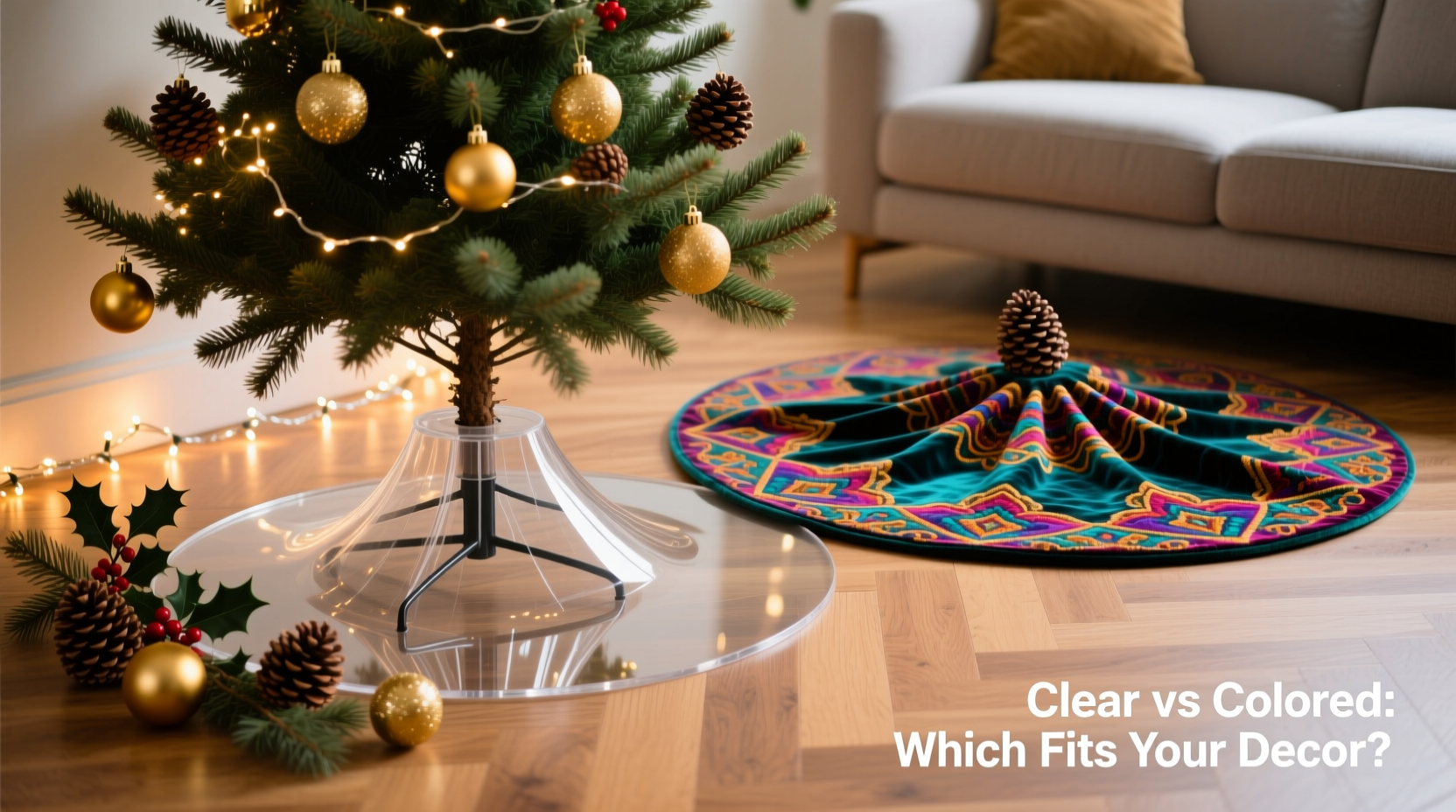
“Clear” is a misnomer that causes frequent confusion. Most so-called clear skirts aren’t optically invisible; they’re translucent or semi-glossy materials engineered to recede visually while still providing structure and subtle refraction. Acrylic skirts diffuse light softly, casting delicate highlights under tree lights. Frosted resin versions mute reflections, offering a hazy, ethereal frame. And high-grade PVC variants may carry a faint blue or green undertone depending on thickness and ambient lighting—something rarely apparent in product photos but unmistakable in person.
This optical behavior fundamentally changes how the skirt functions in a room. A true clear skirt doesn’t compete with decor—it defers. It lets the floor surface (hardwood grain, patterned tile, vintage rug) become part of the composition. That’s its greatest strength—and its most overlooked limitation. When placed over busy carpeting, mismatched flooring transitions, or cluttered entryway rugs, a clear skirt can amplify visual noise rather than simplify it.
The Functional Versatility of Colored Skirts
Colored skirts succeed not because of boldness—but because of intentionality. A deep forest green velvet skirt doesn’t just “match” a pine tree; it echoes botanical tones found in garlands, wreaths, and dried citrus slices. A charcoal-gray linen skirt grounds a monochrome scheme without absorbing light like black would. Even a burgundy burlap skirt adds warmth and tactility that balances cool metallic ornaments or white ceramic baubles.
Versatility here comes from chromatic reliability and material resonance. Unlike clear options—which rely on absence to adapt—colored skirts use presence to harmonize. Their flexibility lies in their ability to serve as a deliberate bridge between tree and environment. A navy skirt pairs equally well with brass-trimmed mid-century furniture and farmhouse shiplap walls because navy operates as both a neutral and an accent, depending on saturation and context.
| Skin Tone / Decor Style | Best Colored Skirt Choice | Why It Works |
|---|---|---|
| Modern Minimalist (white walls, black furniture, concrete floors) | Matte charcoal linen or slate-gray wool blend | Provides tonal depth without visual weight; absorbs light subtly, preventing glare |
| Rustic Farmhouse (reclaimed wood, wrought iron, plaid textiles) | Unbleached canvas with raw-edge hem or oatmeal-hued burlap | Reinforces natural texture hierarchy; avoids competing with wood grain |
| Traditional Formal (red velvet sofa, gold picture frames, ornate moldings) | Burgundy or emerald velvet with corded trim | Extends existing luxury materials into the tree base; creates continuity, not repetition |
| Scandinavian (light oak, cream textiles, pale ceramics) | Heather gray or soft sage cotton twill | Introduces gentle contrast while preserving airiness; avoids starkness of pure white |
| Eclectic Boho (macramé, kilim rugs, terracotta pots) | Indigo-dyed cotton with hand-stitched motifs | Acts as a grounded focal point amid layered patterns; indigo reads as both earthy and refined |
The Hidden Constraints of Clear Skirts
Clear skirts are often marketed as “universal”—but universality requires conditions. They perform best when three criteria align: (1) the floor beneath is intentional, uncluttered, and aesthetically resolved; (2) the tree stand and wiring are fully concealed (exposed metal legs or tangled cords break the illusion); and (3) lighting is carefully controlled. Under bright overheads or direct sunlight, clear skirts can create distracting hotspots or reveal dust accumulation within hours.
More critically, clear skirts offer zero chromatic or textural counterpoint. In rooms where the tree is the sole warm element—say, against cool-toned walls and stainless steel appliances—a clear skirt removes the last opportunity to introduce warmth, depth, or seasonal resonance. The result isn’t neutrality—it’s visual thinness. Interior designer Lena Cho notes this frequently in client consultations: “A clear skirt works only when the room already *feels* finished without it. If your space leans cool or sparse, adding warmth at the base isn’t optional—it’s architectural.”
“The most versatile tree skirt isn’t the one that disappears—it’s the one that completes the room’s emotional temperature. Clarity is a tool, not a default.” — Lena Cho, AD100 Interior Designer & Holiday Styling Consultant
A Real-World Comparison: Two Homes, One Season
In Portland, Oregon, Maya renovated her 1920s Craftsman bungalow with wide-plank white oak floors, black steel-framed windows, and a curated mix of vintage Danish teak and contemporary ceramic lighting. She initially chose a clear acrylic skirt for her 7-foot Nordmann fir, believing it would “let the floor shine.” Within days, she noticed how the skirt amplified the slight amber tint in her hardwood finish—making the tree appear warmer than intended, clashing with her cool-toned mercury glass ornaments. She swapped to a heather-gray boiled wool skirt with a hand-fulled edge. Instantly, the tree felt anchored, the floor receded appropriately, and the ornament palette read cohesively.
Meanwhile, in Austin, Texas, David lives in a newly built modern home with polished concrete floors, floor-to-ceiling glass, and a strict monochrome palette. His tree sits directly in front of a sliding door overlooking a native grass garden. He selected a frosted-clear resin skirt—not for invisibility, but for reflection. At dusk, the skirt catches both the tree lights and the ambient glow from outdoor path lighting, creating a soft halo effect that blurs the boundary between interior and exterior. Here, clarity wasn’t neutral—it was atmospheric.
These cases underscore a vital truth: versatility isn’t inherent to the skirt—it emerges from precise alignment between material properties, spatial context, and lighting conditions. Neither option is universally superior; each excels where its physical behavior serves the room’s existing language.
Actionable Decision Framework: 5-Step Selection Process
Instead of asking “clear or colored?”, ask: “What does my room need *at the base* of the tree?” Follow this sequence to determine the optimal choice:
- Analyze your floor surface: Is it a design feature (e.g., herringbone tile, distressed wood) or a background (e.g., uniform carpet, matte vinyl)? If it’s a feature, clear may enhance it—if it’s background, colored adds intention.
- Assess your dominant wall/furniture tones: Count dominant hues in the room (excluding the tree). If three or more are warm (beige, cream, rust, olive), a colored skirt in a complementary tone adds cohesion. If all are cool (gray, navy, white, silver), a clear or very desaturated colored skirt prevents visual overload.
- Evaluate lighting layers: Do you have focused downlights near the tree? Track lighting? Candles or string lights only? Clear skirts demand balanced, diffused light to avoid glare. Colored skirts absorb and soften uneven illumination.
- Inspect your tree stand and wiring: Can you fully conceal legs, screws, and cords? If not, a colored skirt provides essential visual cover and psychological closure. Clear skirts expose infrastructure—intentionally or not.
- Define your seasonal intention: Are you aiming for “effortless elegance,” “cozy tradition,” “sculptural minimalism,” or “joyful abundance”? Match the skirt’s material language—not just color—to that goal. Velvet implies richness; burlap implies craft; acrylic implies precision.
FAQ: Clear vs Colored Tree Skirts
Can I layer a clear skirt under a colored one for added dimension?
Yes—but with caveats. Place the clear skirt *beneath* the colored one to elevate its edges and add subtle lift. Avoid stacking if the colored skirt is lightweight (like cotton) or has a slippery backing—this can cause shifting or bunching. Best reserved for structured skirts (e.g., stiffened linen or quilted velvet) paired with thin, rigid clear bases.
Do clear skirts work with artificial trees that have visible plastic stands?
Rarely. Most artificial tree stands are injection-molded in off-white or light gray plastic with visible seams and logos. A clear skirt magnifies these details rather than masking them. A colored skirt with a 12–14 inch drop fully conceals the stand and creates a clean visual cutoff line.
Are there eco-friendly clear alternatives to acrylic or PVC?
Limited—but emerging. Some designers now use cast bio-resin derived from plant cellulose, which offers similar translucency with 40% lower carbon footprint and full compostability under industrial conditions. Availability remains niche (primarily through European artisan makers), and cost runs 2–3× higher than standard acrylic. For sustainability, prioritize longevity: a well-made colored linen or wool skirt lasts 15+ years with proper storage—far exceeding most clear options.
Conclusion: Versatility Is Earned, Not Assigned
Declaring one type of tree skirt “more versatile” misses the point entirely. True versatility arises not from what a skirt lacks—but from what it contributes. A clear skirt earns its place when it amplifies intentionality in a thoughtfully composed space. A colored skirt earns its place when it resolves tension, warms a cool palette, or grounds visual chaos. Neither is inherently adaptable—their power lies in how deliberately they’re deployed.
Your tree skirt is the foundation of your holiday aesthetic. It’s the first thing guests’ eyes settle on when they enter the room—the threshold between everyday life and seasonal meaning. Choose not for trend or convenience, but for resonance. If your floor tells a story worth highlighting, let clarity speak. If your room needs warmth, texture, or quiet confidence, let color answer.




 浙公网安备
33010002000092号
浙公网安备
33010002000092号 浙B2-20120091-4
Comments
No comments yet. Why don't you start the discussion?