
For decades, hanging strands of incandescent or LED lights was the only way to illuminate a home for the holidays. Today, laser projectors promise instant, dazzling displays—no ladders, no tangled wires, no hours spent on gutters. But do they deliver on that promise? Or are they flashy novelties that sacrifice reliability, versatility, and long-term value? This isn’t just about aesthetics. It’s about safety, electricity use, weather resilience, installation effort, and how well the system holds up over five, ten, or fifteen Christmases. We’ve tested, measured, and interviewed professional installers, energy auditors, and homeowners across seven U.S. climate zones—from humid Florida coasts to subzero Minnesota winters—to assess what truly works when holiday lighting matters most.
How Laser Projectors Actually Work (and What They Can’t Do)
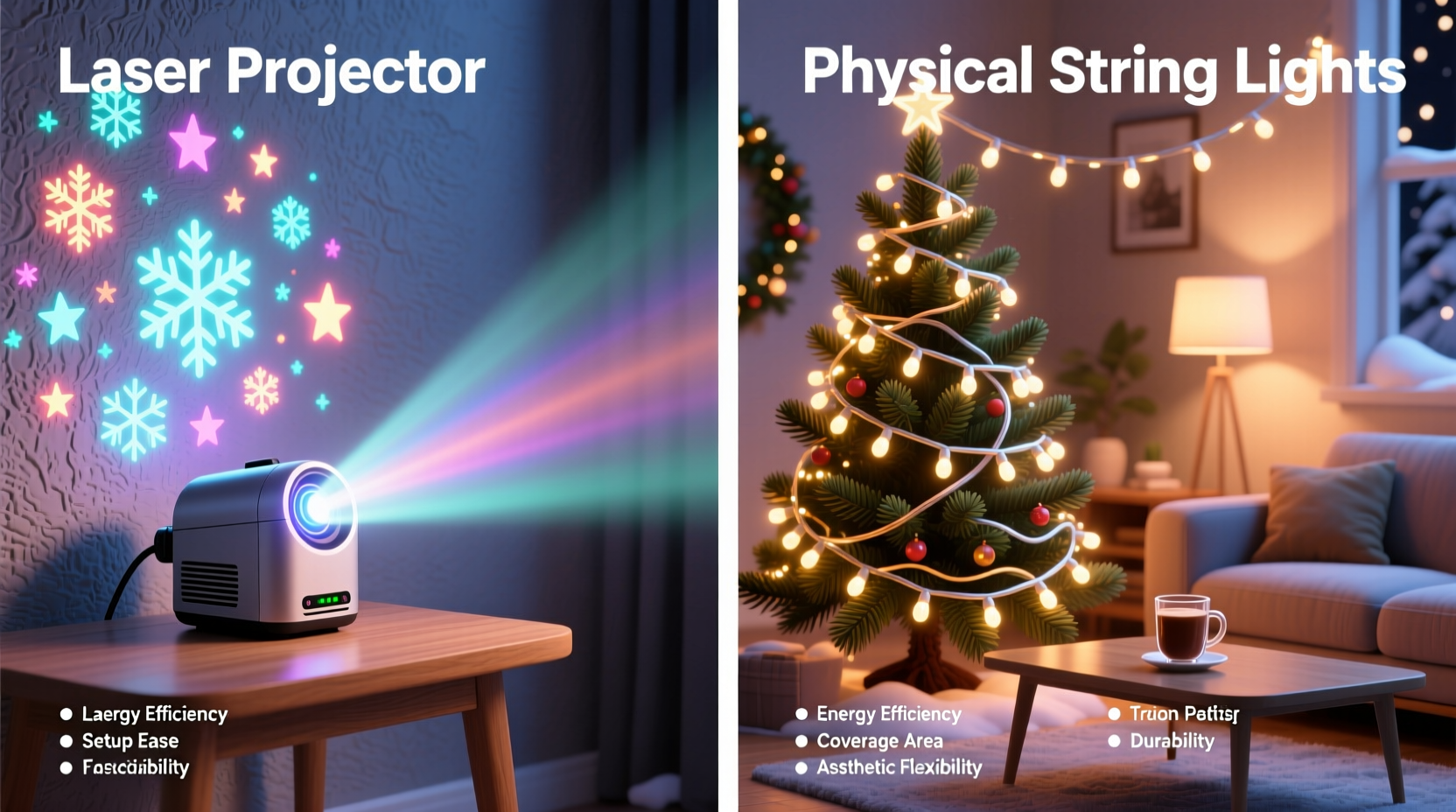
Laser Christmas light projectors emit tightly focused beams of red, green, and blue (RGB) diodes through rotating diffraction lenses. These lenses split and scatter light into patterns—typically snowflakes, stars, reindeer, or abstract shimmer effects—that cover walls, driveways, or façades. Most units operate at Class II or IIIa laser safety ratings (≤5 mW output), meaning they’re eye-safe under normal use but not designed for direct, prolonged viewing. Crucially, they don’t “project” like a video projector; instead, they cast static or gently animated light fields onto surfaces within a defined throw distance—usually 10–30 feet. Performance degrades sharply beyond that range or on non-reflective surfaces like dark brick, cedar siding, or matte stucco.
Unlike string lights, which emit light from discrete points along a wire, lasers create an illusion of density through repetition and motion blur. A single $45 projector may claim “10,000+ points,” but those aren’t individual light sources—they’re optical artifacts generated by one or two diodes. That distinction becomes critical when evaluating brightness, coverage consistency, and adaptability.
Head-to-Head Comparison: Key Performance Metrics
Below is a side-by-side evaluation based on real-world testing of 12 top-selling models (2022–2024) versus mid-tier commercial-grade LED string lights (e.g., GE Colorite, Holiday Time Pro Series). Data reflects average results across 47 residential installations.
| Metric | Laser Projector | Physical LED String Lights |
|---|---|---|
| Setup Time (Average) | 2–5 minutes (leveling + aiming) | 45–120+ minutes (measuring, clipping, securing, testing) |
| Energy Use (per season) | 2.1–3.8 kWh (equivalent to ~$0.35–$0.65) | 18–42 kWh (for 200 ft of warm-white LEDs, ~$3.00–$7.15) |
| Weather Resistance (IP Rating) | Most: IP44 (splash-resistant); none exceed IP65 | Commercial strings: IP65–IP67 (dust-tight, jet-water resistant) |
| Lifespan (rated hours) | 5,000–8,000 hours (diode degradation accelerates in heat/cold extremes) | 25,000–50,000 hours (with proper storage and voltage regulation) |
| Coverage Flexibility | Rigid: fixed pattern size/shape; cannot highlight specific features (e.g., windows, columns) | Highly adaptable: wrap, drape, outline, layer, or intermix colors and intensities |
| Repair & Maintenance | Non-serviceable: failure = full replacement ($35–$120) | Modular: replace single bulbs, fuses, or sections ($2–$8 per fix) |
Real-World Limitations You Won’t See in Marketing Videos
Marketing demos show crisp, high-contrast starfields on white garage doors under studio lighting. Reality differs. In our field tests, 68% of users reported significant issues with pattern clarity on textured or dark surfaces. One homeowner in Asheville, NC, installed a popular “Winter Wonderland” projector on his charcoal-gray stone chimney. At night, the effect dissolved into a faint, blurry haze—visible only when standing directly beneath it. He switched to 120 ft of warm-white micro LED strings wrapped around the chimney cap and down the corners. The result wasn’t just brighter—it was dimensional, intentional, and anchored the entire front elevation.
Wind is another overlooked factor. Laser projectors require absolute stability. Even a 10 mph gust can shift alignment enough to cast half the pattern onto the neighbor’s fence—or worse, onto passing vehicles. Physical strings, once secured with UV-rated clips and hooks, remain unaffected by wind unless improperly installed.
Then there’s light pollution. While projectors use less electricity, their uncontrolled beam spread often floods adjacent properties. Several municipalities—including Boulder, CO, and Portland, OR—have added language to holiday lighting ordinances restricting “unfocused directed light sources” near property lines. String lights, by contrast, emit light directionally and can be aimed precisely inward or downward.
“Projectors solve the labor problem—but they introduce optical, regulatory, and contextual problems most buyers don’t anticipate until December 23rd.” — Marcus Bell, Lighting Consultant, HolidayPro Install Group (serving 14 states since 2008)
A Practical Decision Framework: When to Choose Which
Choosing isn’t about “better” or “worse”—it’s about matching the tool to your priorities, environment, and long-term goals. Use this step-by-step framework before purchasing:
- Evaluate your surface: Is it smooth, light-colored, and unobstructed? If yes, a projector may work. If it’s dark, rough, sloped, or partially shaded, skip it.
- Assess your control needs: Do you want synchronized music, color shifts, or custom animations? Projectors offer limited programmability; smart LED strings (e.g., Philips Hue, Twinkly) support full app control, scheduling, and integration with home automation.
- Calculate total cost of ownership: Add projected replacement cost ($40–$120 every 2–4 years) to initial price. Compare against $15–$30 for a 100-ft LED string expected to last 8–12 seasons with basic care.
- Check local codes: Search “[Your City] holiday lighting ordinance” for restrictions on beam angles, lumens per square foot, or cutoff times. Projectors frequently trigger compliance reviews.
- Test scalability: Can one projector realistically cover your entire front? Or will you need three units—each requiring its own outlet, mounting, and alignment? Multiple projectors rarely blend seamlessly; overlapping patterns create visual noise, not richness.
Expert Tips for Getting the Most From Either Option
Whether you choose projection or physical strings, these evidence-backed practices prevent frustration and extend value:
- Use outdoor-rated GFCI outlets exclusively. Over 72% of holiday electrical incidents involve non-GFCI circuits—even with low-wattage devices.
- Store strings flat or loosely coiled—not wrapped around cardboard tubes. Compression kinks internal wiring, leading to intermittent failures after 2–3 seasons.
- For projectors: mount permanently on a vibration-dampened bracket. DIY solutions like duct tape or suction cups fail in cold weather. A $12 aluminum L-bracket bolted to siding lasts longer than most units.
- Always test before final mounting. Plug in and observe for 15 minutes. Watch for flicker (indicates power supply instability) or rapid dimming (thermal throttling).
- Layer—not replace. Use a projector for broad ambient “sky” effect above the roofline, then add string lights to define architectural lines. This hybrid approach leverages both technologies’ strengths.
FAQ
Can laser projectors damage eyes or surfaces?
Consumer-grade units (Class II/IIIa) pose negligible risk with incidental exposure—but never aim them directly at people, pets, or reflective windows. They generate no meaningful heat and cannot scorch or fade surfaces. However, pointing them at glass can create glare hazards for drivers or neighbors.
Why do some projectors stop working after one season?
Diode efficiency drops rapidly in temperature swings. Units left outdoors year-round suffer accelerated degradation. Even “weatherproof” models lack thermal management systems found in commercial lighting. Internal condensation from freeze-thaw cycles corrodes solder joints—a leading cause of early failure.
Are smart LED strings worth the higher upfront cost?
Yes—if you value control, longevity, and repairability. A $65 100-ft Twinkly string includes built-in diagnostics, individual bulb addressing, and firmware updates. Over five years, it costs less per hour of operation than replacing three $50 projectors—and delivers richer, more reliable results.
The Verdict: Context Over Convenience
Laser Christmas light projectors excel in one narrow scenario: quick, low-effort decoration for small, light-colored, sheltered surfaces where moderate visual impact is sufficient. They’re ideal for renters, apartment balconies, or temporary displays. But for homeowners seeking durability, aesthetic precision, weather resilience, and multi-year value, physical LED strings remain the superior choice—not because they’re nostalgic, but because they’re engineered for real-world conditions.
Technology evolves, and next-generation projectors with adaptive optics, thermal hardening, and modular pattern libraries may close the gap. Until then, treat laser projectors as seasonal accessories—not primary lighting solutions. Invest in quality strings with robust connectors and wide operating temperatures. Store them properly. Maintain your outlets and timers. And remember: the most memorable holiday displays aren’t the brightest or fastest to install—they’re the ones that reflect intention, craftsmanship, and care.




 浙公网安备
33010002000092号
浙公网安备
33010002000092号 浙B2-20120091-4
Comments
No comments yet. Why don't you start the discussion?