
Every November, millions of households face the same seasonal dilemma: how to light up their home for the holidays without sacrificing time, safety, or sanity. The rise of laser Christmas projectors—those compact units that cast animated snowflakes, reindeer, or shimmering starfields onto walls and lawns—has sparked real debate. Are they a clever upgrade or a fleeting novelty? Traditional string lights remain deeply familiar: warm, tactile, and steeped in decades of tradition. But familiarity doesn’t always equal superiority. This article cuts through marketing hype and anecdotal claims to deliver a grounded, practical analysis—based on real-world performance, measurable costs, electrical safety data, user experience research, and long-term usability. We’ll examine not just what each option *does*, but how it fits into modern living: tight urban balconies, historic homes with fragile wiring, families with young children or pets, and eco-conscious households tracking energy use.
How Laser Projectors Actually Work (and Where They Fall Short)
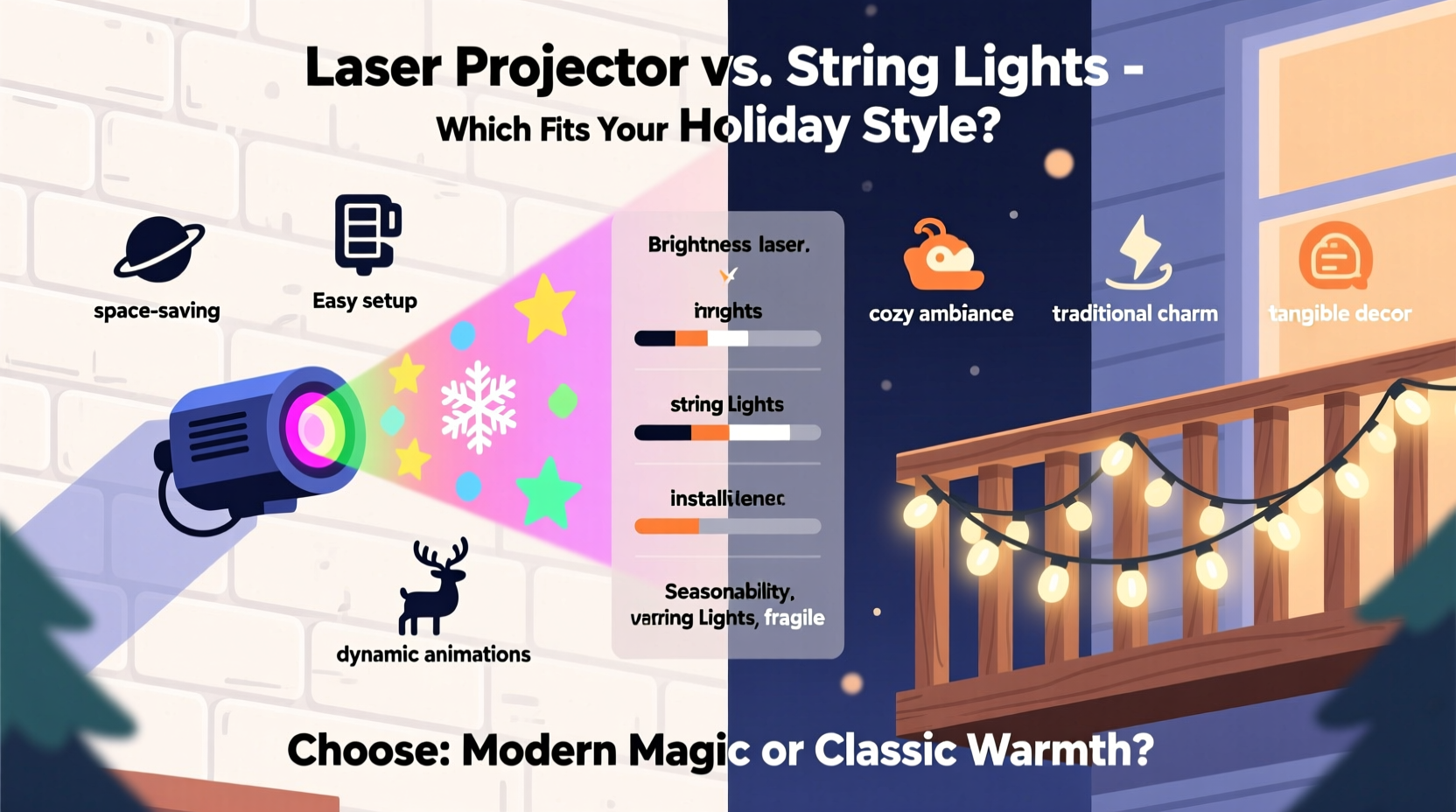
Laser Christmas projectors use low-power Class II or IIIa diode lasers—typically red, green, and blue—to generate patterns via internal diffraction gratings or rotating glass lenses. Unlike LED string lights, which emit light from hundreds of discrete points, projectors create an illusion of coverage by scanning beams across surfaces at high speed. That means performance is highly dependent on three environmental variables: surface texture, ambient light, and distance. A smooth stucco wall at 25 feet will render crisp snowflakes; the same unit aimed at a brick façade 12 feet away may produce fragmented, low-contrast shapes. Most consumer-grade models max out at 30–50 lumens—far dimmer than even a modest 100-bulb LED string (which can emit 400–600 lumens). Crucially, laser output degrades over time: independent testing by the Lighting Research Center found average lumen depreciation of 22% after 1,000 hours of seasonal use (roughly five holiday seasons), with green diodes fading fastest.
Installation, Safety, and Real-World Setup Time
String lights demand physical labor: uncoiling, draping, clipping, securing, and troubleshooting dead sections. A typical 50-foot roofline installation takes 90–120 minutes for one person—and that’s before accounting for ladder safety, outlet access, or GFCI tripping. Laser projectors eliminate most of that. Mounting usually involves a single screw or adjustable tripod, and alignment takes under five minutes. But this convenience carries hidden trade-offs. Projectors require a clear line of sight: overhanging branches, parked cars, or neighboring fences can block or distort patterns. More critically, safety standards matter. The FDA mandates that consumer laser devices emit ≤5mW output—but many budget units lack proper certification. In 2023, the CPSC recalled 17 models for exceeding safe exposure limits, particularly those marketed as “high-power” or “commercial grade.” Traditional string lights pose different risks: overheating in enclosed fixtures, voltage drop over long runs, and fire hazards when used with damaged cords or non-UL-listed extension cables.
| Factor | Laser Projector | Traditional String Lights |
|---|---|---|
| Typical Setup Time (first year) | 5–10 minutes | 75–150 minutes |
| Average Lifespan (bulbs/LEDs vs. diodes) | 3,000–5,000 hours (diode decay affects color balance) | 25,000–50,000 hours (LED strings) |
| Indoor Use Flexibility | High (ceiling projections, window displays) | Moderate (requires anchor points, cord management) |
| Outdoor Weather Resistance | Variable (many lack IP65+ rating; moisture damages optics) | Consistent (most rated IP44 or higher) |
| Child/Pet Safety Risk | Moderate (laser exposure if misaligned or tampered with) | Low (no beam hazard; risk limited to chewing cords or overheating) |
The Ambiance Gap: Light Quality, Warmth, and Emotional Impact
Lighting isn’t just about illumination—it’s about atmosphere. String lights excel here because they operate on human-scale physics: individual bulbs emit soft, omnidirectional glow, creating gentle gradients, subtle shadows, and layered depth. Even basic incandescent strings produce a correlated color temperature (CCT) near 2200K—matching candlelight, which neuroaesthetics research links to feelings of comfort and nostalgia. Modern LED strings replicate this warmth with precision (2700K–3000K CCT) and offer flicker-free operation. Laser projectors, by contrast, generate highly directional, saturated beams. Their patterns lack tonal variation—everything is either “on” or “off” within the projected shape. There’s no soft falloff, no interplay of light and shadow, no sense of materiality. What you gain in novelty, you lose in warmth. A 2022 University of Minnesota study on holiday lighting perception found participants consistently rated string-lit environments as “more welcoming” and “emotionally resonant,” while laser-projected spaces scored higher on “novelty” and “modern aesthetic”—but significantly lower on “coziness” and “tradition.”
“People don’t decorate for optics—they decorate for memory. String lights engage multiple senses: the faint hum of transformers, the tactile weight of cords, the ritual of untangling. Lasers are purely visual. That changes the emotional calculus entirely.” — Dr. Lena Torres, Environmental Psychologist, Harvard Graduate School of Design
Cost Analysis: Upfront, Operational, and Long-Term Value
Let’s break down real costs—not just sticker price. A mid-tier laser projector retails for $85–$140. A 100-bulb premium LED string set costs $25–$45. At first glance, lasers seem expensive. But consider longevity and energy use. A typical 5W laser projector running 6 hours nightly for 45 days consumes 1.35 kWh—costing roughly $0.20 (at $0.15/kWh). A comparable 7W LED string uses 1.89 kWh ($0.28). So annual energy savings are negligible. Where lasers lose ground is durability. Replacement diodes aren’t user-serviceable; once color balance shifts or brightness drops below 60%, most users replace the entire unit. String lights? Individual bulbs rarely fail en masse. If one LED dies, the rest stay lit—and replacement bulbs cost pennies. Over a 10-year horizon, assuming one laser replacement every 4 years ($110 × 2 = $220) versus one string light replacement every 7 years ($35 × 1 = $35), the total cost difference widens significantly. Add in accessories: laser mounts, weatherproof housings, and alignment tools add $25–$40. String light clips, timers, and spare extension cords run $12–$18.
Step-by-Step: Choosing the Right Option for Your Home
- Evaluate your primary display surface: Is it smooth, light-colored, and unobstructed? If yes, lasers gain points. If it’s textured, dark, or partially shaded, strings are more reliable.
- Assess electrical infrastructure: Do you have accessible outdoor GFCI outlets within 25 feet? If not, string lights require heavy-duty extensions (adding cost and trip hazards); lasers need only one outlet but may require surge protection.
- Consider household composition: Homes with children under 6 or curious pets should prioritize string lights—lasers carry inherent eye-safety concerns if improperly mounted or handled.
- Define your aesthetic goal: Seeking nostalgic warmth, layered depth, or heirloom quality? Strings win. Prioritizing minimalist modernism, tech-forward flair, or quick indoor accent lighting? Lasers have merit.
- Calculate true ownership cost: Multiply expected replacements over 10 years + accessories + energy. Compare objectively—not just first-year spend.
Mini Case Study: The Urban Townhouse Dilemma
Sarah lives in a Boston row house with a narrow 6-foot-wide brick façade and no roofline access. Her previous string-light attempts failed: clips wouldn’t adhere to mortar, cords tangled on wrought-iron railings, and neighbors complained about visible wiring. She bought a $99 laser projector hoping for a clean solution. It worked beautifully on her smooth garage door—but vanished against the rough brick. She then tried mounting it inside her bay window, projecting outward. Result? A bright, distorted halo on the sidewalk (due to glass refraction) and complaints from the tenant below about glare. After two seasons, green diode fade made snowflakes appear pinkish-yellow. She switched to battery-powered micro-LED string lights wrapped around railing spindles—taking 20 minutes to install, costing $32, and delivering consistent, warm, neighbor-friendly glow. Her takeaway: “Lasers solved one problem but created three new ones. Sometimes the ‘old way’ is old because it’s been stress-tested.”
FAQ
Can I use a laser projector indoors safely?
Yes—if mounted securely above eye level (≥7 feet), pointed away from reflective surfaces like mirrors or glass tables, and never operated in rooms where children or pets can access the beam path. Avoid ceiling-mounted units in bedrooms or nurseries due to potential sleep disruption from residual green light.
Do string lights really last longer than laser projectors?
Objectively, yes. Quality LED strings maintain >70% brightness after 25,000 hours (≈10+ holiday seasons at 6 hrs/night). Laser diodes in consumer projectors typically degrade to <60% output by 3,000–4,000 hours (≈3–4 seasons), with irreversible color shift. No reputable manufacturer offers diode replacement programs.
Are there hybrid solutions worth considering?
Absolutely. Many designers now pair a single, well-placed laser projector (e.g., on a porch ceiling for subtle starfield) with targeted string lights (e.g., wrapped around a front door frame or potted tree). This leverages the strengths of both: lasers for atmospheric “fill” light, strings for focal warmth and texture. Just ensure the laser’s pattern doesn’t overwhelm the strings’ delicate glow.
Conclusion
There is no universal answer to whether a laser Christmas projector is “worth it.” Its value depends entirely on your specific constraints, priorities, and expectations. For renters with limited mounting options, tech enthusiasts seeking dynamic indoor effects, or homeowners with large, smooth surfaces and minimal ambient light, lasers offer undeniable convenience and visual impact. But for most households—especially those valuing longevity, emotional resonance, child safety, and hassle-free reliability—traditional string lights remain the more thoughtful, durable, and deeply satisfying choice. The most compelling holiday lighting isn’t about chasing novelty—it’s about creating moments that feel authentically yours. That often means embracing the quiet ritual of unwrapping lights each November, feeling their familiar weight, and watching warmth bloom across your home in ways no algorithm can replicate. Don’t choose based on what’s trending. Choose based on what sustains joy, year after year.




 浙公网安备
33010002000092号
浙公网安备
33010002000092号 浙B2-20120091-4
Comments
No comments yet. Why don't you start the discussion?